Athena
Intelligence applied to life — discipline and judgment over brute force. The most philosophical of the gods, and the one closest to what the Greeks meant by reason.
→ Socrates, Plato, Aristotle: wisdom as a way of living.Greek myth handed the ancient world faces for justice, fate, desire, courage, and death. Then Socrates, Plato, Aristotle, the Stoics, and Nietzsche pressed on what those stories actually mean. This section walks the road between the two.
Michael Paycer
One path lays out the whole pantheon. The other turns those stories into the arguments that built Western thought.
Every Olympian in one place — who they rule, their symbols, the myths that defined them, and why these stories shaped Greek religion, drama, and art. The map before the deep dives.
Read the overview →Fate, hubris, reason against passion. The themes that turn Achilles or Prometheus into a question Plato or the Stoics would argue.
Cross over →Intelligence applied to life — discipline and judgment over brute force. The most philosophical of the gods, and the one closest to what the Greeks meant by reason.
→ Socrates, Plato, Aristotle: wisdom as a way of living.Harmony, clarity, measure — and the command carved at Delphi: know thyself.
→ Where Socrates begins: the examined life.Authority and order — just in some myths, unjust in others.
→ Does power equal justice? Plato's worry.The irrational, boundary-breaking side of being human.
→ Nietzsche: order against life-force.Attraction that inspires love — or obsession and war.
→ The Symposium: desire as a ladder to truth.Ruler of the dead — stern, not evil, no Greek Satan.
→ How knowing we die should shape life.Power that is generous or destructive, like the sea.
→ Nature against human plans and reason.Order and family — and a marriage full of betrayal.
→ Social order versus personal injury.The brutal side of war — rage, not strategy.
→ Courage or recklessness? Aristotle asks.Fierce independence, untamed by city or marriage.
→ Freedom, nature, and self-rule.The imperfect god whose skill outshines beauty.
→ The dignity of work; worth is not looks.Clever crosser of boundaries — truth and trickery alike.
→ Language, meaning, and persuasion.The cycle of loss and renewal; the seasons explained.
→ Suffering, and whether renewal follows.The gods are exaggerated forces. The heroes are us — choosing, failing, and facing death.
Nearly invincible, ruled by honor and grief. He must choose between a long, quiet life and a short, glorious one — the sharpest version of the question this whole section asks.
→ What is glory worth if it costs your life?Survival by wit and longing for home — the counter-model to Achilles.
→ Identity, temptation, and the long road home.The sea-nymph mother who cannot save her son.
→ Love against fate.The bond whose death breaks Achilles' pride.
→ Grief beyond honor.The immovable wall, undone by wounded pride.
→ Identity tied to esteem.Stole fire for humankind and paid forever.
→ The price of progress.Opened the jar of suffering — but hope remained.
→ Evil, blame, and hope.The Twelve Labors — redemption through action.
→ Atonement and the good life.The gods give the questions faces; the philosophers give them arguments. Sixteen thinkers, each with a single lens for living.
The thinkers who connect straight back to the gods and heroes — Socrates, Plato, Aristotle, Stoicism, and Nietzsche.
Cross the bridge →Across the world and the centuries — Laozi, Confucius, the Buddha, Aquinas, Locke, Kant, Mill, and Arendt — each distilled to one lens for how to live.
See all the lenses →The thinkers above ask how to live. I turned that question into working tools: two AI councils that put great minds in one room and make them reason out loud. Each has a different job.
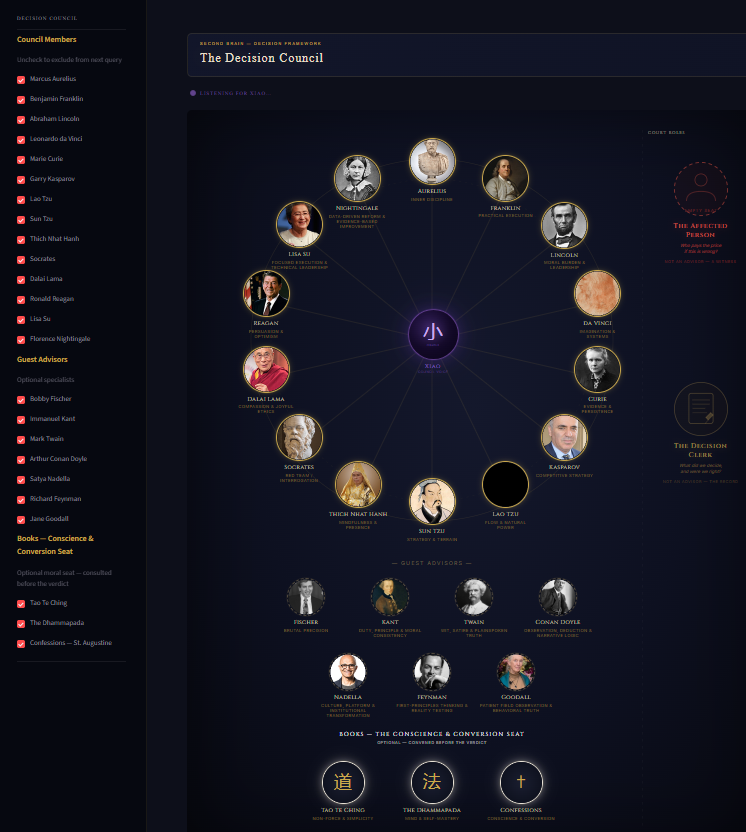
Made to reach a decision. It mixes eras on purpose — Marcus Aurelius and Socrates sit beside presidents (Lincoln, Reagan), CEOs (Lisa Su, Satya Nadella), the field observer Jane Goodall, and a moral seat of three sacred books. An oracle named Xiao weighs the whole room and returns one verdict.
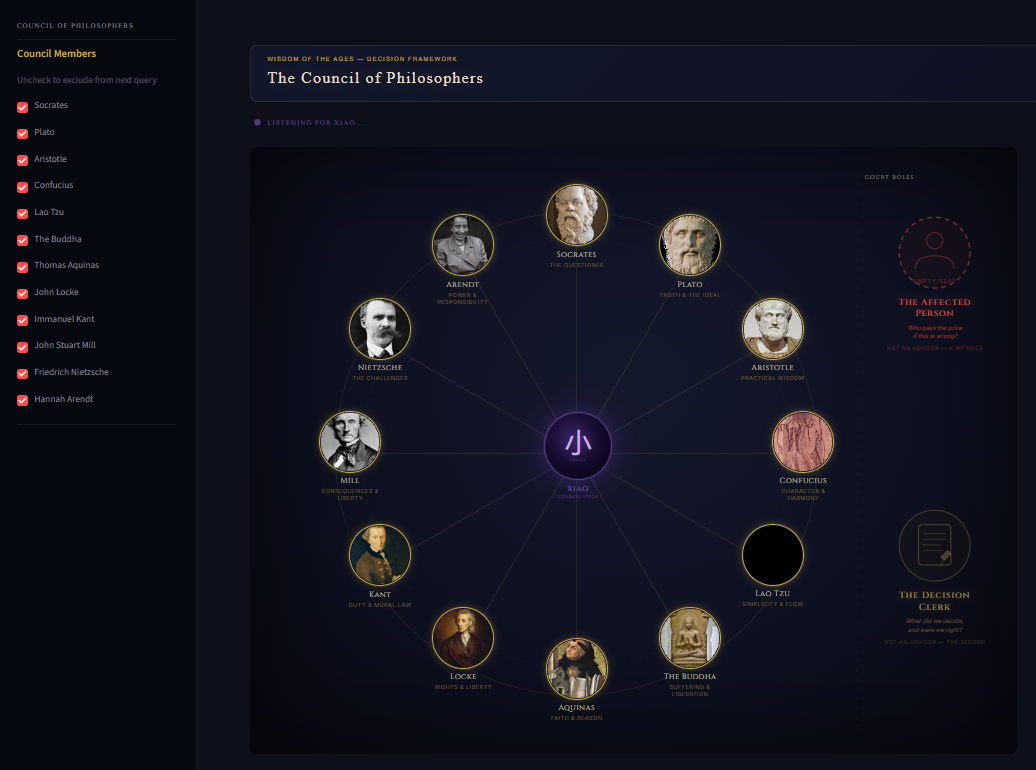
Meet the council →Made to understand an idea. A pure-philosophy table — the great thinkers from antiquity to the Enlightenment — arguing one question from first principles, so you can see where the traditions agree, where they split, and why. No presidents, no CEOs: this one is philosophy all the way down.
Enter the council →When I'm not reading Homer or Nietzsche, I tune databases, design high-availability systems, and run cloud migrations.