Heroes · Strength · Honor · Shame
Ajax the Great
The immovable wall of the Greek army — second only to Achilles in strength, and undone not in battle but by wounded honor.
 Michael Paycer
The immovable wall of the Greek army — second only to Achilles in strength, and undone not in battle but by wounded honor.
Michael PaycerRole
Greek warrior, second only to Achilles
Symbols
The great tower shield
Domain
Strength, honor, endurance, shame
Family
Son of Telamon, king of Salamis
Ajax the Great (Ajax the son of Telamon) is one of the strongest Greek warriors at Troy — a massive, hulking fighter who relies on courage, physical power, and sheer endurance. If Achilles is the blazing, almost supernatural warrior, Ajax is the immovable wall.
He carries a huge tower shield, holds his own in single combat against Hector, and defends the Greek ships when the Trojans nearly overrun the camp. He is greatness without subtlety.
Ajax was king of Salamis and one of the most reliable of the Greek champions — never wounded in the Iliad, the bulwark the army leaned on in its worst hours. The Athenians later honored him as a national hero, and one of their tribes bore his name.
His tragedy unfolds after the Iliad, in the tradition dramatized by Sophocles in his play Ajax: a study of a great man broken by shame.
When Achilles withdrew and the Trojans pushed the Greeks back to their beached ships, it was Ajax who held the line, fighting from deck to deck to keep the fleet from burning.
Ajax fought Hector in single combat to an honorable draw; at nightfall the two exchanged gifts in mutual respect — a rare moment of chivalry in the war.
After Achilles died, his divine armor was to go to the worthiest Greek. Ajax and Odysseus both claimed it; it was awarded to Odysseus. Overcome by the dishonor, Ajax fell into a ruinous madness and, on coming to his senses, could not bear to live with the shame and took his own life.
When Hector challenged the Greeks to single combat, nine champions stepped forward and drew lots. Ajax's was chosen — and he fought the Trojan hero to a standstill, the army's great defender proving his worth before all.
When Achilles fell, it was Ajax who held off the Trojans and carried the body from the field while Odysseus covered the retreat — which made the later award of Achilles' armor to Odysseus, not Ajax, all the more bitter.
Sophocles' Ajax made him the archetype of the great man undone by shame — a study so penetrating that it is still staged today, including in modern productions performed for military veterans grappling with honor and moral injury.
He endures as a warning about building a self entirely on others' recognition. Brave, loyal, and immovable, Ajax cannot survive being passed over — a sharp philosophical contrast to the adaptable Odysseus, and a permanent question about where true self-worth should rest.
Ajax, with his great tower shield, symbolizes immovable strength and steadfast loyalty — the wall that holds when all else fails. But he also symbolizes the danger of an identity built entirely on honor and the recognition of others.
When the world withholds the esteem he believes he has earned, he has nothing within to fall back on. He stands as a lasting warning about basing one's whole self-worth on external recognition — the tragic opposite of the adaptable, inwardly resourceful Odysseus.
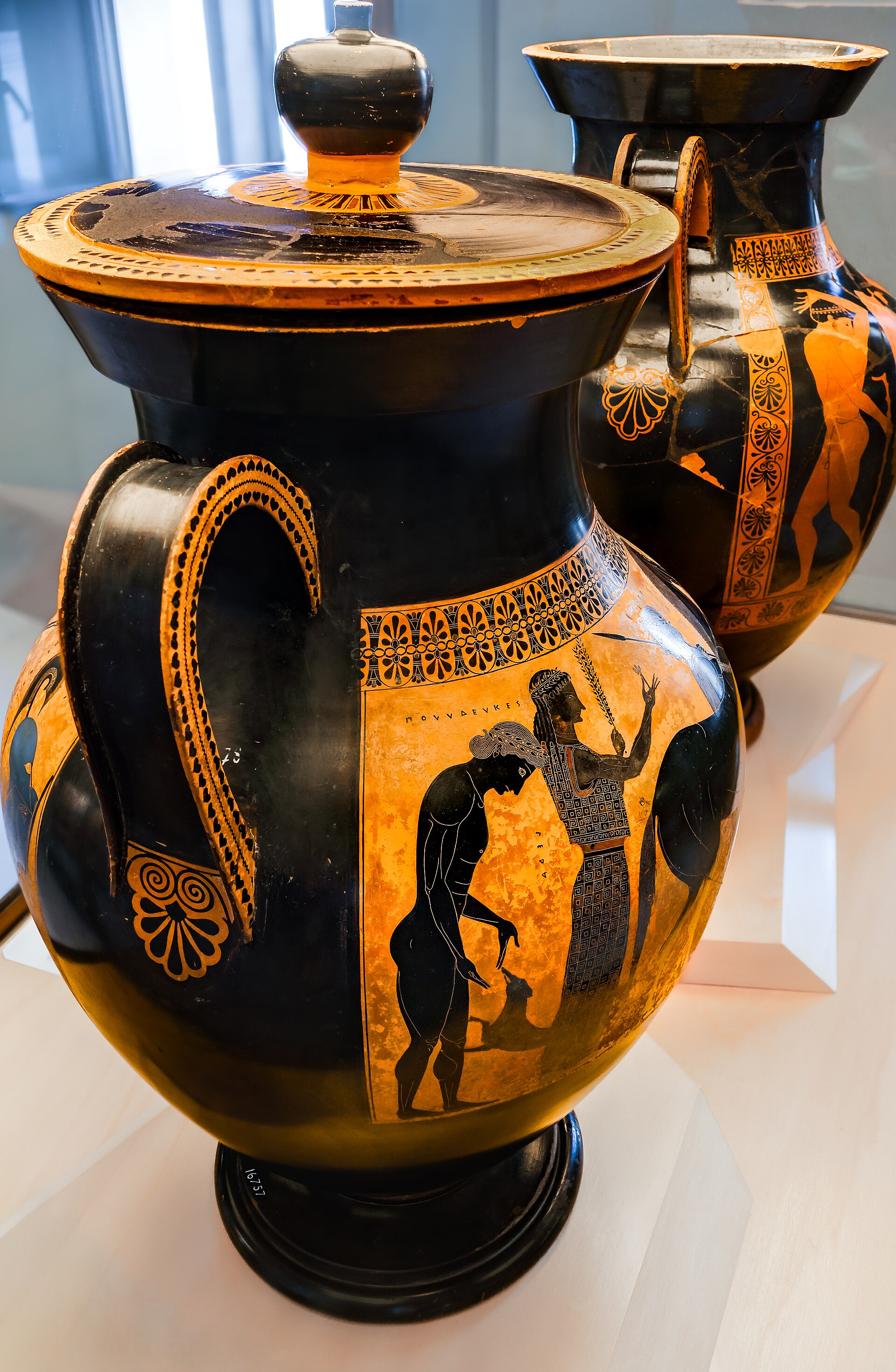
Famous public-domain depictions — click any image to view it full size.
“Now is the time to be saved or to perish. Better to settle the matter at once than to die slowly.”
Homer, Iliad 15 — Ajax at the ships (paraphrase)
“It is the brave man's part to live with honor, or with honor die.”
Sophocles, Ajax (paraphrase)
“Let there be light, and in the light destroy us.”
Ajax's prayer, Homer, Iliad 17
Ajax represents the danger of tying your whole identity to honor and the recognition of others.
His story asks what happens when a person's entire sense of worth depends on being publicly recognized. Ajax is brave and noble, but he cannot survive the shame of being passed over for the armor. His downfall is not cowardice — it is wounded greatness.
He connects to honor culture, to pride and shame, and to the contrast between strength and wisdom: he has the strength but lacks the adaptability of Odysseus. When the world stops giving him the role he believes he deserves, he has nothing inside to fall back on — a sharp warning about building a self entirely from others' esteem.
Direct strength and rigid honor — the wall that cannot bend.
Cunning and adaptability — the mind that finds a way through.
A king of Salamis and one of the strongest Greek warriors at Troy, second only to Achilles. He was famed for his tower shield, his defense of the ships, and his endurance.
After Achilles died, his divine armor was awarded to the worthiest Greek. Both Ajax and Odysseus claimed it; when it went to Odysseus, the dishonor destroyed Ajax.
There are two: Ajax the Great (son of Telamon), the mighty defender, and Ajax the Lesser (son of Oileus), a swift but lesser and infamous figure. This page is about Ajax the Great.
Driven mad with shame by the loss of the armor, Ajax attacks the army's livestock believing them his enemies; restored to his senses and unable to bear the disgrace, he takes his own life — the subject of Sophocles' tragedy.
When I am not reading Homer or Nietzsche, I tune databases, design high-availability systems, and run cloud migrations.