The Greek Bridge · The Stoa · Self-mastery
Stoicism: Control What You Can
The ancient philosophy of resilience — govern your own judgments and character, and let go of everything outside your power.
 Michael Paycer
The ancient philosophy of resilience — govern your own judgments and character, and let go of everything outside your power.
Michael PaycerFounded
c. 300 BCE, Athens
School
The Stoa (Zeno of Citium)
Lens
Control what you can; accept the rest
Key texts
Epictetus' Enchiridion; Marcus Aurelius' Meditations
Stoicism was founded in Athens by Zeno of Citium and matured in Rome through Seneca, the freed slave Epictetus, and the emperor Marcus Aurelius. It is less a set of doctrines than a practice for living well under pressure.
Its lens is the "dichotomy of control": some things are up to us (our judgments, choices, character) and some are not (health, reputation, fortune, other people). Peace and virtue come from mastering the first and accepting the second.
The school took its name from the Stoa Poikile, the painted porch in the Athenian agora where Zeno taught around 300 BCE. It grew out of the Greek tradition of Socrates, whose calm in the face of death the Stoics revered.
Stoicism became the dominant philosophy of the Roman elite and has been continuously revived ever since — in the Renaissance, in modern cognitive therapy, and in today's resurgence of practical philosophy.
Epictetus opens his handbook with it: distinguish what is in your power from what is not, invest only in the first, and you become unshakeable. Most suffering comes from trying to control the uncontrollable.
For the Stoics, wealth, health, and reputation are 'indifferents' — nice to have, but not what makes a life good. Only virtue (wisdom, justice, courage, temperance) is truly good, and it is always within reach.
Rather than merely enduring what happens, the Stoic learns to accept and even welcome it. The figures of Prometheus, Heracles, and Odysseus — endurance under suffering — were Stoic favorites.
The Stoics practiced imagining the world from a cosmic height — seeing one's troubles shrink against the vastness of nature and time. It is a discipline of perspective, meant to loosen the grip of petty fears and desires.
The Stoics taught that all rational beings share in a single universal reason (logos), making every person a fellow "citizen of the world." From this came powerful early arguments for human equality and a common humanity.
Stoicism shaped Roman law and the idea of natural rights, influenced early Christianity, and was revived in the Renaissance as "Neostoicism." Its insistence on a shared human reason fed directly into Enlightenment ideas of universal dignity.
Today it is the most visibly revived ancient philosophy: its distinction between what we can and cannot control underlies modern cognitive behavioral therapy, and its practical writings — especially Marcus Aurelius' Meditations — are read by millions seeking steadiness in an uncertain world.
Fate and freedom. The Stoics believed the universe is rigidly determined, yet insisted we are responsible for our judgments. How both can be true — a kind of ancient compatibilism — is one of the most discussed puzzles in Stoic thought, and a forerunner of modern debates about free will.
Acceptance or passivity? Critics worry that "accept what you cannot control" can shade into resignation in the face of injustice. Defenders reply that Stoicism frees energy for what can be changed. Where serenity ends and complacency begins is the perennial Stoic question.
Public-domain portraits and depictions — click any image to view it full size.
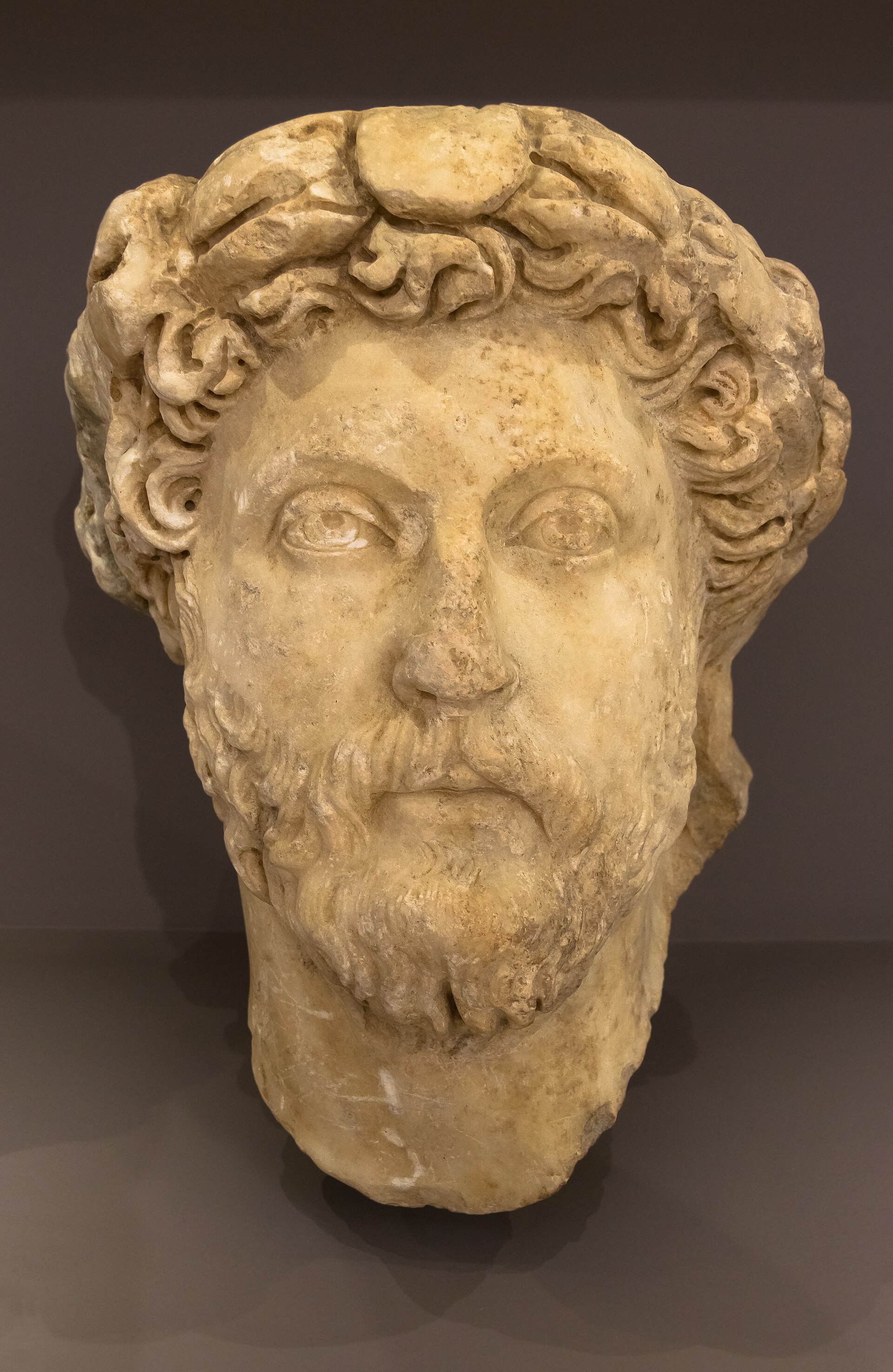

“Some things are within our power, and some are not.”
Epictetus, Enchiridion
“If thou art pained by any external thing, it is not this thing that disturbs thee, but thy own judgement about it. And it is in thy power to wipe out this judgement now.”
Marcus Aurelius, Meditations 8.47 (trans. George Long)
“Waste no more time arguing about what a good man should be. Be one.”
Marcus Aurelius, Meditations
The Stoic lens is to control what you can and accept the rest — to govern your own judgments and character, and let go of everything fortune does not place in your hands.
It is the most directly practical inheritance of Greek philosophy: an answer to the question every myth raises — how should I live when I cannot control fate, the gods, or the sea (Poseidon)?
The Stoic answer: you cannot calm the storm, only your response to it. That is why Stoicism keeps being rediscovered, from the Renaissance to modern therapy.
Virtue alone is the good; accept fate and master your judgments.
A tranquil, modest pleasure is the good; avoid pain and fear of death.
The core Stoic distinction between what is up to us (our judgments, choices, and character) and what is not (health, reputation, fortune). Focus only on the first, and accept the second.
Zeno of Citium founded the school; the best-known Stoic writers are the Roman Seneca, the former slave Epictetus, and the emperor Marcus Aurelius, author of the Meditations.
No. Stoicism is not suppressing feeling but training judgment — not being ruled by fear, anger, or craving. Stoics aim for steadiness and clear action, not coldness.
Its practical focus on what you can control, resilience under stress, and acceptance of fate maps closely onto modern cognitive behavioral therapy and the demands of uncertain times.
When I am not reading Homer or Nietzsche, I tune databases, design high-availability systems, and run cloud migrations.