The Olympians · War · Violence
Ares, God of War
War stripped to its rawest form — rage, slaughter, and the chaos of the battlefield, distrusted even by the gods.
 Michael Paycer
War stripped to its rawest form — rage, slaughter, and the chaos of the battlefield, distrusted even by the gods.
Michael PaycerRole
War, violence, bloodlust
Symbols
Spear, helmet, dog, vulture
Domain
The battlefield
Family
Son of Zeus & Hera
Ares is the god of war in its most violent form — rage, slaughter, and the chaos of combat. Son of Zeus and Hera, he is disliked even by his own father.
Where Athena brings strategy and justice to war, Ares brings only force. Myth repeatedly humbles him — a sign that the Greeks distrusted the very thing he embodies.
Tellingly, Ares had few major temples or devoted cults in Greece; he was feared more than loved. The Areopagus (“hill of Ares”) in Athens, where he was said to have been tried for murder, kept his name as the seat of an ancient homicide court.
The Romans, by contrast, exalted him as Mars — father of Romulus, patron of soldiers, and one of their most honored gods. The same figure was a villain to the Greeks and a founder to the Romans.
Ares' affair with Aphrodite ended in humiliation when her husband Hephaestus trapped the lovers in an invisible net and exposed them to the laughter of the gods.
In the Iliad, the hero Diomedes — guided by Athena — wounds Ares with a spear, and the god flees Olympus bellowing. War-as-rage is beaten by war-as-strategy.
Ares killed a son of Poseidon who had assaulted his daughter and was tried by the gods on the hill that bears his name — the mythical origin of Athens' homicide court.
From the union of Ares (war) and Aphrodite (love) was born Harmonia — harmony itself. The Greeks liked the paradox: concord as the child of strife and desire.
When Cadmus slew a dragon sacred to Ares and sowed its teeth, armed men sprang from the earth and fought until only a few remained, who founded Thebes. War, in Ares' myths, is generative and self-consuming at once.
As Mars, Ares fared far better with the Romans, who honored him as a dignified father of their people and named a planet, a month (March), and the very word "martial" for him. The Greek distaste and Roman reverence for the same god remain a striking measure of two civilizations' attitudes toward war.
Philosophically he endures as the test of where courage ends and mere violence begins — the question Aristotle answered with the golden mean. Every later argument about just war, valor, and bloodlust still works in the space between Ares and Athena.
Ares is attended by the spear and helmet of battle and by the dog and vulture — scavengers of the battlefield. There is nothing cultivated in his imagery; it is appetite, noise, and carnage, the very opposite of Athena's disciplined arms.
He symbolizes the raw, destructive face of aggression — what depth psychology might call the shadow of force unbound by reason. The Greeks' very discomfort with him is the point: he is a warning about the part of human nature that loves conflict for its own sake.
Famous public-domain depictions — click any image to view it full size.
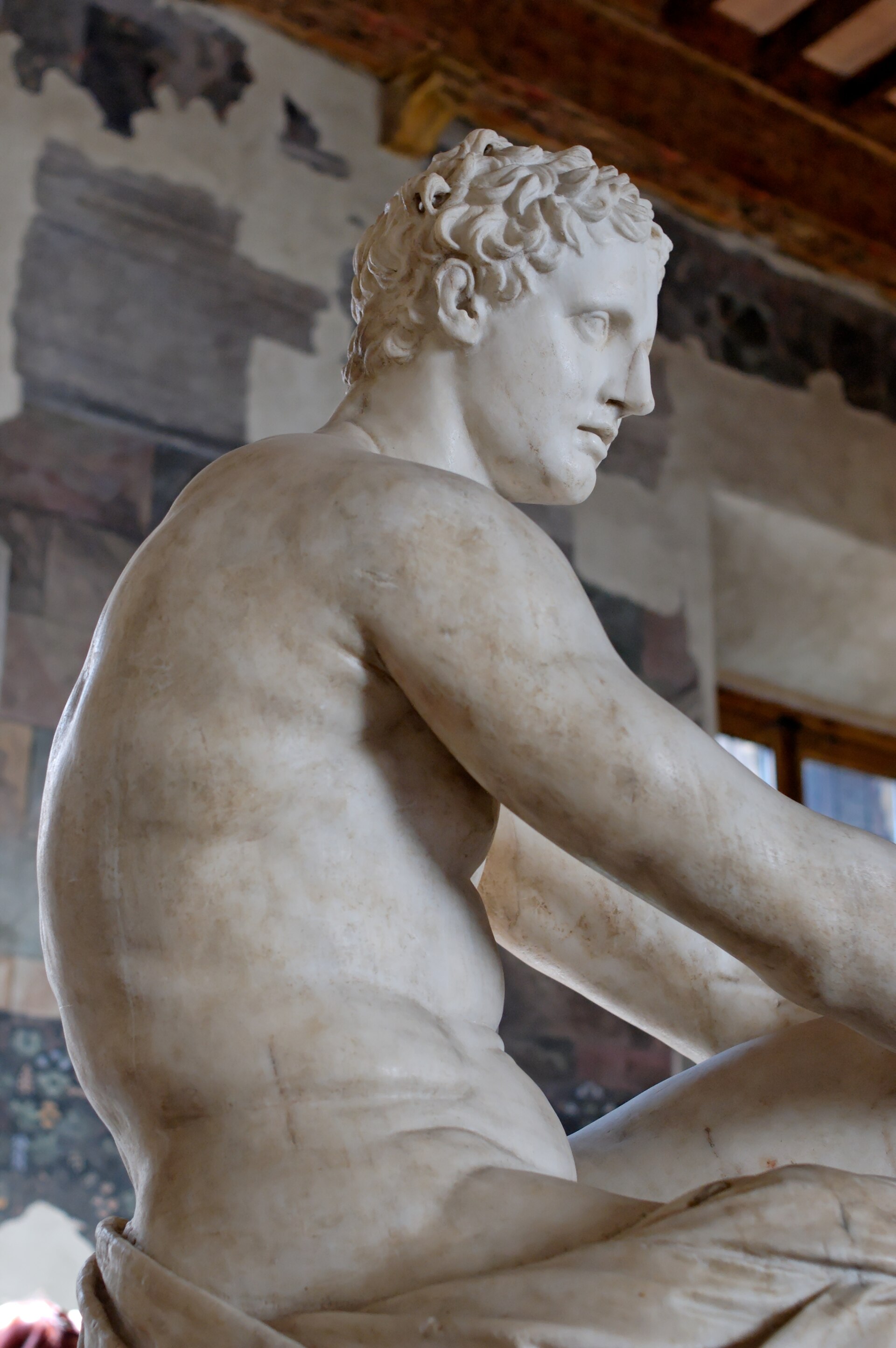

“War is the father of all and king of all.”
Heraclitus, fragment 53
“To me you are the most hateful of all gods who hold Olympus, for ever dear to you is strife and wars and battles.”
Homer, Iliad 5 — Zeus to Ares
“Ares hates those who hesitate.”
attributed proverb; no secure ancient source
Ares forces the line between courage and mere violence: when is fighting a virtue, and when is it just rage dressed up as bravery?
Aristotle's answer is precise. Courage is the mean between cowardice and recklessness, aimed at a noble end. Pure aggression with no measure and no good purpose is not courage at all — it is the excess, the vice on the far side.
By that standard Ares, all bloodlust and no restraint, is not brave; he is reckless. The Greek preference for Athena over Ares is the same judgment in mythic form: disciplined, purposeful bravery over violence for its own sake.
Rage and violence — force with no measure or purpose.
Disciplined, just, strategic warfare — force governed by reason.
War in its most violent, chaotic form — bloodlust, slaughter, and the brutal energy of battle, as distinct from Athena's disciplined strategy.
Ares represents raw violence; Athena represents reasoned, just, strategic warfare. The Greeks consistently favored Athena.
He embodies the ugliness of war, and myth repeatedly humbles him — wounded in battle and publicly shamed — reflecting Greek suspicion of violence without purpose.
They are equated, but the attitudes differ sharply: the Greeks distrusted Ares, while the Romans honored Mars as a dignified father-god of their people.
When I am not reading Homer or Nietzsche, I tune databases, design high-availability systems, and run cloud migrations.