The Olympians · Love · Beauty · Desire
Aphrodite, Goddess of Desire
Attraction so powerful it bends gods and mortals alike — capable of inspiring love, obsession, betrayal, or ruin.
 Michael Paycer
Attraction so powerful it bends gods and mortals alike — capable of inspiring love, obsession, betrayal, or ruin.
Michael PaycerRole
Love, beauty, desire, sexuality
Symbols
Dove, rose, myrtle, scallop shell
Domain
Attraction and desire
Family
Born from sea foam; or daughter of Zeus & Dione
Aphrodite is the goddess of love, beauty, and desire — a power so strong it compels even the king of the gods. Married to the craftsman Hephaestus but lover of Ares, she is desire that refuses to stay inside its assigned bounds.
She is beauty that can inspire devotion or destroy — love, but also jealousy, obsession, and loss. The Greeks never treated her power as merely sweet.
Hesiod gives her a striking origin: when Cronus castrated his father Uranus and cast the remains into the sea, Aphrodite rose from the foam off the coast of Cyprus, fully grown. (Homer, more conventionally, makes her a daughter of Zeus and Dione.)
Her great cult centers were Cyprus and Cythera, and the Romans worshipped her as Venus, claiming her as ancestor of the Roman people through her son Aeneas. Her image — most famously the Aphrodite of Knidos by Praxiteles — set the standard for the depiction of the female nude in Western art.
Offered the golden apple “to the fairest,” Paris chose Aphrodite over Hera and Athena because she promised him the most beautiful woman alive — Helen, already married to Menelaus. Helen's flight to Troy ignited the Trojan War: desire as the spark of a decade of ruin.
Her love for the mortal youth Adonis, killed by a boar, became one of the great myths of beauty and loss — echoed in cults and lamented in poetry across the ancient world.
When Aphrodite took Ares as her lover, her husband Hephaestus trapped them in an unbreakable net forged at his anvil and exposed them to the laughter of the gods — the craftsman's revenge on beauty and war.
The sculptor Pygmalion carved a woman so perfect he fell in love with his own creation. Aphrodite, goddess of love, took pity and brought the statue to life — a myth about art, desire, and the longing to make the ideal real.
Aphrodite, jealous of the mortal Psyche's beauty, set her impossible tasks — but Psyche, helped by Aphrodite's own son Eros, endured them and won immortality. The tale of the soul (Psyche) united with love (Eros) became a favorite allegory of the soul's journey.
As Venus, Aphrodite became the most depicted goddess in Western art — the Venus de Milo, Botticelli's Birth of Venus, and Titian's reclining Venuses define the very idea of beauty in the European tradition. Her name marks the planet Venus and the word "aphrodisiac."
Her deeper legacy is philosophical: Plato's Symposium turned the desire she embodies into a ladder the soul climbs toward truth, making her a permanent bridge between love, beauty, and the search for meaning. Every later debate about whether desire ennobles or enslaves us begins in her shadow.
Born from the sea foam, Aphrodite is symbolized by the scallop shell (emergence, birth), the dove and rose (love and its fragile beauty), and the mirror (desire and self-regard). Her imagery hovers always between tenderness and danger.
She stands for the power of attraction itself — the force that draws us out of ourselves toward another, and toward beauty. In Plato's hands that same power becomes a ladder toward truth; in myth it just as often becomes obsession and ruin. Aphrodite is the permanent reminder that beauty can both elevate and enslave.
Famous public-domain depictions — click any image to view it full size.
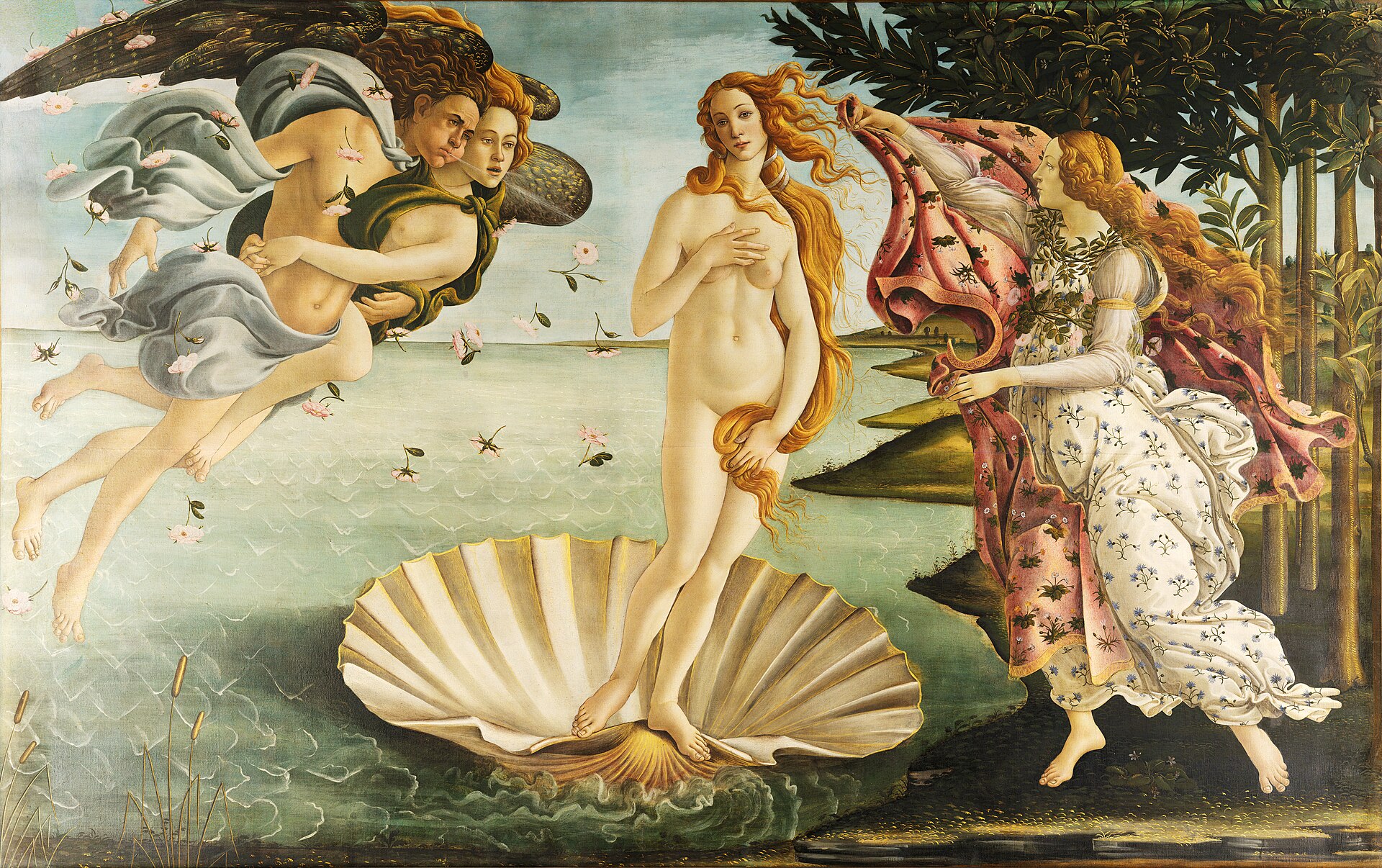
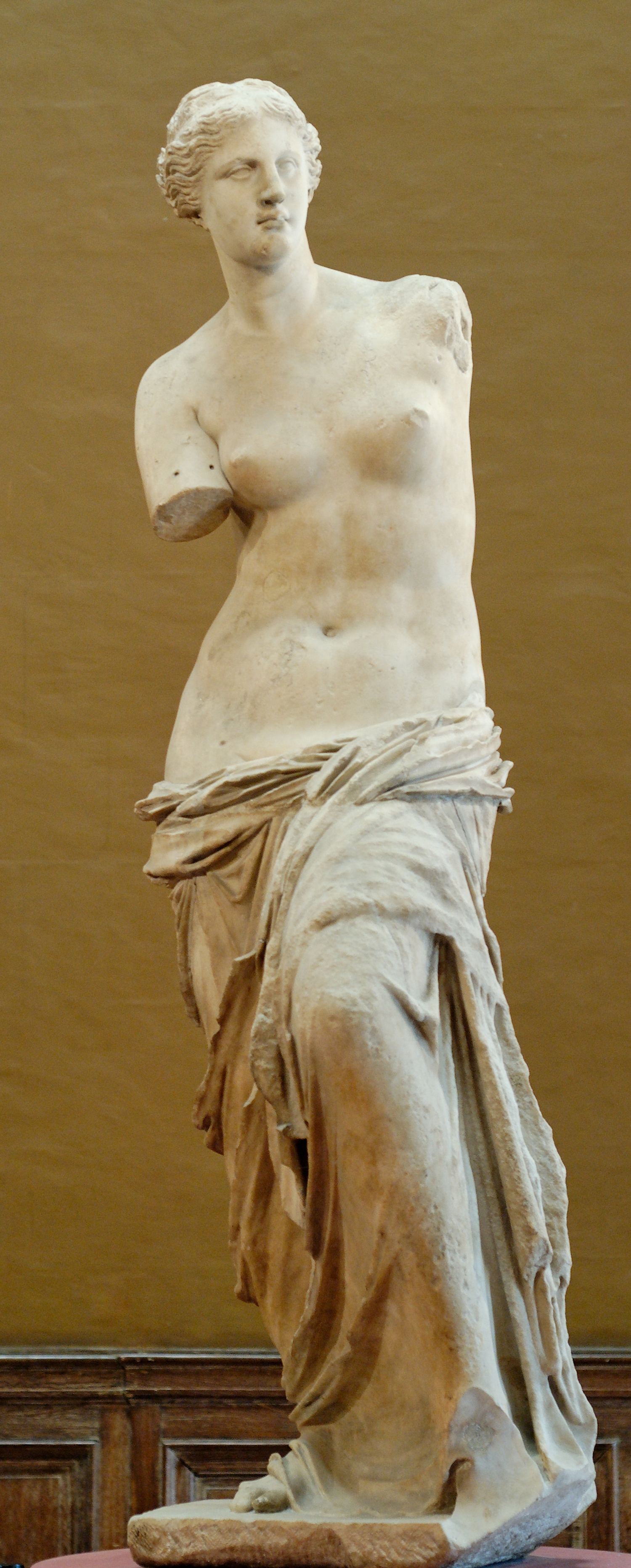
“Deathless Aphrodite of the spangled mind, child of Zeus, weaver of wiles, I beg you, do not break my spirit with longing.”
Sappho, fragment 1 (Hymn to Aphrodite)
“Beginning from obvious beauties, one must mount ever upwards for the sake of that other Beauty.”
Plato, Symposium — Diotima's ladder of love
“Love is born into every human being; it calls back the halves of our original nature together.”
Plato, Symposium (Aristophanes' speech)
In Plato's Symposium, desire stops being mere appetite and becomes a ladder: the love of one beautiful body can lead the soul upward toward beauty itself — and finally toward truth.
Plato distinguishes common love from a higher Eros. Physical attraction is only the first rung: from one beautiful body the soul climbs to beauty in all bodies, then to beauty of souls, of laws, of knowledge, and at last to Beauty itself, the eternal Form.
So Aphrodite is not just romance — she becomes a doorway into metaphysics. But the same force can trap the soul in obsession rather than lift it. Beauty, in Greek thought, is both danger and ascent.
Desire that can lift the soul toward truth — or trap it in obsession.
Chastity and independence — a life ordered around freedom from desire.
Love, beauty, desire, and sexual attraction — a force so powerful it can compel gods and mortals alike. In myth that power inspires love but also obsession, betrayal, and war.
In Plato's Symposium it is not sexless affection but a 'ladder of love': desire for a beautiful body leads upward to love of beautiful souls, ideas, and finally Beauty itself. Desire becomes a path toward truth.
In the Judgment of Paris she promised Paris the most beautiful woman, Helen, who was already married. Helen's flight to Troy triggered the war.
Yes — Venus is the Roman name for the same goddess of love and beauty, claimed by Rome as an ancestor through Aeneas.
When I am not reading Homer or Nietzsche, I tune databases, design high-availability systems, and run cloud migrations.