The Olympians · Order · Prophecy · Reason
Apollo, God of Light and Order
Music, prophecy, healing, and the clarity of reason — and above his temple at Delphi, two words that launched philosophy: know thyself.
 Michael Paycer
Music, prophecy, healing, and the clarity of reason — and above his temple at Delphi, two words that launched philosophy: know thyself.
Michael PaycerRole
Music, prophecy, healing, light, order
Symbols
Lyre, laurel wreath, bow, sun
Domain
Delphi; harmony and measure
Family
Son of Zeus & Leto; twin of Artemis
Apollo governs music, prophecy, healing, archery, light, and rational order. He embodies measure, clarity, and harmony — the principle later called “Apollonian.”
But there is an edge to that order: with his bow he also brings plague and sudden death. Reason and form, in Apollo, are powerful precisely because they hold something dangerous in check. Twin of Artemis, he is the god you consult when you want the truth — though his prophecies are famously hard to read.
Born on the floating island of Delos to Leto, Apollo soon claimed the sanctuary of Delphi by slaying the serpent Python that guarded it. There his priestess, the Pythia, delivered the most authoritative oracle in the Greek world for over a thousand years.
Carved at the temple's forecourt were the Delphic maxims — above all gnothi seauton (“know thyself”) and meden agan (“nothing in excess”). Delphi was treated as the spiritual center of Greece, the omphalos or navel of the world.
The young god kills the great serpent at Delphi and founds his oracle there, replacing an older, chthonic power with the clarity of prophecy. Order, again, is established by mastering something wild.
The satyr Marsyas dared challenge Apollo's lyre with his flute and lost — a myth about the supremacy of harmonious, ordered music over raw, intoxicating sound, and a foretaste of the Apollo–Dionysus contrast.
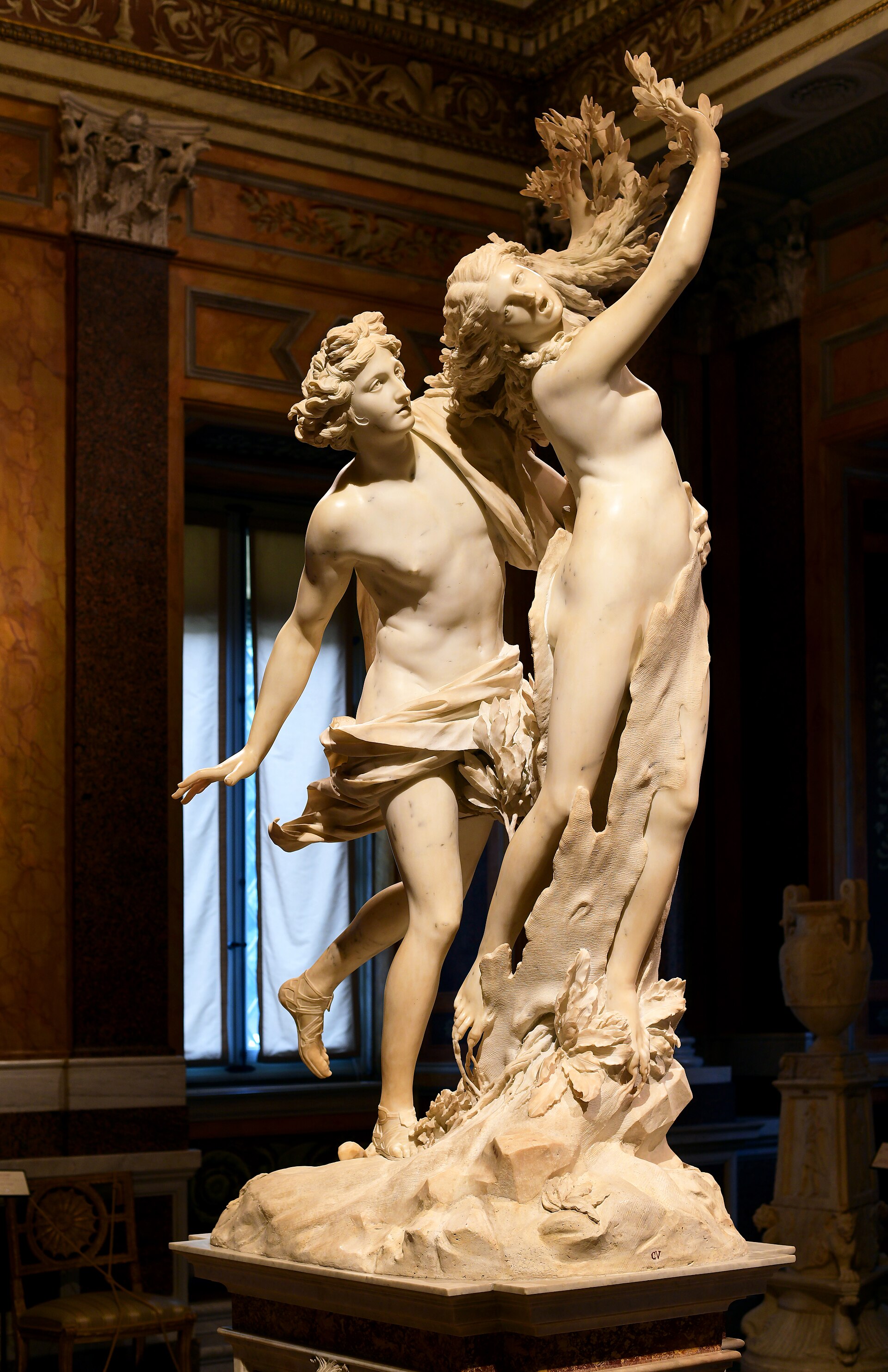
Mocked by Apollo, the love-god Eros shot him with a golden arrow and the nymph Daphne with a leaden one. Apollo pursued; Daphne, desperate, was turned into a laurel tree. Ever after the laurel was his sacred emblem — the crown of poets and victors.
The Iliad opens with Apollo's wrath: insulted by the Greeks, he rains arrows of plague on their camp for nine days. The god of healing is also the god of sudden death — order with a lethal edge.
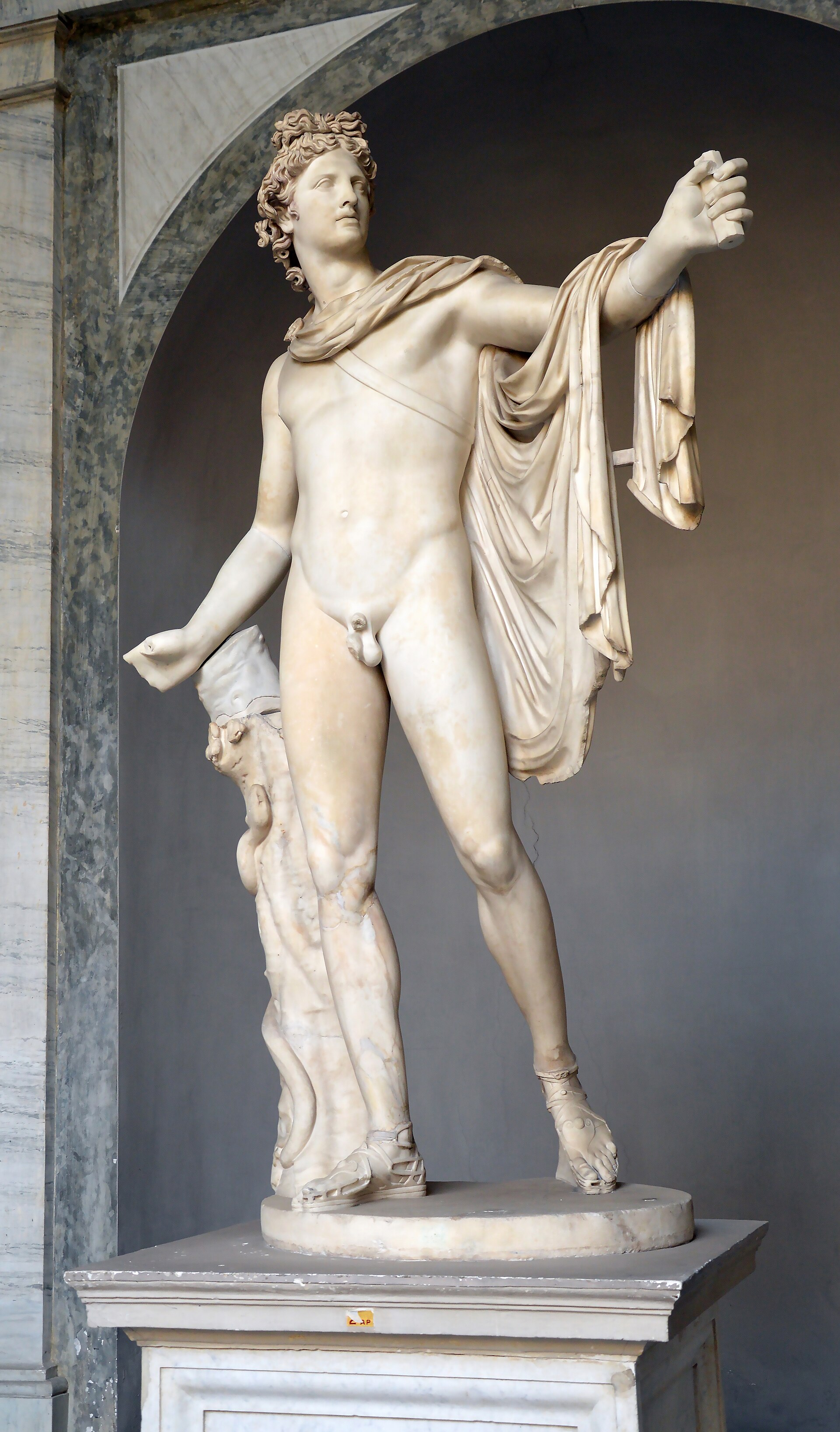
Apollo became the West's enduring image of harmony and rational beauty — the Apollo Belvedere set the standard of ideal form for centuries, and the word "Apollonian" still names the principle of order, clarity, and measure. NASA's Apollo program borrowed his name to carry humanity toward the light he embodied.
His Delphic motto, "know thyself," passed from the temple wall into Socrates, and from Socrates into the whole tradition of self-examination. And his contrast with Dionysus — order against ecstasy — became, through Nietzsche, one of the most influential ideas in modern thought about art and life.
Apollo's attributes are all forms of order made visible. The lyre is harmony — number turned into beauty; the laurel is achievement crowned; the sun is clarity that dispels shadow. Even his bow expresses measure: the precise, distant strike rather than the brawl.
He gave his name to the "Apollonian" — the principle of form, boundary, and rational self-knowledge. Set against the Dionysian, he represents one half of the human spirit: the drive to make sense of things, to find proportion, and above all to know thyself.
Famous public-domain depictions — click any image to view it full size.
“Know thyself.”
Inscribed at the Temple of Apollo, Delphi
“Nothing in excess.”
Delphic maxim, Temple of Apollo
“The god whose oracle is at Delphi neither speaks nor conceals, but gives a sign.”
Heraclitus, on Apollo
The phrase carved at Apollo's temple — know thyself — is where philosophy begins. Socrates turned it into a way of life.
For Socrates, “the unexamined life is not worth living.” Wisdom starts not with clever answers but with honestly knowing your own ignorance and examining your character. That whole project is Apollonian: clarity, measure, and self-knowledge.
Centuries later, Nietzsche set Apollo against Dionysus — order and form against ecstasy and chaos — and argued that a full life and great art need both. Apollo alone is clarity without life; the tension is the point.
Order, form, reason, measure, the boundaried self. “Nothing in excess.”
Ecstasy, music, chaos, intoxication, the dissolving of the self.
Inscribed at Apollo's temple at Delphi, it calls a person to honest self-examination — to understand one's own character, limits, and ignorance. Socrates made it the heart of philosophy: wisdom begins with knowing what you do not know.
Apollo's sanctuary at Delphi, where his priestess the Pythia delivered prophecies for over a thousand years. It was regarded as the spiritual center of the Greek world.
He governs music, prophecy, healing, and light — all forms of harmony and clarity. That made him the natural symbol of the 'Apollonian': order, measure, and the boundaried self.
The lyre (music and harmony), the laurel wreath, the bow (prophecy's edge and sudden death), and the sun.
When I am not reading Homer or Nietzsche, I tune databases, design high-availability systems, and run cloud migrations.