Heroes · Friendship · Sacrifice · Grief
Patroclus, Achilles' Companion
The bond that breaks through Achilles' pride — and whose death turns the Iliad from wounded honor to devastating grief.
 Michael Paycer
The bond that breaks through Achilles' pride — and whose death turns the Iliad from wounded honor to devastating grief.
Michael PaycerRole
Closest companion of Achilles
Symbols
Achilles' borrowed armor
Domain
Friendship, loyalty, sacrifice, grief
Family
Son of Menoetius; raised beside Achilles
Patroclus is Achilles's closest companion in the Iliad. Importantly, he is not simply Achilles' cousin, as the film Troy presents him; he is Achilles' beloved companion, and the exact nature of their bond has been interpreted in different ways across history.
Older and gentler than Achilles, Patroclus is the steadying human presence beside the blazing hero — and his death is the emotional turning point of the entire poem.
As a boy Patroclus was sent into exile after an accidental killing and raised in the household of Achilles' father, Peleus. The two grew up together, and Patroclus became Achilles' inseparable companion at Troy.
Already in antiquity their relationship was read as a model of devoted love and friendship: Plato's Symposium has the speaker Phaedrus hold them up as exemplars, and Aeschylus dramatized them in his lost play Myrmidons.
With Achilles withdrawn from battle and the Greeks being slaughtered, Patroclus begged to wear Achilles' armor and lead the Myrmidons, so the Trojans would think Achilles had returned and lose heart.
Achilles agreed but warned him only to drive the Trojans from the ships, not to pursue them. Patroclus, carried away by success, went too far — and was struck down by Hector, with the help of Apollo.
Patroclus's death is the hinge of the Iliad. Achilles returns to battle not for politics or honor but out of grief and rage, and his vengeance on Hector seals his own doom.
Before he ever donned the armor, Patroclus was the gentler voice in Achilles' tent — the one who tended the wounded and pleaded the Greeks' case. Achilles loved and trusted him above all, which is exactly why his loss shattered him.
After death, Patroclus' ghost came to Achilles begging that their bones be buried together. Achilles ordered it: their ashes were mixed in a single golden urn — in death, as in life, inseparable.
The bond between Achilles and Patroclus became antiquity's model of devoted love and friendship — debated in Plato's Symposium, staged by Aeschylus, and reinterpreted ever since, most recently in Madeline Miller's best-selling The Song of Achilles.
His death is the hinge on which the Iliad turns from wounded pride to human grief, and so he endures as proof of a deep truth in the poem: that even the greatest warrior is, at heart, a person who can love and be broken by loss.
Patroclus symbolizes the bond of love and friendship that can reach past pride — the gentler presence beside the blazing hero, and the loss that finally breaks him open. In his borrowed armor he becomes a kind of shadow-Achilles, raising the theme of identity and substitution.
His death is the symbol of grief as a moral turning point: the moment a warrior's story stops being about honor and becomes about love and loss. He stands for the proof that even the greatest fighter is, at heart, a person who can be shattered by the death of someone he loves.
Famous public-domain depictions — click any image to view it full size.
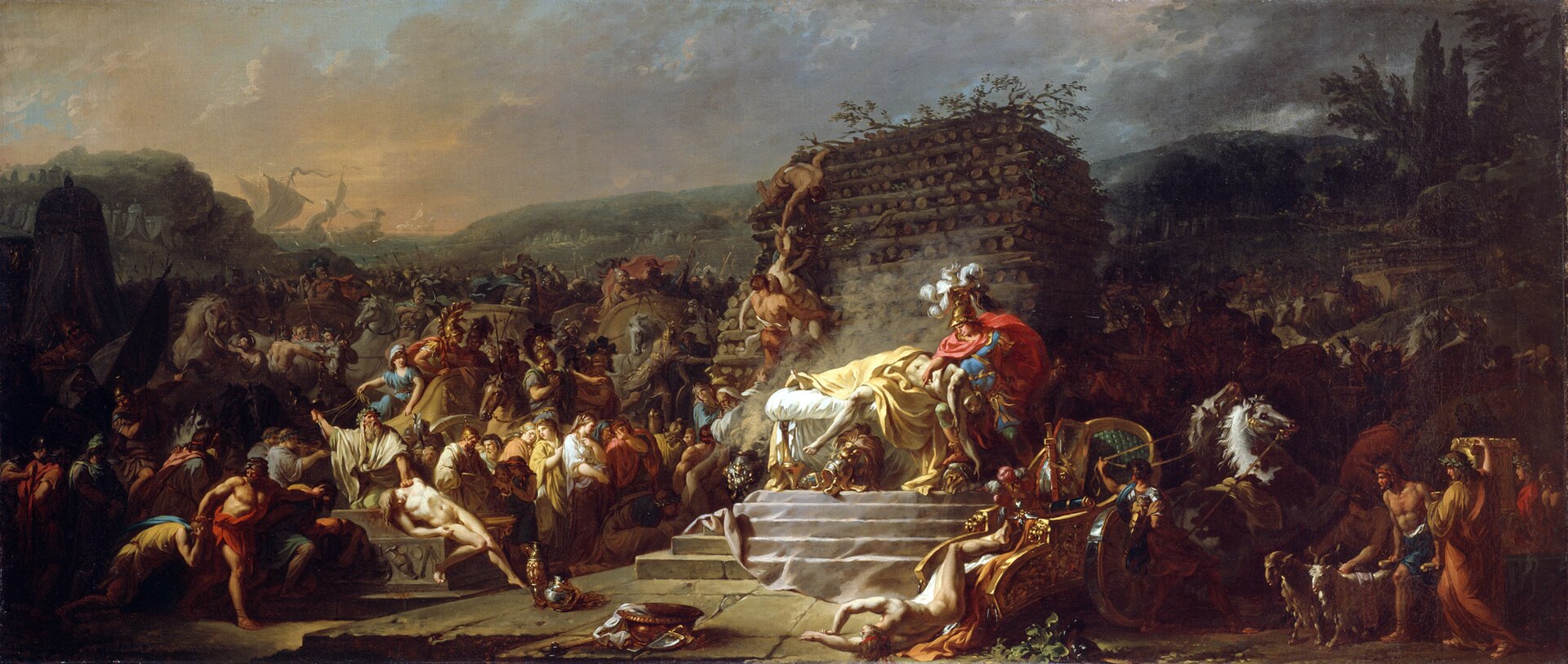
“Let me put on your armor and lead the Myrmidons, that the Trojans may think you have returned.”
Homer, Iliad 16 — Patroclus (paraphrase)
“Now I shall go to meet Hector, the killer of the man I loved.”
after Homer, Iliad 18 — Achilles (paraphrase)
“Bury my bones with yours, that we may not lie apart.”
Homer, Iliad 23 — the ghost of Patroclus
Patroclus is the human bond that breaks through Achilles' pride — the love and grief that move a man beyond honor.
For much of the Iliad, Achilles is consumed by wounded pride. Patroclus's death changes the whole register of the poem: from politics and honor to raw human grief. Achilles fights again not for glory but because he has lost the person he loved.
Patroclus raises questions of friendship, loyalty, and sacrifice; of identity (in Achilles' armor he becomes a symbolic Achilles); and of moral awakening. Above all, he proves that the war-machine is also a person — Achilles can love, lose, and be shattered.
Compassion and loyalty — the friend who acts to save others.
Pride and rage — honor that withdraws until grief calls it back.
Homer never calls them cousins — the film Troy leans on a marginal later genealogy while playing down their bond. In Homer they are the closest of companions; many ancient readers, including in Plato's Symposium, understood their bond as a deep romantic love, though Homer does not state it explicitly.
It is the turning point of the Iliad. His death draws the withdrawn Achilles back into the war — out of grief, not honor — and sets in motion Achilles' killing of Hector and his own doom.
To make the Trojans believe Achilles had rejoined the fight and to rally the failing Greeks. The disguise worked at first, but Patroclus pressed too far and was killed.
Hector delivered the fatal blow, but only after the god Apollo had stunned Patroclus and stripped away his borrowed armor.
When I am not reading Homer or Nietzsche, I tune databases, design high-availability systems, and run cloud migrations.