The Olympians · King · Sky · Law
Zeus, King of the Gods
Ruler of Olympus, god of the sky, thunder, and law — the very image of authority, and, in myth after myth, deeply and deliberately flawed.
 Michael Paycer
Ruler of Olympus, god of the sky, thunder, and law — the very image of authority, and, in myth after myth, deeply and deliberately flawed.
Michael PaycerRole
King of the gods; sky, thunder, law
Symbols
Thunderbolt, eagle, oak, scepter
Domain
Mount Olympus; order & justice
Family
Son of Cronus & Rhea; husband of Hera
Zeus rules Mount Olympus as king of the gods and lord of the sky, thunder, and law. He is the guarantor of order — protector of guests and suppliants, enforcer of oaths, patron of kings. When the Greeks swore by anything, they swore by Zeus.
Yet he is the most flawed of the gods. Endless affairs, disguises, and jealous punishments fill his myths. He defends justice in some stories and violates it in others — often in the same breath. That contradiction is not careless storytelling; it is the Greeks thinking out loud about what power really is.
In Hesiod's Theogony, Zeus is the youngest child of the Titans Cronus and Rhea. Cronus, who devoured his children to forestall a prophecy, was tricked by Rhea into swallowing a stone instead of the infant Zeus, who was hidden on Crete. Grown, Zeus freed his siblings and led them in the ten-year war against the Titans, the Titanomachy.
Victorious, the three brothers drew lots for the cosmos: Poseidon took the sea, Hades the underworld, and Zeus the sky and supreme rule. His great cult centers were Olympia — home of the Olympic Games and the colossal gold-and-ivory statue by Phidias, one of the Seven Wonders — and the ancient oracle at Dodona.
Zeus's first great act is to depose his own father and end the reign of the Titans — establishing the Olympian order that the rest of mythology assumes. The pattern of a son displacing the father runs deep in Greek thought about power and succession.
Zeus fathers gods and heroes across countless unions — Athena, Apollo, Artemis, Dionysus, Heracles, Perseus, and more — often through disguise (a swan, a bull, a shower of gold) and often provoking the wrath of Hera. These myths spread his bloodline through the heroic world, and also stage, again and again, the abuse of power.
For all his transgressions, Zeus is invoked as Zeus Xenios (protector of guests) and Zeus Horkios (keeper of oaths). He holds the scales of fate and punishes hubris. The Greeks lived inside that tension: the same god embodied both cosmic justice and its violation.
To carry off the Phoenician princess Europa, Zeus took the form of a gentle white bull and bore her across the sea to Crete. The continent of Europe carries her name, and the myth became one of the most painted subjects in Western art.
Zeus, taken with the beauty of the Trojan youth Ganymede, sent an eagle (or became one) to carry him to Olympus as cupbearer of the gods — a story later read as a meditation on beauty, power, and the favor of the divine.
Zeus never really left the Western imagination. The Romans merged him with Jupiter, whose name survives in the planet, in the weekday Thursday (Jove's day, via Latin dies Iovis), and in words like "jovial." His thunderbolt and eagle became enduring emblems of sovereign power, borrowed by empires and republics alike.
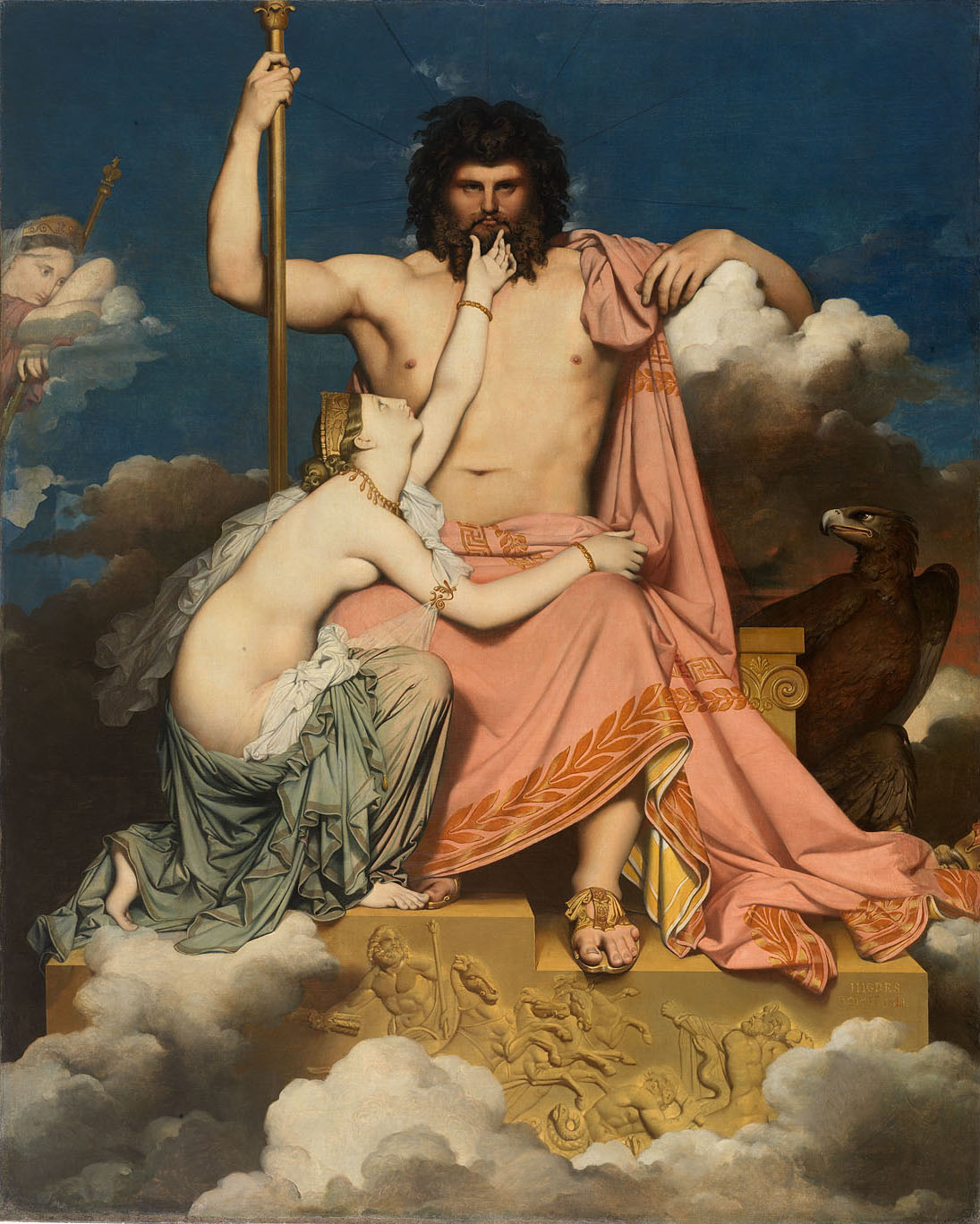
In art he is the enthroned king of Renaissance and Baroque painting, and his many disguises — the swan, the bull, the shower of gold — gave painters from Correggio to Rembrandt some of their most famous canvases. The philosophical question he raises, whether power and justice can ever truly coincide, runs straight from Plato's Republic to every modern debate about authority.
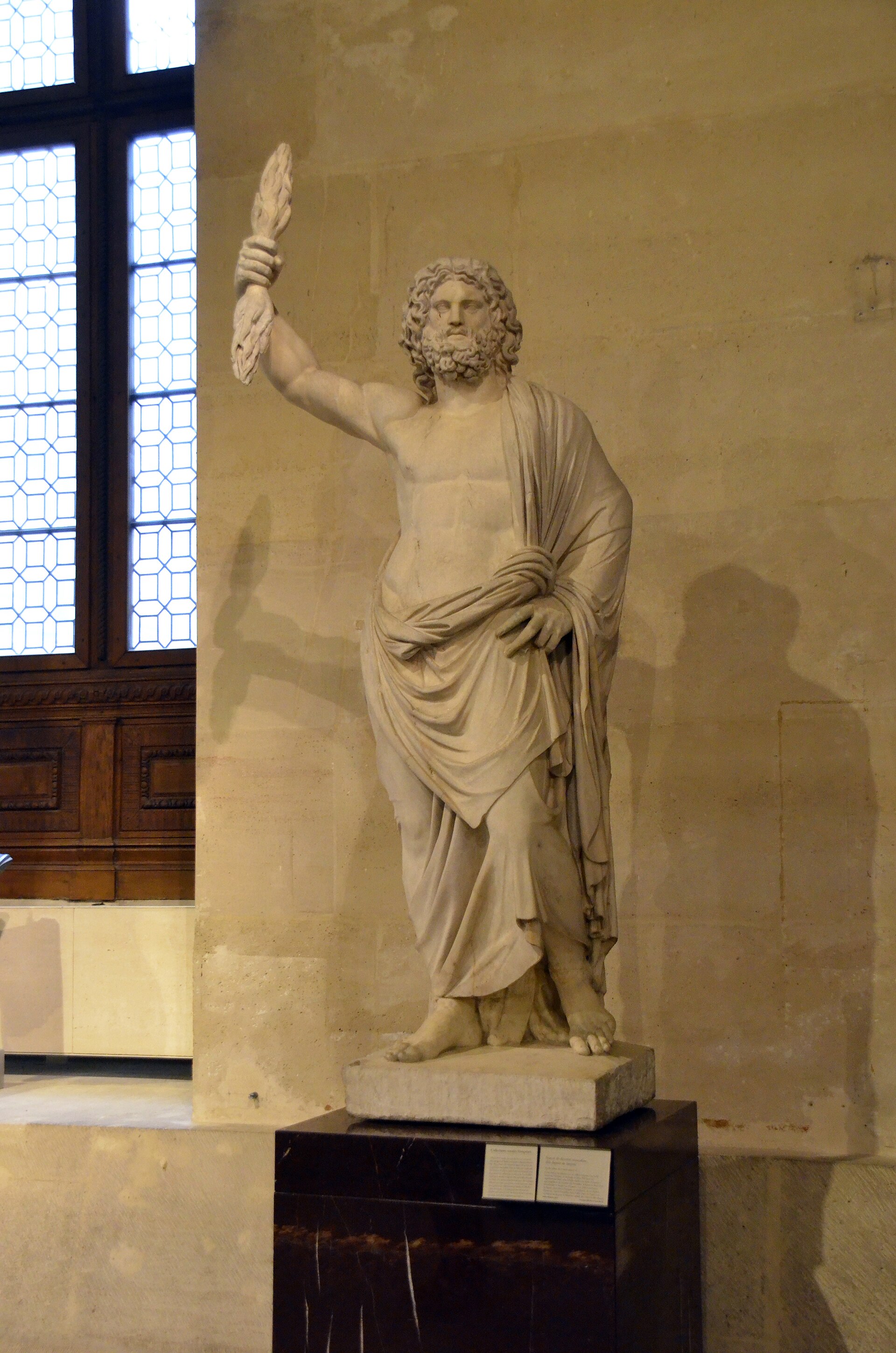
Zeus's emblems all speak of sovereignty. The thunderbolt is power that descends from on high, irresistible and sudden; the eagle is the king of birds surveying his domain; the oak is endurance rooted to the earth. Together they make him the archetype of legitimate, top-down authority.
As a sky-father ruling a flawed but ordered cosmos, Zeus also became the West's projected image of patriarchal power itself — majestic and protective, yet capricious. That double face is exactly why he remains such a useful figure for thinking about the relationship between authority and justice.
Famous public-domain depictions — click any image to view it full size.
“Such is the way the gods spun life for unfortunate mortals, that we live in unhappiness, but the gods themselves have no sorrows.”
Homer, Iliad 24 — Achilles, on the two jars of Zeus
“Zeus, who guided men to think, has laid it down that wisdom comes alone through suffering.”
Aeschylus, Agamemnon
“The Fates have given to mortals hearts that can endure.”
Homer, Iliad — on the will of Zeus (paraphrase)
Zeus forces the oldest question in political philosophy: when the most powerful being is also the one who makes the law, is justice something real — or just whatever power says it is?
Plato's Republic opens with Thrasymachus claiming that justice is simply “the advantage of the stronger.” Zeus is that claim in divine form: the strongest being, whose will is law. If might makes right, his every act is just by definition.
Socrates and Plato spend the rest of the dialogue arguing the opposite — that justice is real, good in itself, and binding even on the powerful. Zeus, both guardian of justice and its frequent violator, keeps that tension permanently open.
Power that makes the law and demands obedience — order from the top down.
Defiance on behalf of humankind, punished without mercy — conscience against authority.
Zeus led the younger gods to victory over the Titans and drew the sky as his realm when the cosmos was divided. His kingship rests on that victory and on his role as guarantor of order, oaths, and justice.
Both, deliberately. He defends guests, suppliants, and oaths as a god of justice, yet behaves unjustly in his affairs and punishments. The Greeks used that contradiction to ask whether power and justice naturally align.
The thunderbolt, the eagle, the oak tree, and the royal scepter — all signs of sovereignty and command over the sky.
A roughly 12-metre seated figure of gold and ivory by the sculptor Phidias, around 435 BCE — one of the Seven Wonders of the Ancient World, lost in late antiquity.
When I am not reading Homer or Nietzsche, I tune databases, design high-availability systems, and run cloud migrations.