The Olympians · Messenger · Boundaries
Hermes, the Boundary-Crosser
Messenger of the gods and guide of souls — clever, quick, and ambiguous, moving freely between every world.
 Michael Paycer
Messenger of the gods and guide of souls — clever, quick, and ambiguous, moving freely between every world.
Michael PaycerRole
Messenger, travel, trade, language, boundaries
Symbols
Winged sandals, caduceus, traveler's hat
Domain
Roads and boundaries
Family
Son of Zeus & the nymph Maia
Hermes is the messenger of the gods and the great crosser of boundaries — between Olympus and earth, the living and the dead (as the guide of souls), truth and trickery. He is god of travel, trade, language, and thieves.
Quick, charming, and adaptable, he is the most flexible of the gods, and the one who moves messages — and meaning — between worlds.
Roadside pillars called herms — stone shafts topped with his head — marked boundaries, crossroads, and doorways across the Greek world. As psychopompos, he led the souls of the dead down to Hades.
The Romans worshipped him as Mercury, patron of commerce. In later antiquity he was fused with the Egyptian Thoth as “Hermes Trismegistus,” the legendary source of the Hermetic writings on magic and wisdom.
On the very day of his birth, Hermes slipped from his cradle, stole the cattle of Apollo, and disguised their tracks. Caught out, he invented the lyre from a tortoise shell and gave it to Apollo to make peace — charm and cleverness winning where force could not.
Hermes alone moved freely between the living world and the dead, escorting souls to the underworld. He is the god of every threshold, every passage from one state to another.
Sent by Zeus, Hermes lulled the hundred-eyed giant Argus to sleep with stories and music, then killed him to free Io — proving the power of words over watchfulness.
Hermes fathered Pan, the goat-legged god of the wild, of shepherds, and of sudden "panic." Quick, rustic, and irrepressible, Pan extended his father's reach into the untamed countryside.
It was Hermes whom Zeus sent down to Hades to escort Persephone back to the surface each spring — the one god trusted to pass freely between the living world and the dead.
As Mercury, Hermes named the swiftest planet and the liquid metal, and his caduceus — the winged staff with twin serpents — became (through a long confusion with the rod of Asclepius) a worldwide symbol of medicine and commerce. His name lives in "mercurial," in "merchant," and in "hermeneutics," the art of interpretation.
In later antiquity he was fused with the Egyptian Thoth into "Hermes Trismegistus," legendary author of mystical and alchemical wisdom. As the god of language, boundaries, and ambiguity, he remains the patron of every discipline concerned with how meaning is made — and how it can deceive.
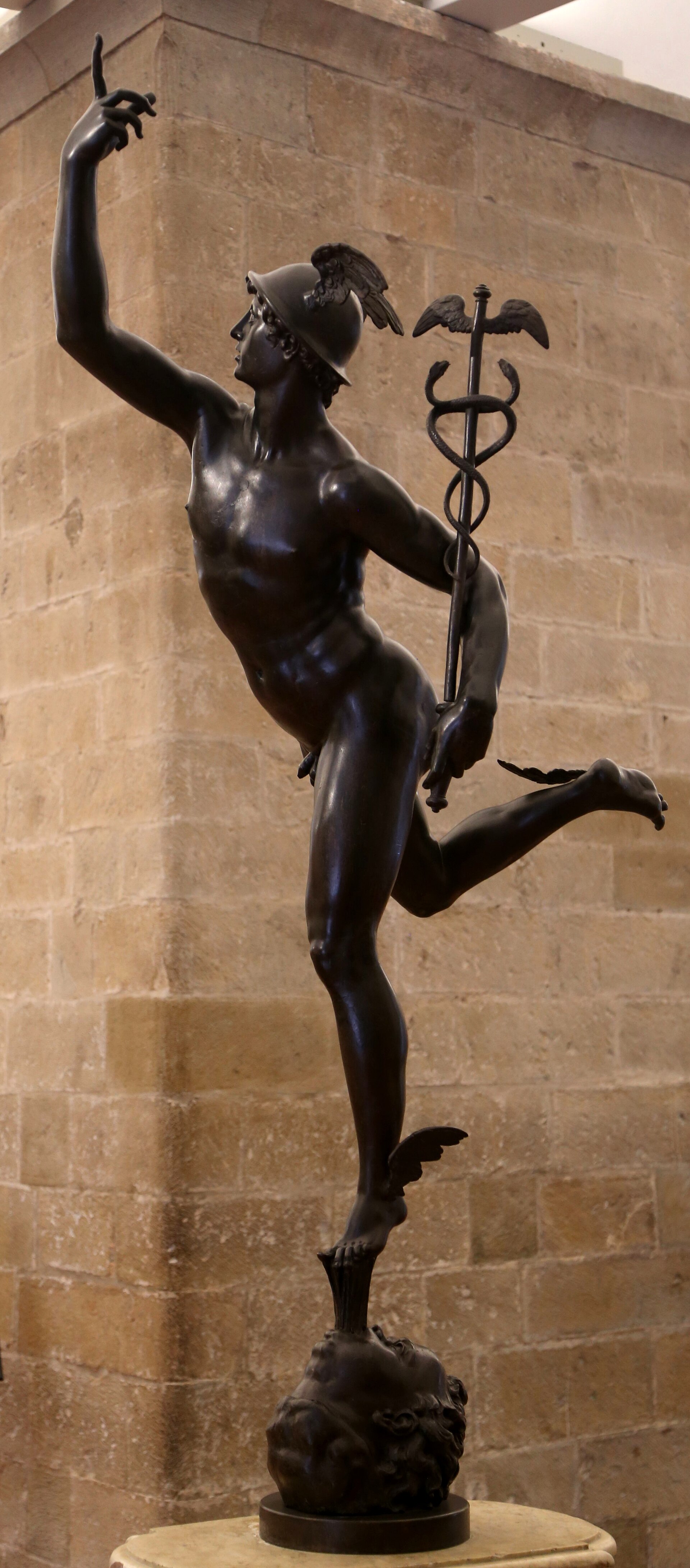
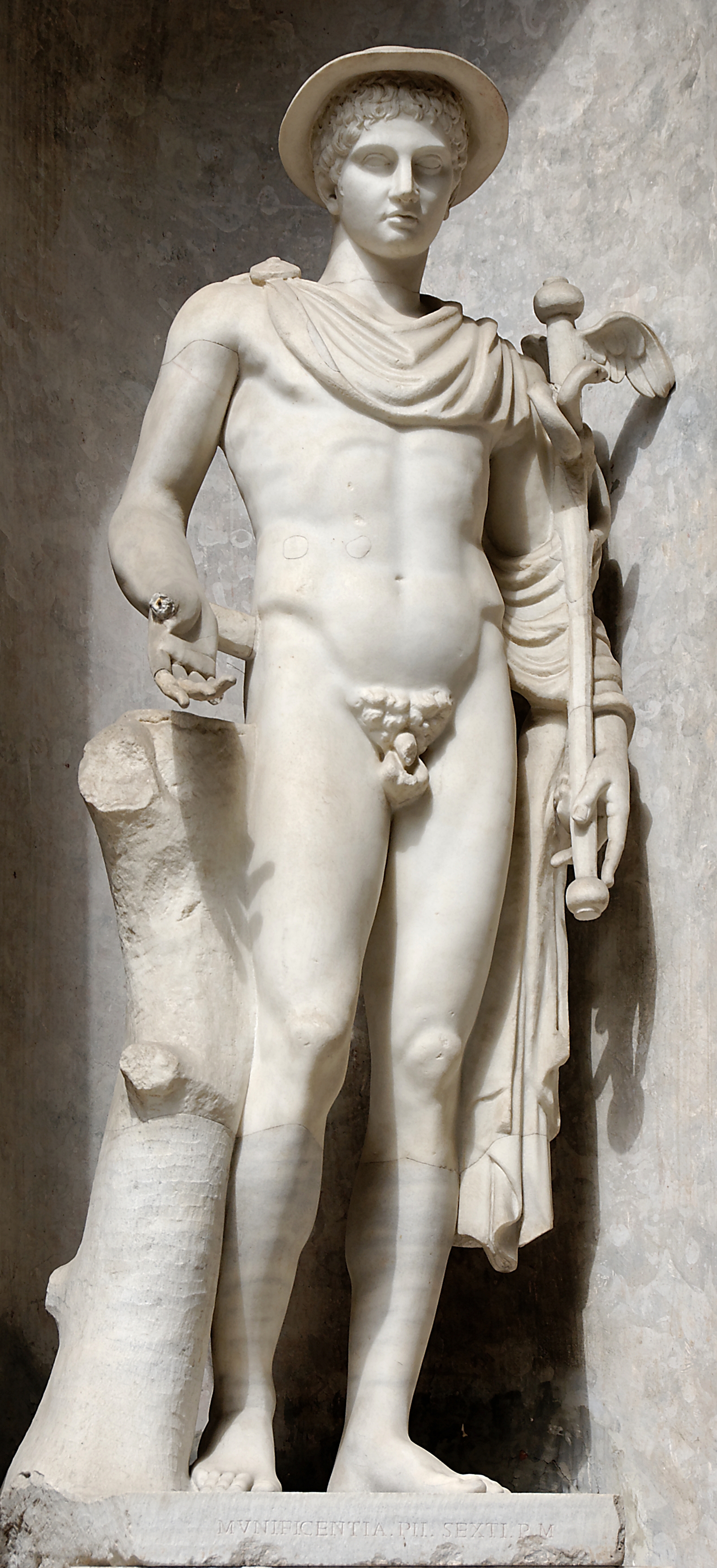
Hermes's winged sandals and cap are speed and the crossing of every boundary; the caduceus — twin serpents entwined on a staff — is the reconciliation of opposites and safe passage between worlds. He alone moves freely between Olympus, earth, and the dead.
He symbolizes communication itself, with all its promise and peril: the messenger who can reveal the truth or twist it, who guides souls and also patronizes thieves. As the namesake of "hermeneutics," he stands for the eternal problem of meaning — how a message changes as it travels, and how we can ever be sure we are being informed rather than deceived.
Famous public-domain depictions — click any image to view it full size.
“Born in the morning, by midday he played the lyre, and in the evening he stole the cattle of far-shooting Apollo.”
Homeric Hymn to Hermes (paraphrase)
“A name is a tool for teaching and for distinguishing reality.”
after Plato, Cratylus (paraphrase)
“Hermes, of many turns, gracious one, guide and giver of good things.”
Homeric Hymn to Hermes
Hermes is the god of language and interpretation itself — the reminder that communication can reveal the truth or manipulate it, and often we cannot tell which.
The very word hermeneutics, the art of interpretation, descends from his name. He embodies the philosophical problems of meaning, persuasion, and ambiguity: how language carries truth, how rhetoric can deceive, and how a message shifts as it travels.
The Sophists, masters of persuasion, and Plato's anxiety about rhetoric versus genuine knowledge both live in Hermes' territory. He is the patron of everyone who has ever wondered whether they are being informed or being played.
Persuasion and ambiguity — meaning that can inform or deceive.
Clear, oracular truth — the drive toward what is plainly so.
Messages, travel, trade, language, boundaries, and thieves. He moves freely between worlds and is the gods' herald and the guide of souls to the underworld.
As the divine messenger he carries meaning between gods, mortals, and the dead. The study of interpretation, 'hermeneutics,' takes its name from him.
On his first day he stole Apollo's cattle, then invented the lyre from a tortoise shell and gave it to Apollo to settle the quarrel — the classic image of his cleverness.
Yes — Mercury is the Roman name for the same god of messages and commerce.
When I am not reading Homer or Nietzsche, I tune databases, design high-availability systems, and run cloud migrations.