The Greek Bridge · Classical Athens · Reason
Socrates: Question Everything
The barefoot Athenian who asked relentless questions, claimed to know nothing, and made self-examination the beginning of all philosophy.
 Michael Paycer
The barefoot Athenian who asked relentless questions, claimed to know nothing, and made self-examination the beginning of all philosophy.
Michael PaycerLived
c. 470–399 BCE
School
Classical Athens
Lens
Question everything
Known for
The Socratic method; the examined life
Socrates wrote nothing himself; we know him through his students, above all Plato. He wandered Athens questioning anyone who claimed to know what justice, courage, or piety really were — and exposing how little they actually understood.
His lens is the famous command from Apollo's temple at Delphi: know thyself. Wisdom, for Socrates, begins not with answers but with honestly admitting your own ignorance.
An Athenian stonemason's son who served as a soldier, Socrates spent his life in the public squares of a city at the height of its power and on the edge of decline. He took no fees and founded no school — he simply talked, and changed everyone who talked back.
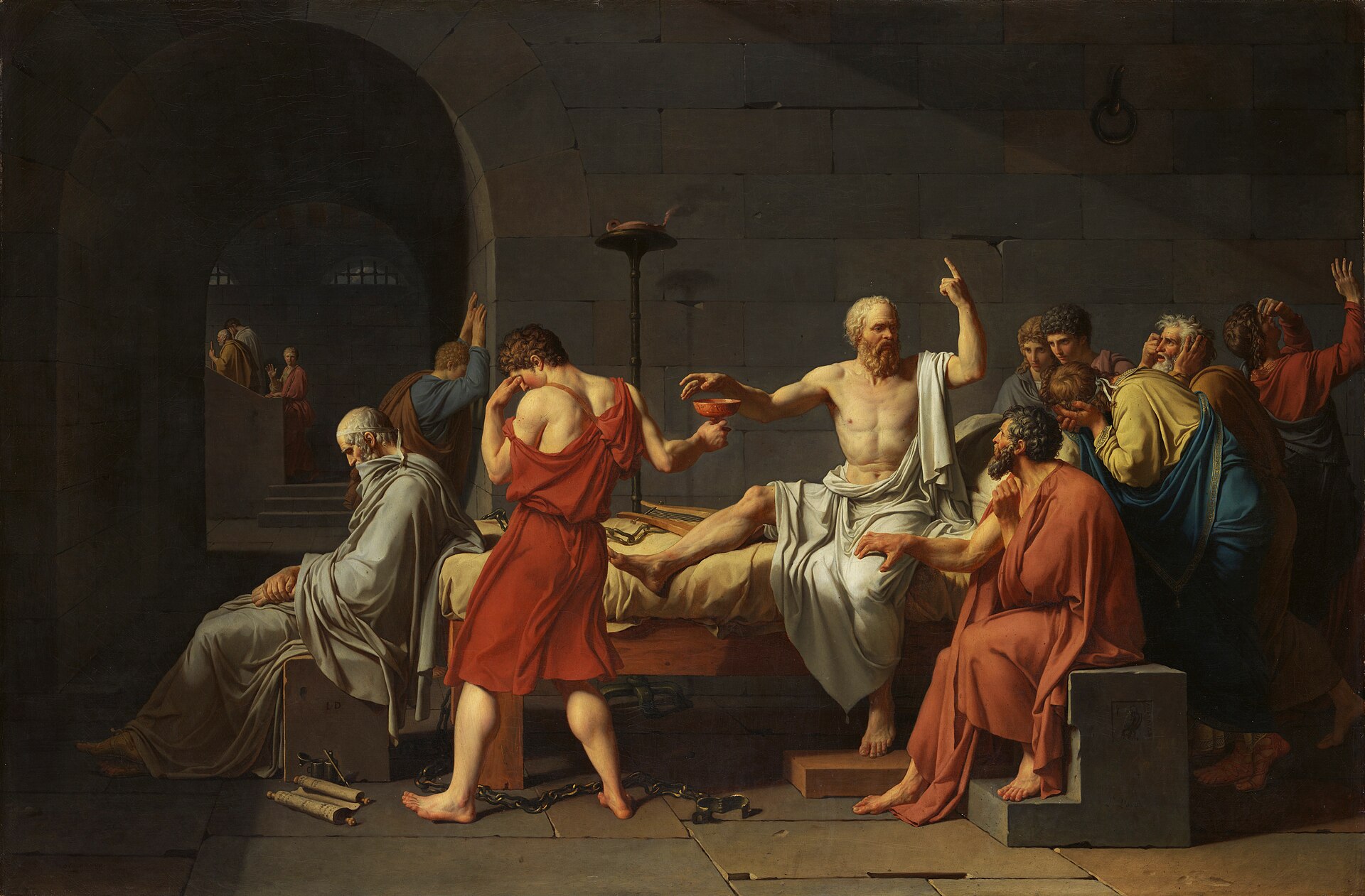
In 399 BCE Athens tried him for "corrupting the youth" and impiety. He refused to flee or grovel, defended the examined life, and was condemned to die by drinking hemlock — a death he met calmly, as a test of everything he had taught.
Socrates taught by questioning, not lecturing — drawing out contradictions in what people thought they knew until a clearer truth emerged. The method survives in law schools and good teaching everywhere.
His trademark was intellectual humility: he was wisest, the Delphic oracle said, because he alone knew the extent of his own ignorance. Real inquiry starts there.
Socrates held that no one does wrong willingly — that wrongdoing comes from ignorance of the good. Know what is truly good, and you will do it. A bold, much-debated claim.
Socrates defended claims that sound strange but follow from his reasoning: that no one does wrong knowingly, that it is better to suffer injustice than to commit it, and that virtue is a kind of knowledge. Each was meant to provoke, and each still does.
Socrates spoke of a divine "sign," an inner voice that warned him away from wrong actions. It was part of the charge of impiety against him — and an early image of conscience as a guide that reason must heed.
Socrates wrote nothing, yet he split the history of philosophy in two: thinkers before him are simply called "the Presocratics." Through his student Plato and Plato's student Aristotle, his method of relentless questioning became the engine of the entire Western tradition.
His calm acceptance of an unjust death — choosing principle over escape — made him a model of integrity for the Stoics, the Christian martyrs, and modern figures of conscience alike. The "Socratic method" still shapes law schools and classrooms, and "the examined life" remains philosophy's oldest summons.
Conscience against the state. Socrates obeyed Athens' death sentence rather than escape, yet had defied the city whenever it asked him to act unjustly. His example frames a permanent question: when does individual conscience rightly override the law, and when must the citizen submit?
Can virtue be taught? Socrates pressed this relentlessly and never settled it. If virtue is knowledge, it should be teachable like geometry — yet good parents often raise bad children. The puzzle drives much of Plato's work and still shapes debates about moral education.
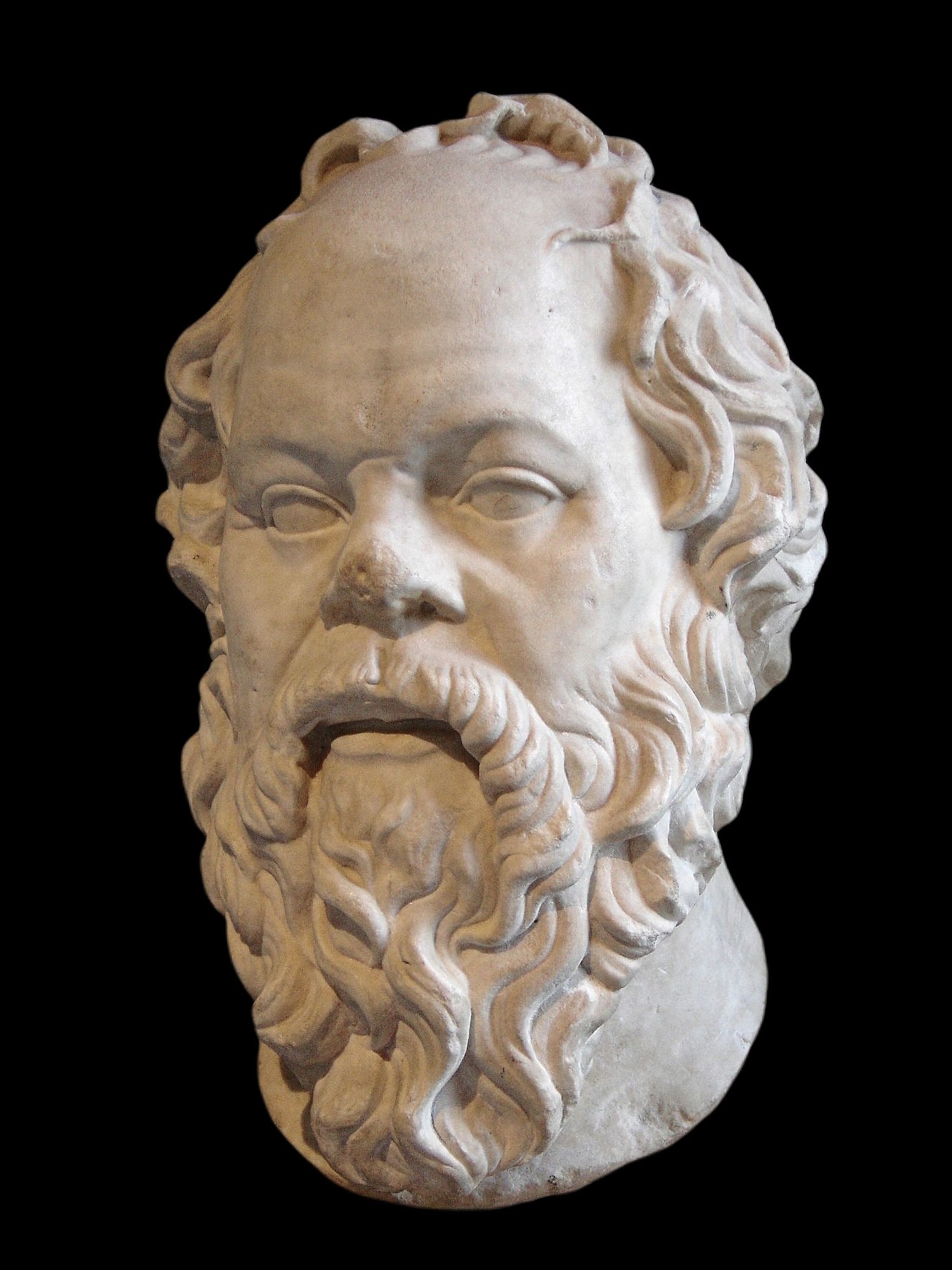
Public-domain portraits and depictions — click any image to view it full size.
“The unexamined life is not worth living.”
Socrates, in Plato's Apology
“I know that I know nothing.”
attributed to Socrates
“There is only one good, knowledge, and one evil, ignorance.”
Socrates, in Diogenes Laertius
Socrates' lens is to question everything — especially yourself. The path to wisdom begins by admitting how little you actually know.
This is where philosophy itself begins. Socrates took the Delphic motto carved at Apollo's temple — know thyself — and turned it into a way of life: examine your beliefs, test them against hard questions, and follow the argument wherever it leads.
His student Plato built an entire philosophy on his example, and the bridge from Greek myth to philosophy runs straight through him: the god's command became the philosopher's mission.
Question to find the truth — even when it leaves you with nothing to sell.
Argue to win — teaching persuasion for a fee, truth optional.
Teaching and inquiry by disciplined questioning. Instead of asserting answers, Socrates asked questions that exposed contradictions in people's beliefs, pushing them toward clearer understanding.
Athens convicted him of impiety and 'corrupting the youth' in 399 BCE. He refused to abandon his philosophical mission or beg for mercy, and was sentenced to die by drinking hemlock.
No. Everything we know comes from others — chiefly his students Plato and Xenophon, and the playwright Aristophanes. This is called the 'Socratic problem.'
Inscribed at Apollo's temple at Delphi, it calls for honest self-examination. Socrates made it central: wisdom begins with knowing the limits of your own knowledge.
When I am not reading Homer or Nietzsche, I tune databases, design high-availability systems, and run cloud migrations.