The Olympians · Sea · Earthquakes
Poseidon, God of the Sea
Lord of the ocean, earthquakes, and horses — power as generous or as catastrophic as the sea itself.
 Michael Paycer
Lord of the ocean, earthquakes, and horses — power as generous or as catastrophic as the sea itself.
Michael PaycerRole
Sea, earthquakes, horses
Symbols
Trident, horse, dolphin, bull
Domain
The sea
Family
Son of Cronus & Rhea; brother of Zeus & Hades
Poseidon rules the sea, the earthquakes that earn him the title “earth-shaker,” and horses. He is powerful, proud, and volatile — like the ocean, generous one moment and devastating the next.
Brother of Zeus and Hades, he drew the sea when the cosmos was divided, and he guards his honor jealously.
A seafaring people held Poseidon in awe; sailors poured offerings to him before any voyage. His great temple at Cape Sounion still stands above the Aegean, and the Isthmian Games at Corinth were held in his honor.
The Romans worshipped him as Neptune. His association with horses is ancient — he was said to have created the first horse, and bulls and horses were sacrificed to him.
Poseidon and Athena competed to become the patron of Athens. He struck the Acropolis and produced a saltwater spring; Athena gave the olive tree and won. Poseidon's loss is a recurring note — raw power judged less valuable than cultivation.
When Odysseus blinded his son, the Cyclops Polyphemus, Poseidon kept him storm-tossed and far from home for years. He is the divine obstacle of the Odyssey — the sea that cannot be outwitted, only endured.
Poseidon's anger was felt as earthquakes and floods. To a culture living along fault lines and coasts, he personified the planet's indifference to human intention.
Poseidon's union with Medusa led, after her death, to the birth of the winged horse Pegasus, who sprang from her blood. As god of horses, Poseidon is bound up with the most famous steed in myth.
Poseidon and Apollo once built the great walls of Troy for King Laomedon, who then cheated them of their wages. Poseidon's grudge helped doom the city — a god whose anger, like the sea's, never quite forgets.
As Neptune, Poseidon gave his name to the eighth planet and remains the default image of the sea itself — trident in hand, rising from the surf in fountains, ship figureheads, and seaside statuary the world over. His earthquakes made him, to the Greeks, the explanation for the planet's most terrifying power.
Philosophically he endures as the face of nature's indifference to human plans — the force Odysseus can endure but never outwit. That recognition, that some things lie permanently beyond our control, is exactly the insight the Stoics would later build an entire ethics upon.
The trident is Poseidon's threefold mastery of the sea; the horse is raw, untamable power (he was said to have made the first one); the bull and the earthquake are nature's brute force. Every emblem is something that moves, surges, and cannot be commanded.
He symbolizes nature's sublime indifference to human plans — the ocean and the trembling earth that care nothing for our intentions. In later thought the sea became an image of the unconscious and of fate itself: vast, powerful, and beyond control, to be endured rather than mastered.
Famous public-domain depictions — click any image to view it full size.
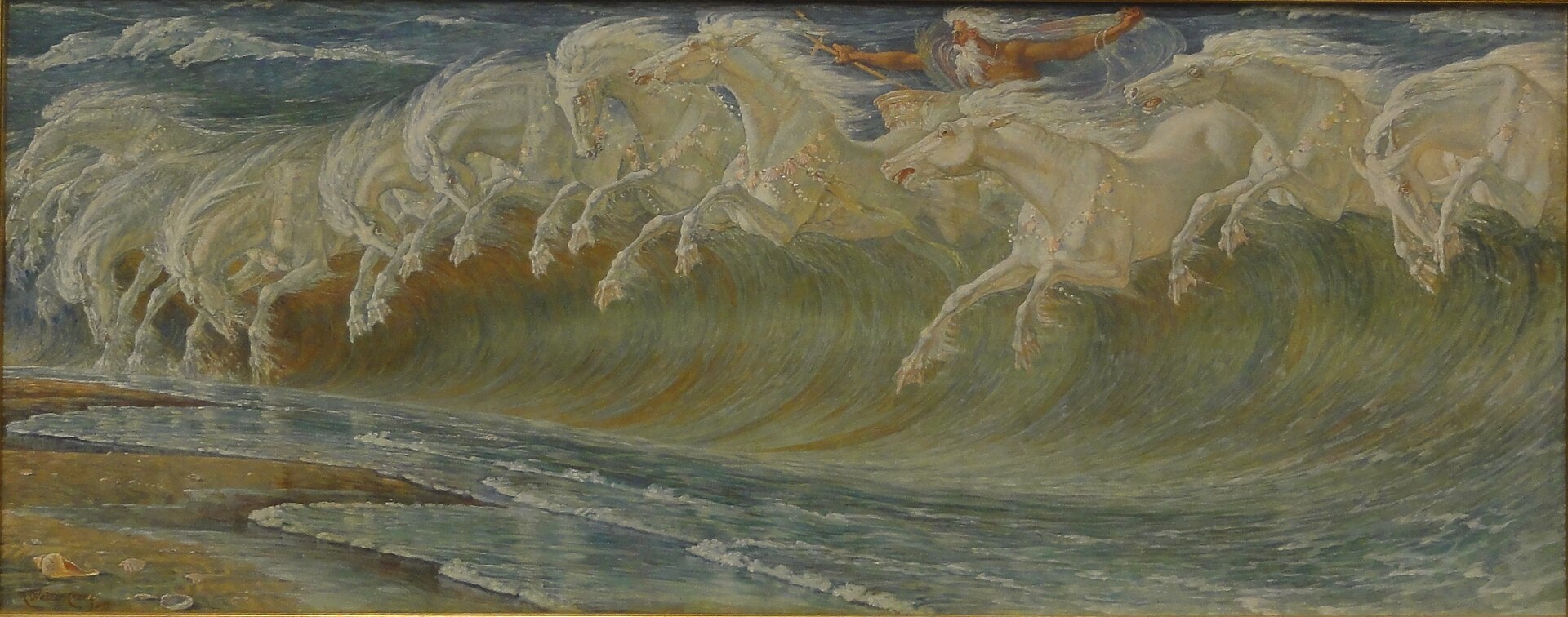
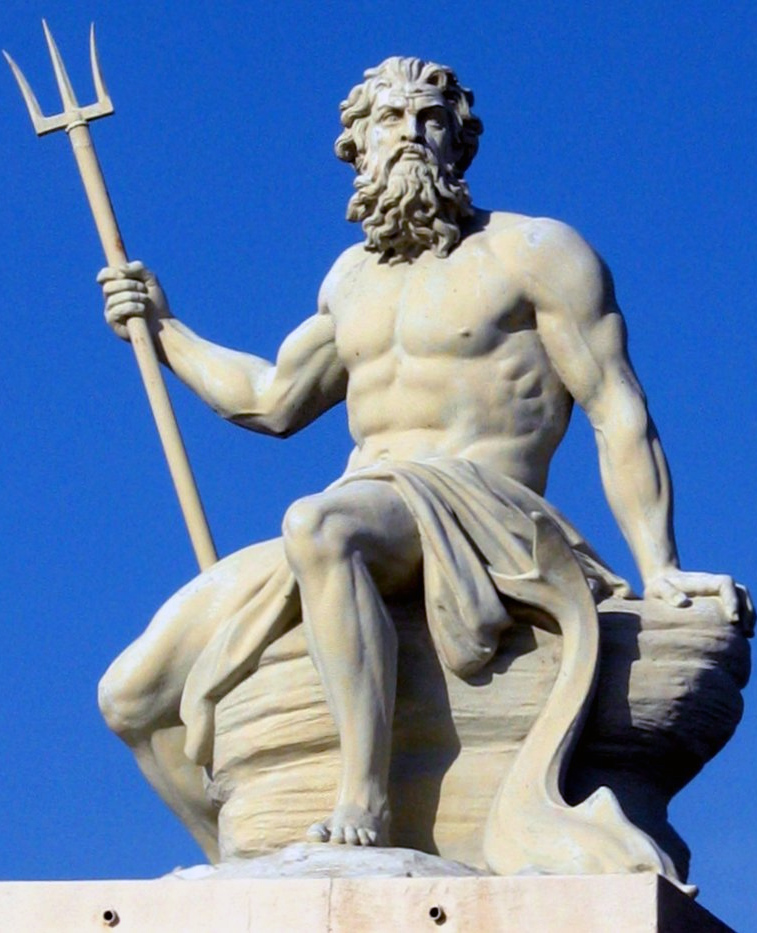
“But Poseidon, shaker of the earth, raged on without ceasing against godlike Odysseus, before he reached his own land.”
Homer, Odyssey 1
“Some things are within our power, and some are not.”
Epictetus, Enchiridion
“The sea drives away all of mortals' ills.”
Euripides, Iphigenia in Tauris
Poseidon is nature's raw power against human plans — the Greek sense that storms, seas, and tremors care nothing for our intentions or our reason.
Greek thought repeatedly sets human reason and order against chaotic natural forces, and Poseidon personifies that opposition. Odysseus can outwit monsters and kings, but he cannot outwit the sea — only endure it.
That recognition — that some forces exceed all human control — is exactly what Stoicism later builds an ethics around. You cannot calm the storm; you can only govern your response to it. Poseidon is the storm.
Untamable nature — the sea and the earthquake that ignore human plans.
Human craft and reason — the olive tree, the city, the cultivated world.
The sea, earthquakes, and horses. As 'earth-shaker' he governs both the ocean's moods and the trembling of the ground.
Odysseus blinded Poseidon's son, the Cyclops Polyphemus. In revenge Poseidon kept him storm-tossed and far from home for years — the engine of the Odyssey.
Athena. Poseidon offered a saltwater spring; Athena offered the olive tree, judged the more valuable gift, and the city took her name.
Yes — Neptune is the Roman name for the same god of the sea.
When I am not reading Homer or Nietzsche, I tune databases, design high-availability systems, and run cloud migrations.