
Simple Repertoire Ideas
You don't need to memorize twenty moves of theory. You need one sound opening for White, one reply to each main defense as Black, and a grasp of the ideas behind them. Here's a simple, practical repertoire — with links to a full guide for every opening.
An opening's job is to get
you a playable position —
not to win by move 12.
1.e4 = open, tactical,
fast development.
1.d4 = strategic, system-friendly.
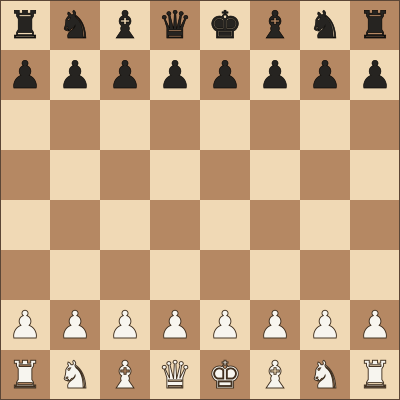
The strongest beginner-to-intermediate approach is not memorizing twenty moves deep. Learn the ideas: centre control, piece development, king safety, the pawn breaks that free your position, and the common tactical patterns. A player who understands why the moves are played will outperform one who has memorized a line but doesn't know the plan behind it every single time. Pick openings whose ideas you enjoy — you'll study them more, and that is what really builds a repertoire.
For White — a classical 1.e4 repertoire
The most instructive way to start: open lines, fast development, and direct play. Meet each of Black's main defenses with a principled system.
- Against 1…e5: the Italian Game (easiest) or the Ruy Lopez (most ambitious)
- Against the Sicilian: the Open Sicilian (main lines) or the Alapin 2.c3 for less theory
- Against the French: the Advance Variation (3.e5) — grab space, clear plan
- Against the Caro-Kann: the Advance Variation (3.e5) — the same space-grabbing idea
- Against the Pirc / Modern: build a big centre with d4, Nc3, Be3, Qd2 and consider castling long
One idea ties it together: control the centre, develop toward it, and use the Advance Variation against both the French and the Caro-Kann so you learn one structure that covers two openings.
Prefer to attack? Trade the quiet lines for the Romantic Gambits — the King's Gambit, the Evans, or the Danish — and play 1.e4 for the initiative instead of the squeeze.
For White — a simpler 1.d4 repertoire
If you want to spend your time on plans instead of memorization, a system-based 1.d4 repertoire is hard to beat.
- The London System against almost every setup — the same Bf4/e3/Bd3/Nbd2/c3 formation nearly every game
- The Queen's Gambit against 1…d5 if you want a more classical, central fight
- A King's Indian Attack-style setup (Nf3, g3, Bg2, 0-0, d3, Nbd2, e4) against flexible defenses — a reversed-KID plan you can steer into from several move orders
The London is the ultimate low-maintenance choice: learn the ideas once and you can play it against nearly anything Black tries.
For Black against 1.e4 — pick your style
Solid — Caro-Kann
1…c6. A sound structure and an active light-squared bishop. The lowest-risk way to meet 1.e4 — the "grandmaster's defense."
Classical — 1…e5
Meet the Italian and Ruy Lopez head-on. The most principled reply, and the one that teaches classical chess best.
Sharp — Sicilian
1…c5. The most ambitious defense — Black plays for the win with asymmetrical, double-edged positions.
Strategic — French
1…e6. Accept a little cramp for a rock-solid chain and clear pawn-break plans (…c5, …f6).
Hypermodern — Pirc / Modern
1…d6/…g6. Let White build a centre, then strike at it. Flexible and low-theory, but requires understanding.
For Black against 1.d4 — pick your style
Solid — Queen's Gambit Declined
The classical fortress. Almost impossible to break down — the backbone of championship Black play.
Flexible — Nimzo / Queen's Indian
1…Nf6 systems. Pin with …Bb4 or fianchetto with …b6 — active, principled, and hard to attack.
Sharp — King's Indian Defense
Cede the centre, then storm the kingside. The counterattacker's weapon of choice.
Dynamic — Grünfeld
1…Nf6 & 2…g6 with …d5. Invite a big White centre, then dismantle it with piece pressure. Concrete and modern.
Simple — Slav Defense
Support d5 with …c6 and keep the bishop free. Solid, reliable, and lower-theory than the Semi-Slav.
Unbalancing — Dutch Defense
1…f5. Grab kingside space and play for a win — the Leningrad, the Stonewall wall, or the Classical. The anti-drawing weapon against 1.d4.
Where to start — the best openings to learn first
You do not need all of these. Pick one for White and one for each of Black's replies, and grow from there.
As White
- Italian Game — the ideal first opening
- Ruy Lopez — when you want more
- Queen's Gambit — classical 1.d4
- London System — lowest theory
- English Opening — flexible 1.c4
As Black
- Caro-Kann against 1.e4 — solid and safe
- Queen's Gambit Declined against 1.d4
- Sicilian Defense if you want sharper games
- King's Indian Defense if you like to counterattack
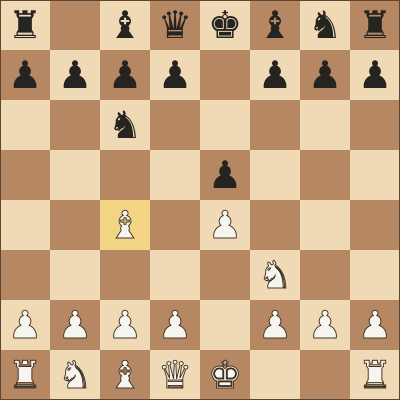
The Italian Game — the ideal first opening for White: natural, tactical, principled.
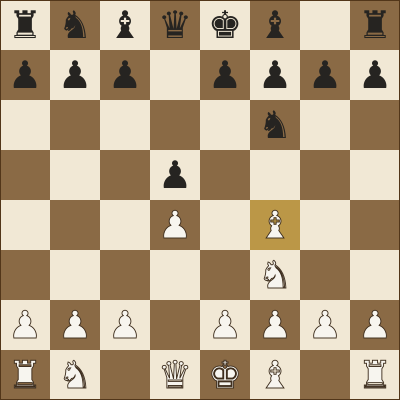
The London System — one setup against almost everything, minimal theory.
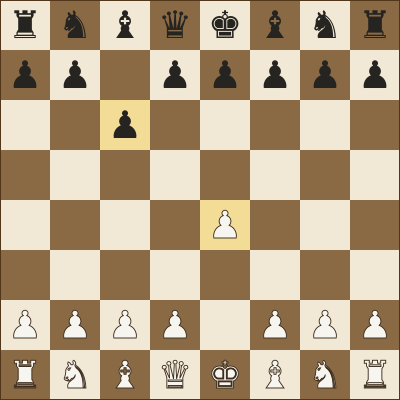
The Caro-Kann — a rock-solid, low-risk answer to 1.e4 for Black.
How to actually learn an opening
Do not memorize twenty moves deep. Learn the opening the way strong players do:
- 1. Learn the first 4–6 moves and why. What is each move fighting for — a square, a file, a piece?
- 2. Learn the pawn structure it leads to. The structure tells you the plans, the breaks, and the good squares. This matters more than exact move orders.
- 3. Know your one main plan. Where do your pieces belong? What pawn break are you aiming for (…c5, …d5, b4-b5, f4-f5)?
- 4. Play it — a lot. You learn an opening by playing it and reviewing what went wrong, not by reading about it.
- 5. Add theory only where you keep getting hit. Look up the exact line only after a game punishes you for not knowing it.
Then spend the rest of your study time on what actually decides games: tactics, checkmate patterns, pawn structures, and endgames. Openings get you to a playable middlegame; skill does the rest.
Frequently Asked Questions
A repertoire is your personal set of openings — what you play as White, and how you answer each of your opponent's main first moves as Black. A good repertoire is small and consistent: one opening for White and one reply to each major defense, all sharing similar ideas so you're not learning five unrelated systems at once.
For White, the Italian Game (or the London System if you want minimal theory). For Black, the Caro-Kann against 1.e4 and the Queen's Gambit Declined against 1.d4. These are sound, principled, and teach the fundamentals — centre control, development, and structure — without heavy memorization.
No. Beyond the first handful of moves, understanding beats memorization. Learn the typical pawn structure, where your pieces belong, and your main plan or pawn break. Add specific theory only when a game punishes you for not knowing it. Time spent on tactics and endgames pays off far more than deep opening prep.
The London System (1.d4 followed by Bf4, e3, Bd3, Nbd2, c3) is the easiest — you play nearly the same setup against almost anything Black does, so you can focus on plans instead of memorizing variations. The Italian Game is the easiest classical 1.e4 choice.
Both are excellent. 1.e4 leads to open, tactical positions that sharpen your calculation and teach direct play — often recommended first. 1.d4 leads to more strategic, system-friendly positions (like the London) with less forced theory. Try both and play the one whose games you enjoy more.