
The Queen's Gambit
1.d4 d5 2.c4 — the oldest and most classical way to contest the center. The Queen's Gambit is not truly a gambit at all: White offers the c4 pawn with every intention of recovering it. What it is, instead, is a positional weapon that has decided world championships and defined classical chess for over 150 years.
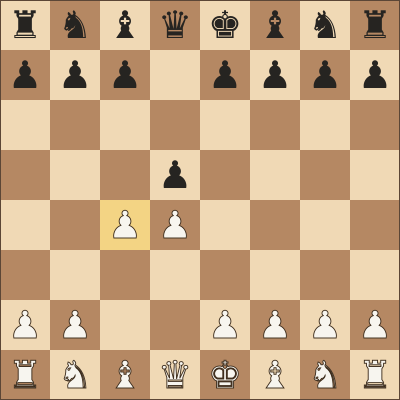
The Queen's Gambit begins with 1.d4 d5 2.c4 — White offers the c-pawn to lure Black's d5 pawn away from the center. Whether Black accepts or declines shapes everything that follows.
ECO Codes
D06–D69 — Queen's Gambit Declined · D20–D29 — Queen's Gambit Accepted · D10–D19 — Slav Defense
The Moves
1.d4 d5 2.c4 — White offers the c-pawn. Black chooses: accept (2...dxc4), decline (2...e6), or Slav (2...c6)
Origin
First analyzed in the Göttingen Manuscript (~1490). Popularized in tournament play by Chigorin and Marshall in the 1890s.
Famous Practitioners
Capablanca, Botvinnik, Karpov, Kasparov, Carlsen — the Queen's Gambit has been White's most durable elite weapon
Why it's not really a gambit
A true gambit offers material without expectation of recovery — like the King's Gambit (1.e4 e5 2.f4), where the f-pawn is genuinely sacrificed. The Queen's Gambit is different. If Black accepts with 2...dxc4, White plays 3.e3 (or 3.Qa4+, or 3.Nf3 followed by e3) and will recover the pawn with interest. Black cannot easily hold the c4 pawn.
What the Queen's Gambit actually does is force Black to make a positional choice. Accepting (2...dxc4) gives Black a temporary extra pawn but cedes central control. Declining (2...e6) keeps the d5 pawn but accepts a somewhat cramped position. The Slav (2...c6) supports d5 more flexibly but requires precise handling. Each choice creates a different type of game.
After 1.d4 d5 2.c4 — the Queen's Gambit offered
After 1.d4 d5 2.c4 — the Queen's Gambit. The highlighted c4 pawn is White's offer. Black must now choose: accept with 2...dxc4 (Queen's Gambit Accepted), decline with 2...e6 (QGD), or play 2...c6 (Slav Defense).
QGD Classical after 4.Bg5 Be7
After 1.d4 d5 2.c4 e6 3.Nc3 Nf6 4.Bg5 Be7 — the Queen's Gambit Declined Classical. White's Bg5 (highlighted) pins the f6 knight, pressuring Black's central defender. Black responds with Be7 (highlighted) to break the pin. The tension over the d5 pawn defines the middlegame — White will play Nf3, e3, and 0-0 before deciding whether to exchange on d5.
Accepted, Declined, or Slav
2...e6 — The Queen's Gambit Declined
The QGD is the most classical and fundamentally sound response. Black supports the d5 pawn with the e-pawn and develops solidly. The trade-off is the c8 bishop, which becomes locked behind the e6 pawn and must find its way out — typically via ...b6 and ...Bb7 in the Tartakower/Makogonov/Bondarevsky system. The QGD leads to rich positional battles where pawn structure and minor piece coordination are paramount.
2...dxc4 — The Queen's Gambit Accepted
Black accepts the pawn temporarily, knowing White will recover it. After 3.e3, White will play Bxc4 and develop actively. Black's compensation is faster piece development and the possibility of ...c5 to fight back in the center. The QGA is fashionable at all levels and leads to dynamic positions where Black's active piece play compensates for the temporary loss of center control.
2...c6 — The Slav Defense
The Slav supports the d5 pawn with the c-pawn rather than e-pawn, crucially keeping the c8 bishop's diagonal open. After 4...dxc4, Black accepts the pawn with better prospects of holding it, because the c-pawn is protected by ...c6. The Slav is one of the most solid defenses to the Queen's Gambit and was Anatoly Karpov's preferred weapon for decades.
The Semi-Slav (combining 2...c6 and 3...e6) reaches even richer territory, including the Botvinnik Variation (5.Bg5 dxc4 6.e4 b5!) — one of the most theoretically complex positions in chess. The Botvinnik leads to 30+ moves of forced play that has been analyzed for generations.
Key ideas in the Queen's Gambit
White's Plans
- Establish a strong d4-e3/e4 center
- Execute the minority attack: push b2-b4-b5 to undermine Black's c6-d5 pawn chain
- Use the c-file for rook pressure after the center trades
- Exploit the "bad" c8 bishop in QGD positions
- Play Ne5 to centralize and restrict Black's queenside counterplay
Black's Plans
- Free the c8 bishop via ...b6-Bb7 (Tartakower system)
- Counter in the center with ...c5 break at the right moment
- In the Slav, hold the c4 pawn and expand with ...b5-b4
- Activate pieces via the c-file after ...c5xd4 trades
- In the Semi-Slav Botvinnik, accept the complications of b5-c4 and pawn grabbing
The opening that defined classical chess
The Queen's Gambit has been part of chess theory since at least the late 15th century, appearing in the Göttingen Manuscript (~1490). But it was the great 20th-century classical players who made it the centerpiece of their repertoires.
José Raúl Capablanca
Capablanca's handling of the Queen's Gambit was legendary for its clarity and precision. His endgame technique in QGD positions — particularly the minority attack — was studied and copied by generations of grandmasters. The "Capablanca style" of converting small advantages in closed positions remains influential.
Anatoly Karpov
Karpov used the QGD and Slav Defense as Black throughout his reign as World Champion. His positional mastery in these structures — squeezing advantages with minimal material or pawn advantages — set a new standard for precision chess. Karpov's games in the QGD remain model examples of positional technique.
Magnus Carlsen
Carlsen uses the Queen's Gambit from both sides at the highest level. As White, he favors quiet, technical QGD systems that minimize Black's counterplay. As Black, he employs the Slav and QGA. Carlsen's record in QGD-type positions is exceptional — his patience and endgame technique in closed positions is unmatched in modern chess.
Queen's Gambit — FAQ
Is the Queen's Gambit actually a gambit?
Technically no. If Black accepts with 2...dxc4, White plays 3.e3 and recovers the pawn. A true gambit offers material without expectation of recovery — the Queen's Gambit is more accurately described as a "pawn offer" that exploits the structure rather than sacrificing material. It is named a gambit by historical convention, not chess logic.
What is the Queen's Gambit Declined?
The QGD arises when Black plays 2...e6, declining the c4 pawn and supporting d5 with the e-pawn. Black creates a solid but slightly cramped position. The main challenge is the c8 bishop, locked behind the e6 pawn, which must escape via ...b6-Bb7 in the Tartakower system. The QGD has been White's most analyzed and employed response to 1.d4 d5 for over a century.
What is the Slav Defense?
The Slav arises after 2...c6, supporting d5 with the c-pawn and crucially keeping the c8 bishop's diagonal open. Unlike the QGD (...e6 closes the bishop diagonal), the Slav allows ...Bf5 or ...Bg4 development. The Semi-Slav (adding ...e6) leads to the highly complex Botvinnik and Meran variations, which contain some of the deepest theoretical analysis in chess.
Why is the Queen's Gambit so popular after Netflix?
Netflix's 2020 miniseries "The Queen's Gambit" (based on Walter Tevis's 1983 novel) sparked a global chess revival. Chess.com reported millions of new sign-ups in the weeks following the premiere. Searches for "Queen's Gambit chess" surged worldwide. The show featured the 1.d4 opening prominently, introducing the concept to a massive new audience and dramatically increasing interest in chess as both a game and competitive activity.
What is the best response to the Queen's Gambit?
There is no single best response — all major defenses are theoretically sound. The QGD (2...e6) is the most classical and solid. The Slav (2...c6) is equally sound with more flexibility for the c8 bishop. The QGA (2...dxc4) is active and dynamic. The Nimzo-Indian (2...Nf6 3.Nc3 Bb4) is the most theoretically rich alternative for players who prefer piece-over-pawn battles.
Is the Queen's Gambit good for beginners?
Yes — it is one of the best openings for beginners on 1.d4. Plans are clear, logical, and teach fundamental positional concepts: center control, piece coordination, pawn structure, and the minority attack. The QGD requires less memorization than the Sicilian or King's Indian and rewards positional understanding over tactical calculation, making it ideal for developing players who want to build a solid foundation.
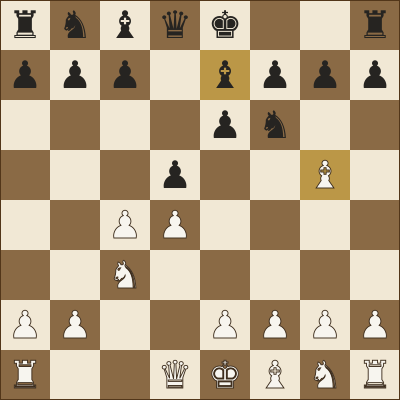
The QGD Classical (after 4.Bg5 Be7): a closed, strategic struggle where pawn structure and the tension over d5 — not early tactics — decide the outcome.
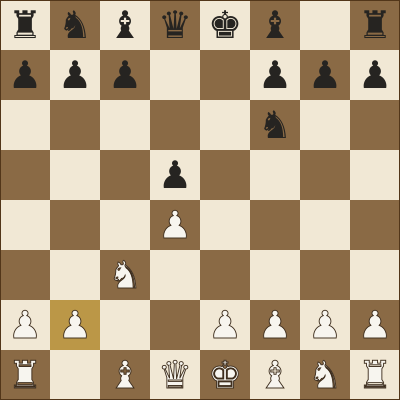
The Exchange Variation's Carlsbad structure (after 4.cxd5 exd5): White's minority attack with b4-b5 undermines Black's c-pawn — one of chess's most instructive positional motifs.
The starting offer — 1.d4 d5 2.c4. Capablanca, Karpov, and Carlsen all built their success on this position: three world champions across three eras, one opening.
- Geller, Y. & Nikitin, A. (1985). The Queen's Gambit. Batsford.
- Avrukh, B. (2010). Grandmaster Repertoire 2: 1.d4 Volume 2. Quality Chess.
- Karpov, A. (1987). Selected Games 1969–1977. Pergamon Press. (QGD model games.)
- Watson, J. (1997). Mastering the Chess Openings. Gambit Publications.
- Chess Informant Database — ECO D06–D69.
Seven opening guides — Ruy Lopez, Sicilian, Queen's Gambit, and more
Each opening guide includes a board diagram at the key position, strategic ideas for both sides, historical context, famous game references, and a complete FAQ section.