The Ruy Lopez
Named for a Spanish priest who analyzed it in 1561, the Ruy Lopez is the most played opening in high-level chess — three moves that set up a fight for the center, pressure on Black's e-pawn, and middlegames that have been contested at the highest level for five centuries.
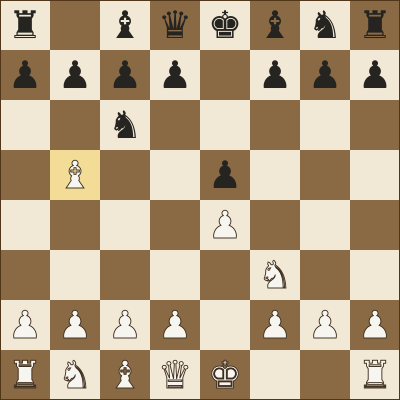
The Ruy Lopez arises after 1.e4 e5 2.Nf3 Nc6 3.Bb5. Three moves — and the stage is set for some of the most deeply analyzed and strategically rich positions in all of chess.
Three-part deep dive on the Spanish Opening
ECO Code
C60–C99 (dozens of named variations within this range)
The Moves
1.e4 e5 2.Nf3 Nc6 3.Bb5 — the "Spanish" bishop defines the opening
Origin
Analyzed by Ruy López de Segura in his 1561 treatise Libro de la Invención Liberal
Famous Practitioners
Fischer, Kasparov, Karpov, Anand, Carlsen — every world champion has played it
1.e4 e5 2.Nf3 Nc6 3.Bb5 — three moves, one complete plan
Every chess opening is a statement of intent. The Ruy Lopez states its intent immediately and completely in just three moves. Understanding what each move does — and why — is the foundation of everything that follows.
1.e4 — White opens with the king's pawn, staking a claim to the center. Fischer called this "best by test." It opens lines for the queen and king's bishop, and immediately occupies a central square with a pawn that is difficult to attack. Fischer played it almost exclusively as White throughout his career.
1...e5 — Black mirrors the move, establishing equal central presence. This is the most direct and most historically analyzed reply. Black controls d4, prepares to develop the kingside, and fights for the center symmetrically.
2.Nf3 — White develops a knight to its ideal square, attacks the e5 pawn immediately, and prepares to castle kingside. Every chess teacher will tell you this is a model developing move: it goes to a central square, it attacks something, and it contributes to king safety. There is no flaw in it.
2...Nc6 — Black defends the pawn with a developing move. The knight goes to its natural square and prepares Black's own development. Again, principled and strong.
3.Bb5 — this is the Ruy Lopez. The bishop lands on b5, apparently targeting the c6 knight — but the threat is more subtle than it looks. White is not immediately winning the e5 pawn. Instead, White has placed the bishop on an active square from where it will influence the game for many moves. It eyes the knight that defends e5, it prepares to castle, and it begins a long-term strategic pressure that will define the middlegame.
These three moves have been played millions of times at every level of chess, from club players to world champions. What makes the Ruy Lopez special is not the moves themselves but what they represent: a complete strategic plan carried out from the very first move.
After 3.Bb5 — the Ruy Lopez position
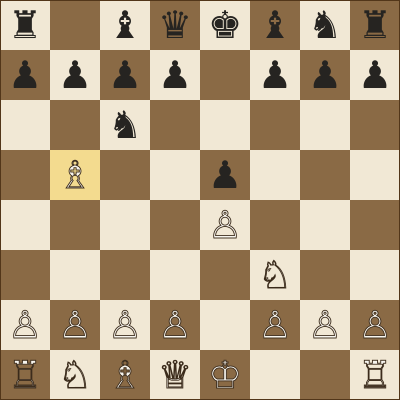
The position below shows the board after all three moves. The bishop on b5 (highlighted) sits on an active diagonal, eyeing the knight on c6 that defends Black's e5 pawn. Black's pawn on e5 and White's pawn on e4 create the central tension that will define the middlegame.
Position after 1.e4 e5 2.Nf3 Nc6 3.Bb5. The bishop on b5 (highlighted) eyes the c6 knight. Both sides have occupied the center with pawns and developed one piece each.
What White threatens (sort of)
If White plays 4.Bxc6, Black recaptures with the d-pawn — doubling the c-pawns but opening the d-file and getting the bishop pair. This trade is not obviously good for White. The real threat is more subtle: the bishop indirectly pressures e5 through the knight.
What Black's most common response is
After 3...a6 (the Morphy Defense), Black asks "are you going to take on c6?" White usually retreats with 4.Ba4, keeping the tension. This is the most common continuation and the starting point for the Closed Lopez and dozens of named systems.
What the Ruy Lopez is really about
The Ruy Lopez is not an attack. It is a set of strategic principles carried out across many moves. Understanding these ideas is what separates a player who knows the moves from one who understands the opening.
The indirect pressure on e5. The bishop on b5 does not directly threaten the e5 pawn — but it eyes the c6 knight that defends it. If the knight moves or is exchanged, e5 becomes harder to defend. This is the fundamental long-term pressure the Lopez exerts.
The d4 break. White's plan is to play d4 at some point, challenging the e5 pawn directly. The Lopez is built around executing this break effectively. White wants to push d4 when Black cannot take it without falling into a worse position. All the preparatory moves — c3, Bc2 or Ba2, Re1 — are about setting up d4 cleanly.
Structural advantages and the e-file. When the center clarifies, White often has pressure on the e-file with a rook on e1. Black's position tends to be cramped. The Lopez middlegame is a long squeeze — White restricts Black's counterplay, opens lines when favorable, and converts space into long-term advantage.
The bishop is not always safe. The bishop on b5 (or a4 after Black plays a6) is always potentially in danger from Black's …b5 advance. White has to time Ba2 or Bb3 carefully. The bishop is a long-term asset, but it requires management.
Kingside plans. White often builds kingside pressure while maintaining central tension — ideas like f4, Ng5, or building with g4 in aggressive systems. Black counters with queenside or central breaks. The resulting imbalances are the richest in chess.
From a Spanish priest to the world's best players
In 1561, Ruy López de Segura — a Spanish Catholic priest and chess enthusiast — published Libro de la Invención Liberal y Arte del Juego del Axedrez, the first major scientific study of chess strategy. In it, he analyzed the opening that now bears his name, arguing that 3.Bb5 applied pressure on Black's center while maintaining piece activity. For a book written 465 years ago, it holds up remarkably well.
The opening fell out of fashion in favor of gambit play during the 19th century. When the Romantic era of chess — characterized by sacrifices and direct attacks — gave way to the more positional approach of Wilhelm Steinitz and Siegbert Tarrasch in the 1880s and 1890s, the Ruy Lopez returned. Steinitz showed that the Lopez was not about immediate attack but about long-term strategic pressure. His ideas became the foundation of classical chess.
By the 20th century, the Lopez had become the most theoretically developed opening in chess. It was the weapon of champions: a fixture of world championship play through the era of Emanuel Lasker and José Raúl Capablanca, and employed extensively by Boris Spassky and Tigran Petrosian. Bobby Fischer refined the Ruy Lopez theory more than any other player of his era, adding new ideas to both sides and calling 1.e4 "best by test" in his famous declaration.
Garry Kasparov and Anatoly Karpov contested the Lopez through five World Championship matches — the most deeply analyzed chess rivalry in history. Today, Magnus Carlsen, Fabiano Caruana, and virtually every top-10 player plays the Ruy Lopez on both sides of the board. The opening has never stopped evolving.
Five centuries at the top
Bobby Fischer
Fischer's 1972 World Championship match against Boris Spassky featured the Ruy Lopez extensively. Fischer's contributions to Lopez theory — including his refinements of the Closed Variation as both colors — were massive. He said he never stopped believing in 1.e4.
Garry Kasparov
Kasparov contested five World Championship matches against Karpov, with the Ruy Lopez appearing repeatedly. His preparation was famous for novelties buried deep in theory — sometimes on move 20 or beyond. He and his team's Lopez analysis filled entire books.
Magnus Carlsen
Carlsen uses the Ruy Lopez regularly, often going into the endgame with only a tiny edge and outplaying opponents from there. His Lopez games are studies in patience — slight pressure, converted over dozens of moves. He epitomizes the long-squeeze approach.
Why the Ruy Lopez rewards study
The Ruy Lopez is demanding. It requires understanding strategic ideas — not just move sequences — and the theory tree is enormous. So why play it? Because it teaches you chess. More than perhaps any other opening, studying the Ruy Lopez forces you to understand what every move accomplishes, what plans the pawn structure supports, how piece activity relates to pawn tension, and how to convert small advantages in the endgame. Players who master the Lopez become better chess players generally.
For White players
The Lopez gives you long-term pressure from move three, rich strategic middlegames with many plans available, and the opportunity to outplay opponents over many moves even from equal positions. It punishes passive play severely and rewards strategic understanding. It scales: the same opening works at club level and world championship level.
For Black players
Playing the Ruy Lopez as Black teaches you how to handle long-term pressure, how to generate counterplay in cramped positions, and how to find active piece play when your space is restricted. The variations — especially the Marshall Attack and the Open Lopez — offer sharp counterplay for players who want to fight for the initiative rather than equalize and defend.
What comes after 3.Bb5: the theory branches
After 3.Bb5, Black has many responses. The most common is 3...a6 (the Morphy Defense), which asks White directly: will you take on c6? From there, the theory branches into systems that will be covered in Part 2 of this series. Below is a brief orientation to the main lines.
Berlin Defense — 3...Nf6
One of the most important opening choices in modern chess. After 4.0-0 Nxe4 5.d4 Nd6 6.Bxc6 dxc6 7.dxe5 Nf5 8.Qxd8+, an endgame arises that has been contested at the world championship level many times. Vladimir Kramnik used it to neutralize Kasparov's 1.e4 in their 2000 World Championship match — Kasparov could not win a single Berlin game and abandoned 1.e4 as the match wore on. The Berlin is heavily studied and deeply strategic.
Morphy Defense, Closed — 3...a6 4.Ba4 Nf6
The most popular continuation. After castling and further development, White builds with c3-d4, Re1, and Bc2. The position becomes the "Closed Lopez" — a long strategic battle where White squeezes slowly and Black looks for counterplay with ...d5 or queenside expansion. This is the main line of Ruy Lopez theory.
Open Lopez — 3...a6 4.Ba4 Nf6 5.0-0 Nxe4
Black accepts the challenge, takes the e4 pawn, and invites complications. After 6.d4 b5 7.Bb3 d5 8.dxe5 Be6, the position is extremely complex and both sides must navigate sharp tactical waters. The Open Lopez is a legitimate weapon for Black players who want to take the game out of normal channels.
Marshall Attack — 3...a6 4.Ba4 Nf6 5.0-0 Be7 6.Re1 b5 7.Bb3 0-0 8.c3 d5
Black delays the standard Closed Lopez setup and instead sacrifices a pawn for long-lasting initiative and attacking chances. Frank Marshall prepared this idea for years before springing it on Capablanca in 1918. Today it remains one of the most deeply analyzed gambits in chess — and one of the most dangerous.
These four lines — the Berlin, the Closed, the Open, and the Marshall Attack — account for the vast majority of Ruy Lopez games at the top level. Each will be covered in detail in Part 2 (Intermediate), including the key move sequences, critical moments, and strategic plans for both sides.
The atmosphere of chess
Opening position
The first moves of the Ruy Lopez begin a strategic battle that can last 60 or more moves and requires understanding plans, not just sequences.
Knight and bishop
The interaction between White's bishop on b5 (or later a4) and Black's knight on c6 is the defining tension of the early Lopez. Every player of the opening knows this relationship intimately.
The long game
Ruy Lopez games often go deep into the endgame. The strategic pressure White builds from move three can take 50 moves to convert — or Black can find counterplay and equalize. This is chess at its richest.
Primary references for this overview: Ruy López de Segura, Libro de la Invención Liberal y Arte del Juego del Axedrez (1561); John Nunn, Nunn's Chess Openings; Garry Kasparov, My Great Predecessors series (Volumes 1–5); Bobby Fischer, My 60 Memorable Games (1969); Andrew Soltis, Ruy Lopez: Move by Move; game databases from Lichess and Chess.com; and ECO classification Volume C.
Ruy Lopez — Three-Part Deep Dive
Every opening belongs to a family — browse the three theme clusters: Romantic & Attacking Gambits · Flank & Hypermodern Systems · Solid Defenses.
More chess openings
Continue through the chess openings section — the Ruy Lopez is the first in a series of opening deep dives covering the Sicilian Defense, Queen's Gambit, King's Indian, and more.