
The Sicilian Defense
The most played chess opening response to 1.e4. When Black answers with 1...c5, the entire character of the game changes — an asymmetrical struggle begins, where Black fights for a win rather than equality. From Fischer's Najdorf to Tal's attacking Sicilians, the Sicilian has been the proving ground for the world's greatest attacking players.
Dedicated deep dives: Accelerated Dragon & the Maróczy Bind, Taimanov & Kan systems, and the Sveshnikov & Kalashnikov.
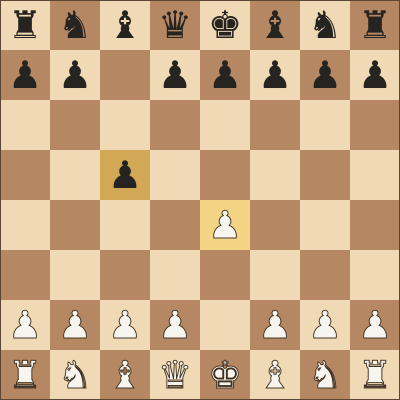
The Sicilian Defense begins with 1.e4 c5 — two moves that establish a fundamentally unbalanced position from the first moments of the game. Black stakes out territory on the queenside while White fights for the center.
ECO Code
B20–B99 — the largest ECO range of any chess opening, reflecting its many variations
The Move
1.e4 c5 — Black immediately fights for the center asymmetrically without mirroring White
Search Volume
The most searched chess opening online — 40,000+ monthly searches globally across all major variations
Famous Players
Fischer, Kasparov, Tal, Polgar, Carlsen — nearly every World Champion has championed the Sicilian
Why 1...c5 instead of 1...e5?
The fundamental idea behind the Sicilian Defense is asymmetry. When Black plays 1...e5 (the Open Game), both players have a symmetrical position and roughly equal chances from the start. When Black plays 1...c5, the game becomes fundamentally different: Black fights for the d4 square without committing to a mirror of White's position.
The c5 pawn controls d4 but leaves Black with an asymmetrical pawn structure. White typically responds with 2.Nf3 followed by 3.d4, exchanging the d-pawn for Black's c-pawn. Black recaptures with a piece (usually the knight after 3...cxd4 4.Nxd4), and the position becomes fundamentally unbalanced: White has more central space with the e4 pawn, but Black has a half-open c-file and potential queenside counterplay.
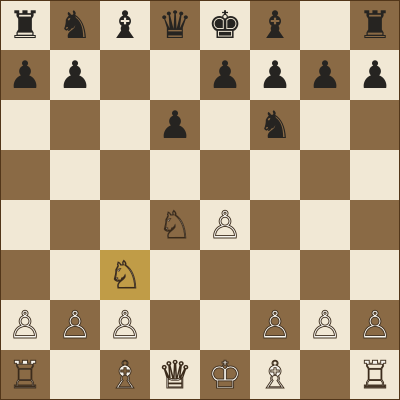
This position — after 5.Nc3 — is the starting point for most major Sicilian variations. Black now chooses between the Najdorf (5...a6), Dragon (5...g6), Scheveningen (5...e6), and Classical (5...Nc6).
After 1.e4 c5 2.Nf3 d6 3.d4 cxd4 4.Nxd4 Nf6 5.Nc3
This is the Open Sicilian starting position — the main crossroads where Black must choose a variation. White has a powerful center with e4 and a knight on d4. Black has the open c-file and a flexible pawn structure. Everything now depends on Black's 5th move choice.
After 1.e4 c5 2.Nf3 d6 3.d4 cxd4 4.Nxd4 Nf6 5.Nc3 — the Open Sicilian crossroads. White's knight on d4 (highlighted) controls the center. Black's response on move 5 determines the entire variation: 5...a6 (Najdorf), 5...g6 (Dragon), 5...e6 (Scheveningen), or 5...Nc6 (Classical).
Najdorf Sicilian — 5...a6
After 1.e4 c5 2.Nf3 d6 3.d4 cxd4 4.Nxd4 Nf6 5.Nc3 a6 — the Najdorf Sicilian. Black's a6 (highlighted) is one of the most studied moves in chess theory. It prevents Nb5 while preparing b5, Be7, and queenside expansion. White's knight on d4 (highlighted) controls the center. From here: 6.Bg5 (Classical), 6.Be3 (English Attack), or 6.Bc4 (Fischer-Sozin).
Najdorf, Dragon, Scheveningen, Classical
5...a6 — The Najdorf Variation
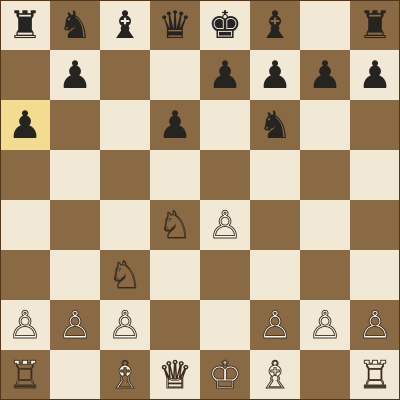
The most popular and theoretically complex Sicilian variation, named for Argentine-Polish grandmaster Miguel Najdorf. The move 5...a6 prevents Nb5, prepares ...b5, and keeps Black's options flexible. Fischer called it his "favorite opening" and used it to demolish opponents throughout his career. Kasparov built his entire World Championship career around the Najdorf.
After 5...a6, White's most dangerous response is the English Attack (6.Be3 with f3, g4 later) or the Classical (6.Bg5). Each path leads to enormous theoretical complexity that has been mapped for decades.
5...g6 — The Dragon Variation
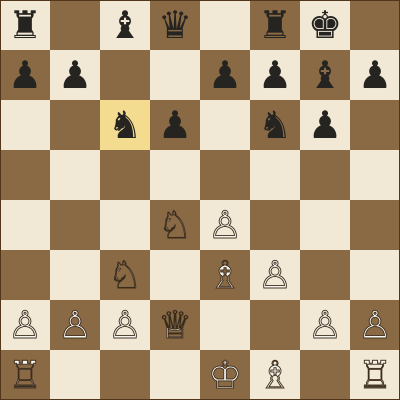
The Dragon gets its name from the pawn structure Black creates — the kingside pawns form the shape of a dragon. Black fianchettoes the bishop to g7, creating a powerful long diagonal aimed at the center. White's most aggressive reply is the Yugoslav Attack, with White attacking on the kingside while Black counterattacks on the queenside after castling opposite sides. Games are often decided by who gets there first.
5...e6 — The Scheveningen Variation
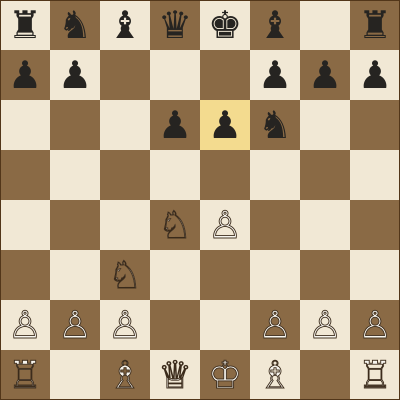
The Scheveningen (named for a Dutch city where it was popularized in 1923) establishes a solid defensive setup with pawns on d6 and e6. Black creates a compact "small center" and plans to fight back with ...a6 and ...b5 on the queenside or ...d5 in the center at the right moment. It is flexible — the Scheveningen can transpose into Najdorf or Kan structures — and suitable for players who want options rather than forcing lines.
5...Nc6 — The Classical Variation
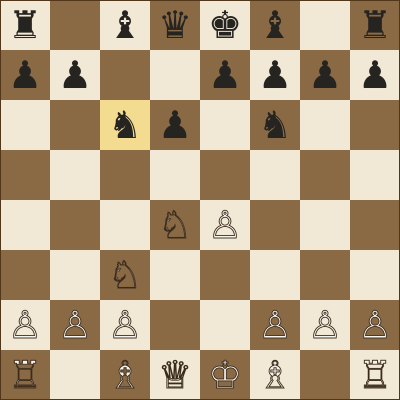
The Classical Sicilian develops the queen's knight immediately, creating threats against the Nd4 and pressuring the center. It is one of the oldest Sicilian systems and remains fully viable. The Richter-Rauzer Attack (6.Bg5) is White's sharpest reply. The Classical leads to rich positional fights and is an excellent starting point for players learning the Sicilian for the first time.
The Sicilian's key ideas for both sides
Black's Plan
Black's primary counterplay is on the queenside. After the c-pawn is exchanged, Black has a half-open c-file for a rook, and pawns ready to advance on the b and c files. Black aims to attack White's queenside and center while deflecting White's kingside ambitions.
- Use the half-open c-file for rook activity
- Advance ...a5 and ...b4 to attack White's queenside
- Time the central break ...d5 or ...e5 carefully
- In Dragon lines, attack down the g-file after ...g5-g4
White's Plan
White has more space in the center with the e4 pawn, and the extra central control translates into attacking chances. White aims to attack the Black king — often with a kingside pawn advance or a piece attack — before Black's queenside counterplay becomes decisive.
- Maintain the e4-d4 center or transition to e4-e5 advance
- Launch a kingside attack with f4-f5 or g4-g5
- Use the d5 square for a strong central knight
- In the Najdorf, play Bg5-Bxf6 to weaken Black's structure
Five centuries of the Sicilian Defense
The Sicilian was first recorded in 1594 by Giulio Polerio, who analyzed games played in Rome and Spain. For centuries it was considered too passive, but the 20th century revealed its true potential — an opening where Black not only equalizes but genuinely fights for the win.
Bobby Fischer
Fischer played the Najdorf almost exclusively and considered it the best weapon against 1.e4. His collected Sicilian games — particularly his preparation in the 1960s and 1970s — remain foundational study material. Fischer's handling of the Bg5 systems was legendary.
Garry Kasparov
Kasparov's career was built on the Sicilian. He used the Najdorf and Scheveningen in virtually every World Championship match, amassing a record of Sicilian wins that dwarfs any other player in history. His deep theoretical preparation in the sharpest lines set the standard for modern opening preparation.
Mikhail Tal
Tal — the "Magician from Riga" — was the master of the Dragon Variation. His sacrificial attacks in the Dragon remain some of the most spectacular games ever played. Tal's World Championship win in 1960 was largely built on the fire of Sicilian complications that Botvinnik could not handle.
Sicilian Defense — FAQ
Why is the Sicilian Defense so popular?
The Sicilian creates an asymmetrical position from move one. Instead of mirroring White, Black's 1...c5 fights for the center without surrendering the initiative. This asymmetry gives Black genuine winning chances from the very start, making the Sicilian the top choice for players who want to fight for a win with the Black pieces rather than settle for a draw.
What is the Najdorf Variation of the Sicilian?
The Najdorf arises after 1.e4 c5 2.Nf3 d6 3.d4 cxd4 4.Nxd4 Nf6 5.Nc3 a6. Black's 5...a6 prevents Nb5 and prepares queenside expansion with ...b5. It's the most complex and theoretically demanding Sicilian variation — Fischer and Kasparov both relied on the Najdorf as their primary weapon against 1.e4 throughout their careers.
What is the Dragon Variation in chess?
The Dragon arises after 5.Nc3 g6, with Black fianchettoing the bishop on g7. The name comes from the pawn structure, which resembles a dragon. The Yugoslav Attack (6.Be3 Bg7 7.f3) leads to ultra-sharp play with opposite-side castling and mutual attacks — White assaults the Black king, Black attacks White's queenside. It is among the most tactical and theoretically complex openings in existence.
Is the Sicilian Defense good for beginners?
The basic Sicilian concept is accessible, but the sharp variations (Najdorf, Dragon) require significant theory. Beginners can start with the Classical Sicilian (5...Nc6) or the Scheveningen (5...e6), which offer natural development and solid middlegame positions without demanding memorization of long forcing lines. Graduate to the Najdorf or Dragon once you have a solid foundation.
What is the difference between the Open and Closed Sicilian?
The Open Sicilian occurs when White plays 2.Nf3 followed by 3.d4 — exchanging pawns to open the d-file and fight for the center actively. This leads to most of the sharp theoretical variations. The Closed Sicilian (2.Nc3 followed by g3 and Bg2) avoids the pawn exchange entirely, leading to slower, maneuvering positions. The Closed is less theoretical but gives Black a solid game.
Who are the most famous Sicilian Defense players?
Bobby Fischer and Garry Kasparov are the greatest Sicilian players in history. Fischer's Najdorf and Kasparov's preparation in the sharpest lines set standards that still define modern Sicilian theory. Mikhail Tal mastered the Dragon, and Magnus Carlsen continues to employ Sicilian variations at the top level, proving the opening remains as competitive as ever.
The Sicilian's pawn structure after the d4-c5 exchange creates the battleground: White's central space against Black's half-open c-file.
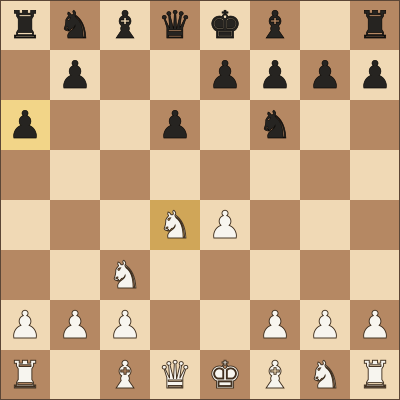
In the Najdorf and Dragon, tactical complications begin as early as move 10. Deep preparation and accurate calculation are the hallmarks of successful Sicilian play.
Garry Kasparov's mastery of the Sicilian set the standard for modern chess. His 5,000+ Sicilian games remain the ultimate study resource for ambitious players.
- Fischer, R. (1969). My 60 Memorable Games. Simon & Schuster. (Numerous Sicilian/Najdorf games annotated.)
- Kasparov, G. (2003–2006). My Great Predecessors, Vols. I–V. Everyman Chess.
- Emms, J. (2005). Starting Out: The Sicilian. Everyman Chess.
- Bologan, V. (2010). The Sicilian Scheveningen. New In Chess.
- Chess Informant Database — ECO B20–B99.
Every opening belongs to a family — browse the three theme clusters: Romantic & Attacking Gambits · Flank & Hypermodern Systems · Solid Defenses.
The Sicilian Defense is one of seven openings covered on this site
From the Ruy Lopez to the Queen's Gambit, each opening guide includes board diagrams, strategic ideas, history, famous games, and a full FAQ section.