
Romantic & Attacking Gambits
Give up material for time, open lines, and a direct attack on the king — the creed of the romantic era. The King's Gambit, the Evans Gambit, and the Danish Gambit, gathered in one place, with the players who made them immortal.
A pawn is currency —
spend it for tempo,
open lines, and attack.
King's Gambit (2.f4)
Evans Gambit (4.b4)
Danish Gambit (2.d4)
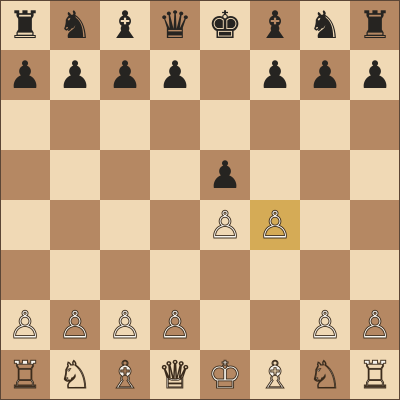
Most opening libraries file the King's Gambit under "1.e4 e5," the Evans under "Italian," and the Danish under "open games" — scattering three openings that share one soul. Grouped together, they tell a story: the romantic era's belief that the initiative is worth more than a pawn. Learn them as a family and each one reinforces the others — the same instincts for development, sacrifice, and attack carry across all three, and across the games of the champions who played them.
Chess as it was meant to be played
For most of the 19th century, chess had one guiding creed: attack. Material was a currency to be spent, not hoarded. Players offered pawns — sometimes whole handfuls of them — to rip open lines, seize the initiative, and hunt the enemy king. This was the romantic era, and its openings still carry that spirit. A gambit is a promise: I will give you material; you will give me time and open lines; and we will see whose attack lands first.
These openings are not the way to squeeze out a half-point against a grandmaster. They are the way to fall in love with chess — to learn, in the most vivid way possible, what development, initiative, and king safety really mean. And every one of them can still bite a modern opponent who defends imprecisely.
The Three Great 1.e4 e5 Gambits
The King's Gambit
1.e4 e5 2.f4
The grandest of them all. White offers the f-pawn on move two for rapid development, the open f-file, and a direct kingside assault. Spassky, Bronstein, and Tal all wielded it. A three-part deep dive.
The Evans Gambit
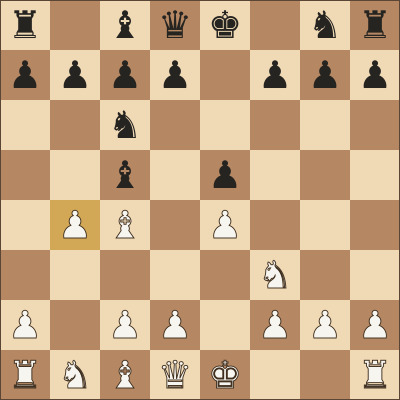
1.e4 e5 2.Nf3 Nc6 3.Bc4 Bc5 4.b4
A wing pawn for a tempo, a big centre, and both bishops aimed at f7. Morphy and Anderssen's weapon — and the gambit Kasparov used to beat Anand in 1995.
The Danish Gambit
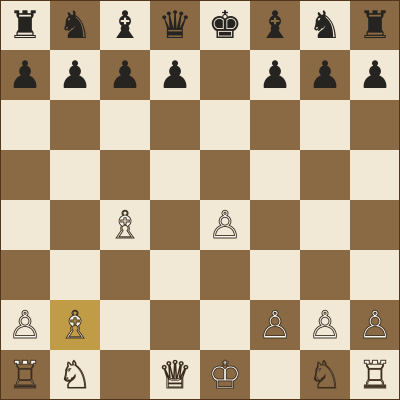
1.e4 e5 2.d4 exd4 3.c3
Two pawns for two raking bishops on the long diagonals. The purest gambit of all — attack or bust — with a modern ...d5 antidote every attacker should know.
The players who made them immortal
Paul Morphy
The first modern genius played the open games and their gambits with a clarity no one had seen before — rapid development and open lines, decades ahead of his time. The Opera Game is the romantic era's calling card.
Mikhail Tal
A century later, the "Magician from Riga" carried the romantic flame into the modern age — sacrifices that defied calculation, beauty as a weapon. Tal proved the attacking spirit never died; it just went deeper.
See the full sweep of attacking players in the Champions of Chess hub.
How to use the gambits
Pick one and play it relentlessly. You will lose some games to accurate defence — that is the tuition fee, and it is worth every point. In exchange you will develop the single most valuable skill in practical chess: the feel for initiative, the instinct for when activity outweighs material. Then read the honest verdicts on each page so you know exactly where the theory bites back. When you want the quiet, solid side of the coin, the Simple Repertoire Ideas page lays out sound, low-risk alternatives for both colours.
Frequently Asked Questions
Romantic gambits are attacking openings from the 19th-century 'romantic era' of chess, where players sacrificed material — especially pawns — to gain rapid development, open lines, and a direct attack on the king. The classic examples are the King's Gambit (2.f4), the Evans Gambit (4.b4), and the Danish Gambit (2.d4 followed by c3). They prize initiative over material.
Yes, especially at club and blitz level, though top players usually meet them with prepared, accurate defences that return material to neutralize the attack. As practical weapons and as the best way to learn attacking chess, they remain valuable and enormously fun. Kasparov even revived the Evans Gambit to beat Anand in 1995.
The King's Gambit is the richest and most respected, with the deepest theory. The Evans Gambit is arguably the soundest of the three and has elite pedigree. The Danish Gambit is the simplest and most direct — great for a first attacking weapon. Any of them will sharpen your feel for initiative; pick the one whose games excite you most.
Paul Morphy and Adolf Anderssen defined the romantic era with brilliant attacking play; Mikhail Chigorin was a great theorist and practitioner of gambits like the Evans. In the modern age, Mikhail Tal carried the romantic, sacrificial spirit into world-championship chess, and Garry Kasparov revived the Evans Gambit at the elite level.
Against well-prepared strong players, most romantic gambits are equalized by accurate defence — the opponent returns the material and neutralizes the attack. Their value is practical: they create sharp, unfamiliar positions where a single imprecise move can be fatal, and they build the attacking intuition that helps in every opening you play.