
Slav & Semi-Slav Defense
The most theoretically dense Queen's Gambit systems — Slav (2...c6), Meran Variation, Anti-Meran, Moscow Variation, and the razor-sharp Botvinnik System. Complete coverage from both sides.
Slav: D10–D19
Semi-Slav: D43–D49
Botvinnik: D44
The c-pawn supports d5
so the light bishop
can develop freely.
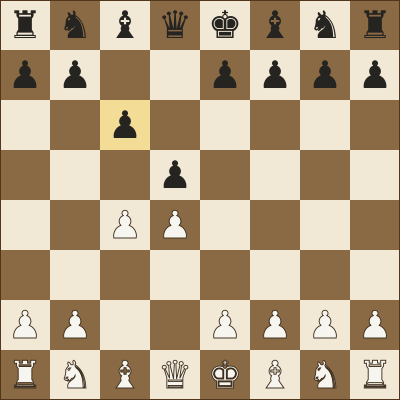
The Queen's Gambit Declined (1.d4 d5 2.c4 e6) has one structural problem: after ...e6, Black's light-squared bishop is locked behind its own pawn chain. This "bad bishop" can be a serious disadvantage in endgames and some middlegames. The Slav Defense (2...c6 instead of 2...e6) solves this: by supporting d5 with the c-pawn, Black keeps the e6-square free — or can develop the bishop to f5 or g4 before closing the position. This single conceptual innovation made the Slav Defense one of the most important responses to 1.d4 in the entire history of chess.
The Slav Defense: 2...c6
After 4...dxc4, Black captures the c-pawn before White can recapture with e3. This is the key Slav structure: Black has captured c4 and will typically follow with 5...a6 and 6...b5 to hold the pawn temporarily, or play 5...Bf5 developing the bishop before White closes it in. The choice between these plans defines the major Slav variations.
The Bf5 plan is the purest Slav — Black develops the light-squared bishop to f5 (outside the pawn chain!) before White can prevent it with e3. After 6...e6, Black has achieved what was impossible in the QGD: the bishop on f5 is actively developed, not buried. This gives Black an excellent piece and a very solid position. White's compensation for giving up the c4-pawn is the advanced a4 pawn and some space, but Black is generally comfortable.
The Chebanenko Slav (4...a6) is a modern, aggressive system where Black prepares ...b5 queenside expansion immediately. Named after Soviet trainer Vyacheslav Chebanenko, it was heavily employed by Ivanchuk and other modern GMs. Black's plan is straightforward: expand on the queenside with ...b5-b4 while maintaining the solid pawn structure. White typically responds with a3, preventing ...b4, then fights for space in the center.
Slav — White's Key Plans
- After 4...dxc4: try to recover the pawn quickly with e3/Bxc4
- After 4...a6 (Chebanenko): play a3 to prevent ...b4
- After 4...Bf5: play e3 normally and contest the c5 square
- The Exchange Slav (cxd5 cxd5) is a drawing weapon — avoid if playing for win
- The Slav Gambit (5.e4) sacrifices a pawn for rapid development
Slav — Black's Key Plans
- Develop the light bishop to f5 before ...e6 closes it in
- After capturing c4: hold with ...a6-...b5 or give it back for activity
- Chebanenko: immediate ...a6-...b5 queenside expansion
- The isolated d5-pawn is the key tension in many lines
- In endgames: the active light bishop is a major asset
The Semi-Slav: Adding ...e6
After 1.d4 d5 2.c4 c6 3.Nf3 Nf6 4.Nc3 e6 5.Bg5 — the Anti-Meran/Botvinnik tabiya (Bg5 highlighted). White pins the Nf6 immediately, leading to the most forcing Semi-Slav lines. Black must now choose between accepting material imbalances (5...dxc4) or maintaining the tension.
The Semi-Slav combines 2...c6 and 4...e6 — getting the solidity of the QGD (two center pawns supported) with the flexibility of the Slav (c6 available for future use). The light-squared bishop is temporarily blocked by e6, but Black accepts this in exchange for the very solid pawn structure. The Semi-Slav leads to the most theoretically rich Queen's Gambit positions.
The Meran Variation: 5.e3 Nbd7 6.Bd3 dxc4
The Meran is the main line of the Semi-Slav after White plays 5.e3. After 6...dxc4 7.Bxc4 b5, Black has grabbed the c4-pawn and extended queenside space with b5. White must now either attack immediately or recover the pawn while keeping initiative. The Meran is one of the most analyzed opening systems in chess history.
White has many aggressive tries in the Meran. The Reynolds Attack features White sacrificing material to open the position dramatically. The Romanov Gambit allows Black to consolidate the extra pawn while White gets piece activity. All Meran lines share the same character: sharp, forcing, requiring precise calculation from both sides.
The Meran has been played at every level of chess for over 100 years. Every position has been analyzed exhaustively by the world's strongest players and engines. In World Championship preparation, Meran lines were studied to move 30 and beyond. For club players, the key is not to memorize everything but to understand the strategic themes: Black's queenside pawn majority, White's central space advantage, and the typical kingside attacks that White can create with pawn advances. Understanding beats memorization at the club level.
The Anti-Meran & Botvinnik System: 5.Bg5
Instead of the quieter 5.e3, White plays 5.Bg5 immediately, pinning the Nf6 and setting up the Botvinnik System. After 5...dxc4 6.e4 b5 7.e5 h6 8.Bh4 g5, Black attacks the bishop with pawns — a completely uncompromising approach. After 9.Nxg5 hxg5 10.Bxg5, both sides have weaknesses: Black's kingside pawns are fractured, White has given up a piece temporarily for massive attacking compensation.
The resulting positions are some of the most analyzed in chess history — Kasparov used the Botvinnik System regularly as White in his World Championship matches, particularly in the famous 1985 and 1986 matches against Karpov. The positions require deep preparation from both sides.
The Moscow Variation (6.Bxf6) and the Anti-Moscow Gambit (6.Bh4) are the two major branches after 5.Bg5 h6. In the Moscow, White gives up the bishop pair to avoid the very sharpest theory while keeping structural pressure. In the Anti-Moscow Gambit, White keeps the bishop on h4 and sacrifices the c4-pawn for a big centre and attacking chances — extremely complex positions that were the main battleground at elite level in the 2000s and 2010s.
Botvinnik Main Line: 6...b5!
The Botvinnik main line is defined by the audacious 6...b5 — after taking the c4-pawn with 5...dxc4, Black immediately grabs more queenside space and creates chaos. The position after 7.e5 h6 8.Bh4 g5 is famous for its sheer violence: Black attacks the bishop with h6 and g5 pawn advances, completely loosening the kingside. After 9.Nxg5, White sacrifices a piece for attacks — positions that require engine-level preparation to navigate correctly.
Botvinnik Main Line — White's Compensation
- After Nxg5 hxg5 Bxg5, White has two pawns for the knight
- More importantly: Black's kingside is shattered
- White's pieces can flood through the open h-file
- The e5 pawn cramps Black's Nf6
- World Championship preparation has mapped every line
Botvinnik Main Line — Black's Defense
- 10...Nbd7 is the main defense — develop and protect
- The a-pawn is Black's secret weapon — ...a5-a4 queenside expansion
- Black's extra piece must coordinate before White opens the position
- The f6 square becomes a weakness after Nxg5
- Correct defense requires very specific move order knowledge
Slav vs. Semi-Slav: Which to Play?
| System | Bishop | Theory Load | Style | Best For |
|---|---|---|---|---|
| Pure Slav (2...c6, 4...Bf5) | Develops actively to f5 | Medium | Solid, active | Players who want the solid QGD structure without the bad bishop |
| Chebanenko Slav (4...a6) | Develops to f5 after ...b5 | Medium | Aggressive, queenside | Players who like Sicilian-style queenside counterplay in 1.d4 openings |
| Meran Semi-Slav (5.e3 lines) | Temporarily blocked, then active | Very High | Complex, balanced | Players who can handle deep theoretical positions and want dynamic equality |
| Botvinnik/Anti-Moscow (5.Bg5 lines) | Blocked but irrelevant — position is tactical | Extreme | Tactical, forcing | Players who enjoy the sharpest positions and have deeply prepared the lines |
Champions of the Slav and Semi-Slav
Mikhail Botvinnik — The System's Founder
Botvinnik's analytical contribution to the Semi-Slav was enormous — he developed and refined the attacking system that bears his name (the 5.Bg5 pawn sacrifices) through deep home preparation. His games from the 1940s–50s established the template for how White plays in these positions. But Botvinnik also played these positions as Black, having a complete two-sided understanding of the system.
Kasparov & Kramnik — The 5.Bg5 Battle
The Kasparov-Kramnik rivalry featured some of the most deeply prepared Semi-Slav games in history. Kasparov played the Botvinnik System as White; Kramnik found defensive ideas as Black. Their encounters in the late 1990s and early 2000s pushed the theoretical frontier of the Anti-Moscow and Botvinnik positions to unprecedented depth, making this one of the most studied opening battles in modern chess.
Frequently Asked Questions
1.d4 d5 2.c4 c6 — Black supports d5 with the c-pawn instead of ...e6. The key advantage: the light-squared bishop can develop to f5 or g4 before being closed in. This solves the fundamental problem of the QGD (the "bad bishop" on c8). The Slav is solid, active, and has been used by virtually every World Champion. Black's typical plans are ...Bf5 development, or capturing ...dxc4 and holding the pawn with ...a6-...b5.
The Meran arises after 1.d4 d5 2.c4 c6 3.Nc3 Nf6 4.Nf3 e6 5.e3 Nbd7 6.Bd3 dxc4 7.Bxc4 b5. Black takes the c-pawn and immediately expands with b5. White must respond aggressively (e4, e5 pawn center) or accept Black's queenside expansion. The Meran has been analyzed to extreme depth — it's one of the most theoretical opening systems in chess, with forced play extending to 20+ moves in many variations.
After 5.Bg5, White avoids the quiet Meran and immediately pins the Nf6. After 5...dxc4 6.e4 b5 7.e5 h6 8.Bh4 g5 9.Nxg5 hxg5 10.Bxg5, a piece sacrifice leads to positions of extreme complexity. Kasparov used this as his primary weapon as White in World Championship matches. The positions require deep specific preparation from both sides — general principles are insufficient.
The real Marshall Gambit of the Semi-Slav is 1.d4 d5 2.c4 c6 3.Nc3 e6 4.e4!? dxe4 5.Nxe4 Bb4+ (ECO D31) — White offers a centre pawn for rapid development, and after 6.Bd2 Qxd4 the position sharpens immediately. It is often confused with the Botvinnik main line (5.Bg5 dxc4 6.e4 b5, covered above), which is a Black pawn-grab rather than a White gambit. Both demand very specific preparation.
After 5.Bg5 h6 (Black challenges the bishop immediately), White can play 6.Bxf6 (Moscow Variation — exchanging, solid) or 6.Bh4 (Anti-Moscow Gambit — keeping the bishop and sacrificing the c4-pawn). After 6.Bh4 dxc4 7.e4 g5 8.Bg3 b5, Black keeps the extra pawn while White gets a huge centre and long-term attacking chances. The Anti-Moscow Gambit was the primary battleground at the elite level in the 2000s–2010s.
Slav: 2...c6 without ...e6 — the light-squared bishop can develop actively to f5 or g4. Semi-Slav: 2...c6 plus 4...e6 — the bishop is temporarily blocked (like the QGD) but the position is more solid and the c6 pawn provides extra flexibility. The Semi-Slav leads to the Meran and Botvinnik Systems (most theoretical); the pure Slav is somewhat less forced. Many players use both depending on White's response.
Further Reading & Study
Books
- Negi, 1.d4 Volume 3 — White's perspective on Semi-Slav and Slav
- Delchev, The Safest Slav — Black's Chebanenko-based repertoire
- Aagaard & Ntirlis, Playing the Semi-Slav — Black's complete guide
Online Resources
- Lichess Opening Explorer — D10–D19, D43–D49
- Chessable — Anti-Moscow and Meran courses
- Kasparov.com — Botvinnik System game annotations
Model Games
- Kasparov – Karpov (Botvinnik System games)
- Kramnik – Kasparov (Anti-Moscow defenses)
- Ivanchuk – various (Chebanenko Slav)
Opening analysis based on current grandmaster practice. ECO D10–D19 and D43–D49 from standard references.