French Defense Advanced
Classical Variation with Bg5, King's Indian Attack for White, Exchange Variation structures, and how to solve the bad bishop — the complete advanced guide to 1.e4 e6.
French Classical
Exchange: C01
KIA: A07/C00
Classical main line.
Pins the Nf6 and
creates rich complexity.
The Classical Variation is where the French Defense becomes a true test of chess understanding. Unlike the Winawer's tactical fireworks or the Advance's clear pawn chains, the Classical requires deep positional judgment: when to exchange on e5, how to activate the c8 bishop, and whether to pursue the ...c5 break or the ...f6 counter. The King's Indian Attack and Exchange Variation require equally precise handling. This page covers all three systems at a level suitable for serious tournament preparation.
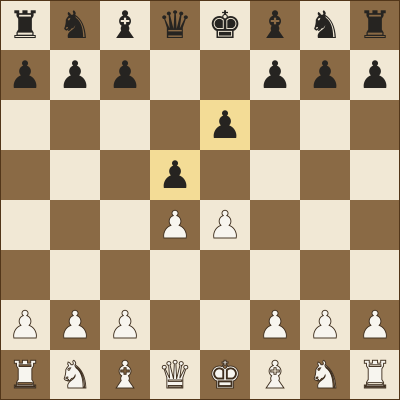
The Classical Tabiya: After 3.Nc3 Nf6 4.Bg5
After 1.e4 e6 2.d4 d5 3.Nc3 Nf6 4.Bg5 — the Classical French tabiya. White's bishop on g5 (highlighted) pins the Nf6 and prepares e5, creating the central tension that defines Classical French theory.
The move 4.Bg5 is White's most ambitious and theoretically rich response in the Classical French. By pinning the Nf6, White prepares 5.e5 to chase the knight and build the classical pawn chain. The pin also threatens to damage Black's kingside structure with Bxf6 if Black is not careful.
Black now has three major responses, each with entirely different character: 4...Be7 (Classical main line), 4...Bb4 (MacCutcheon), and 4...dxe4 (the Burn Variation). A fourth option, 4...Nbd7, has also been employed by top players seeking a solid approach.
Classical Main Line: 4...Be7 5.e5 Nfd7
The main line of the Classical French — Black unpins immediately with 4...Be7, and after White advances with 5.e5, the knight retreats to 5...Nfd7. This is not a passive move: from d7, the knight supports ...c5 and can later go to b6, or reroute via f8-g6 to challenge White's kingside pawns.
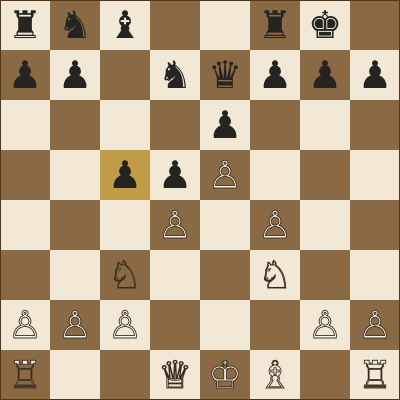
After 6.Bxe7 Qxe7, White often exchanges the bishop voluntarily to eliminate the pin and free the knight. Black recaptures with the queen, keeping a well-placed piece in the center. White continues with 7.f4, reinforcing e5 and preparing a kingside attack.
White can delay the exchange with 6.h4, aiming to control g5 and maintain the pin longer. This is a sharp approach but Black can immediately strike with 6...c5. After the complications, the play typically reaches rich middlegames where both sides have genuine winning chances.
Black's Plan in the Classical
After castling, Black's primary goal is the queenside counter with ...c5. Once this is played, Black aims to exchange on d4 and use the c-file and b4 square for pieces. The knight on d7 reroutes to b6, a4, or c5. White's e5-d4 chain must be challenged or Black will be suffocated.
White's Plan in the Classical
White's f4 pawn forms the second rank of the kingside attack. The typical plan is f4-f5, attacking Black's e6 pawn and opening lines. If Black's kingside weakens, White's pieces pour through. But if Black's ...c5 comes in time, the center can collapse and Black can even counterattack on the queenside.
The MacCutcheon Variation: 4...Bb4
The MacCutcheon is the sharpest response in the Classical. Instead of unpinning with ...Be7, Black immediately pins the Nc3 with 4...Bb4. After 5.e5 h6 6.Bd2 Bxc3 7.bxc3, Black has damaged White's queenside pawn structure but given up the bishop pair. The powerful knight on e4 provides counterplay.
White's most ambitious response is 8.Qg4, attacking g7 and forcing Black's hand. After 8...g6 9.Bd3, the position becomes incredibly complex — both sides have genuine winning chances, and top-level preparation is essential. Viktor Korchnoi made this variation famous, using it as a primary weapon in multiple Candidates matches.
MacCutcheon — Why Play It?
- Avoids the bad bishop — it leaves the board on move 6
- The Nc3 is eliminated, giving Black structural compensation
- Ne4 is an excellent central outpost
- White's kingside structure can be compromised after ...g6
- Rich, unbalanced positions that reward preparation
MacCutcheon — The Tradeoffs
- Black gives up the bishop pair — White can be active with both bishops
- The g6 pawn can become weak if White targets it
- Positions are highly theoretical — deep study required
- White's c-pawns (doubled on c3) actually provide queenside control
- Best for players who have memorized the key continuations deeply
After the forced sequence, White castles queenside artificially via Kd2, and Black strikes with ...c5. The position is wild — White attacks the kingside with h4, Black targets the queenside. This is elite-level French theory requiring precise memory and deep understanding of the resulting structures. Korchnoi excelled here precisely because of his combinational creativity in sharp positions.
The Burn Variation: 4...dxe4
Named after Amos Burn, this variation releases the central tension early. Black takes on e4, White recaptures with the knight, and after the forced exchanges, the position is much less tense than the main lines. Black's plan is to develop pieces quickly and fight for the e5 square. The c8 bishop problem is partially solved by ...h6-...Bd7-...Bc6 plans.
After 8.Bxf6 Qxf6, Black has the bishop pair against White's piece pair, and the position is open enough for both bishops to be effective. The resulting positions are positional and favor precise maneuvering over tactical fireworks. This suits players who want a French position without the extreme theory burden.
By capturing on e4, Black sidesteps the entire theoretical body of 5.e5 and the Classical main lines. The resulting positions after the Burn are less explored and thus more reliant on understanding than memorization. For club players wanting to play French-style positions without memorizing hundreds of moves, the Burn Variation is an excellent practical choice — you understand the structure rather than memorizing forced sequences.
The King's Indian Attack: Fischer's French Weapon
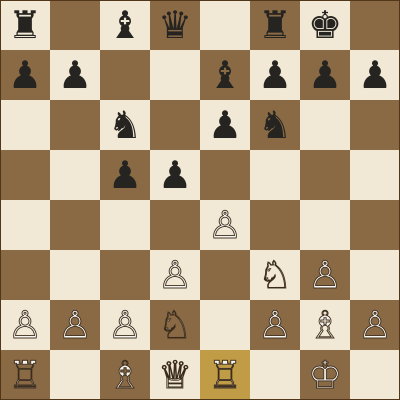
The King's Indian Attack transforms the French into a completely different type of game. White avoids 2.d4 entirely, instead building a kingside fianchetto structure with g3-Bg2, Nbd2, and 0-0. This system was made famous by Bobby Fischer, who used it to devastating effect against French players — his win over Lhamsuren Myagmarsuren at the Sousse Interzonal 1967 remains the model KIA attacking game. The idea: White builds up quietly, then launches f4-f5 to blow open the kingside.
Why White Plays the KIA vs French
- Sidesteps all French mainline theory — no Winawer, no MacCutcheon
- Fischer's proven template: g3-Bg2-0-0-Re1-e5-Nf1-h4
- Kingside attack is concrete and hard to meet
- White's Bg2 is a monster bishop in the resulting positions
- Works against any Black setup — flexible move order
Black's Counter to the KIA
- Strike the center immediately: ...d4 to cramp White
- Queenside expansion: ...b5-...b4 before White gets f5
- ...c4 to stop White's central e5 push
- Develop quickly and don't let f4-f5 happen comfortably
- After ...d4, Black has more space and can attack on the queenside
Fischer's classic plan: after Re1, White prepares e5 to claim space. The knight reroutes to f1 and then h2-g4-f6 — an ideal attacking knight trajectory. Meanwhile Black pursues queenside counterplay with ...b5-...a5-...b4. The race is on: White's kingside attack vs. Black's queenside expansion. Fischer's technique was to ensure the kingside attack arrived first.
If Black pushes 5...d4 early, the position changes character entirely. White cannot play e5 and the pawn chain locks in Black's favor. After 6.Bg2, Black has more space and proceeds with queenside play. This is Black's most direct counter to the KIA — advance in the center before White gets organized. The resulting positions are more positional and less explosive, suiting a different player type than the tactical Fischer games.
The Exchange Variation: 3.exd5
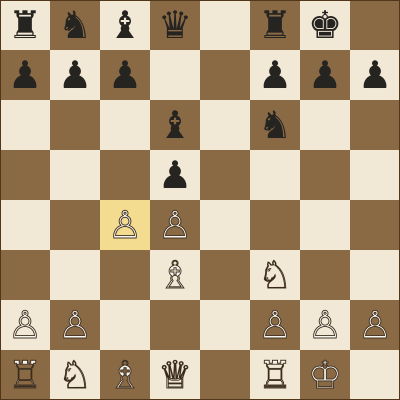
The Exchange Variation creates a symmetrical structure where both sides have pawns on d4 and d5. It looks drawish — and at lower levels, it often is — but White has subtle advantages at the highest level. The immediate 7.c4 is the most ambitious continuation, immediately challenging Black's d5-pawn and opening the game.
The Exchange is not the easy draw White players sometimes hope for. Black has full equality if prepared, but the positions require specific understanding of minority attack concepts and how to handle White's potentially superior piece activity in the open position. Bobby Fischer used the Exchange as a surprise weapon precisely because his opponents assumed it would be boring.
| Structure | White's Advantage | Black's Counter | Key Plan |
|---|---|---|---|
| Symmetrical (d4 vs d5) | Bishop pair, slightly more active pieces | Solid structure, ...Bg4 pin | c4 minority attack, open c-file |
| After cxd5 (IQP for Black) | Pressure on isolated d-pawn | Active pieces, d5 as outpost | Blockade d4, exchange into favorable endgame |
| After ...c5 (Black challenges) | Structural pressure if dxc5 | Active bishops after dxc5 Bxc5 | Quick piece development, Nc6-Nd4 |
| Endgame: bishop vs knight | Bishops in open position | Knight on centralized square | White: open both wings; Black: keep it closed |
The minority attack is White's most dangerous plan in the Exchange French. White advances the queenside pawns (b4-b5) to create pawn weaknesses in Black's position. After 10.b5 cxb5 11.cxd5 Nxd5 12.Nxd5 Qxd5, Black has traded off the knight but White's position is harmonious. Understanding this minority attack is essential for both sides in the Exchange.
Solving the Bad Bishop: Practical Methods
The c8 bishop — locked behind the e6 pawn — is the French Defense's fundamental structural problem. Elite French players have developed a toolkit for solving it:
Method 1: ...b6 and ...Ba6
Black plays ...b6 and routes the bishop via a6 to b7 or to attack c4/e2. This works especially well in the Advance and Classical after White plays c4. Korchnoi frequently used this activation route. The bishop on a6 can be very awkward for White to deal with, especially if it targets the c4-pawn or a rook on a1.
Method 2: ...Bd7-b5
A direct development route — the bishop comes to d7 first, then b5 to target White's pieces. This is particularly effective when White has a knight on c3 that can be pinned. In Classical positions, Black plays ...Bd7-Bb5 with tempo, trading the bishop or forcing concessions.
Method 3: ...f6 Counter
Black plays ...f6 to directly attack White's e5-pawn and open the f-file. If White takes exf6, Black recaptures with the pawn (creating a half-open e-file) or the piece. This is the most radical solution — Black sacrifices some structural integrity for immediate piece activity. Botvinnik used this idea in several model games.
Method 4: Exchange via ...Bd7-c6
Black maneuvers the bishop to d7, then c6, often forcing an exchange with White's knights. After trading a minor piece on c6, Black's position opens and the remaining pieces have more scope. This patient method suits endgame-oriented players who accept a slightly cramped middle game in exchange for long-term structural soundness.
Method 5: Timing the ...c5 Break
The ...c5 break not only challenges White's center — it can also open the c8 diagonal if White takes on c5 and Black responds with ...Bxc5. Understanding exactly when to play ...c5 (sometimes as early as move 3, sometimes as late as move 15) is one of the most critical French skills. Too early and it loses tension; too late and White has consolidated.
Method 6: Korchnoi's Exchange Sacrifice
In some positions, Korchnoi was willing to sacrifice the exchange on c3 — giving up a rook for a bishop — to eliminate the key defending piece and activate all of Black's remaining forces. This radical method only works when Black has massive positional compensation, but it illustrates the key principle: the bishop is worth more than its material value when it remains truly "bad."
Viktor Korchnoi, the greatest French Defense player in history, said: "The bishop on c8 is only bad if you let it stay there. The French Defense is the art of making that bishop good." Every plan in the French Defense, at the advanced level, is ultimately about either activating this bishop or making it irrelevant through other means. Players who accept the bishop's passivity and play around it often find themselves ground down. Players who solve the bad bishop problem proactively almost always find resources.
Pawn Chain Mastery: White's f4-e5 Chain vs Black's Counter
The French Defense's defining feature is the clash of pawn chains: White's d4-e5 vertical chain against Black's d5-e6 chain. Understanding how to attack and defend these chains is the key to French Defense mastery.
| Pawn Theme | Who Benefits | Trigger Condition | Model Idea |
|---|---|---|---|
| f4-f5 advance | White | Black's kingside is fixed, no ...f6 counter | Open the f-file, attack h7 or e6 |
| ...c5 break | Black | White's d4 undefended or only pawn-supported | Trade on d4, get outpost on d5 |
| ...f6 counter | Black | e5-pawn is advanced and overextended | Open f-file, target e5 directly |
| c4 minority attack | White | Exchange structure with symmetrical pawns | b4-b5-bxc6 to create weaknesses |
| ...c4 cramping | Black | KIA/Advance, can close the position | Lock the center, expand queenside |
| a4-a5 queenside freeze | White | Black overextended on queenside (...b5) | Fix ...b5 and create a weakness |
After 6...c4, Black closes the queenside and the position has completely different characteristics than an open French. White must attack on the kingside with f4-f5-g4; Black attacks on the queenside with ...a5-...b5-...b4. This locked pawn structure is the most "French" of all — deeply positional, strategic, and won by the player who correctly identifies which break to pursue and when.
Move Order Subtleties and Anti-French Systems
At the advanced level, move order is everything in the French. White has several anti-French systems that bypass the main theory:
The King's Indian Attack (2.d3)
As covered above — sidesteps all French theory. White gets the Bg2 structure and typical kingside attack. Black must be prepared for the specific KIA plans rather than the mainline French positions. The KIA is increasingly popular at club level because it avoids the theoretical burden.
The Two Knights Variation (3.Nf3 without d4)
After 1.e4 e6 2.Nf3 d5 3.Nc3, White delays or avoids d4. This avoids the Winawer and MacCutcheon (which require 3.Nc3 with d4 already played). Black should respond with 3...Nf6 developing normally and see what White chooses.
The Alapin Gambit (2.d4 d5 3.Be3)
A rare but tricky anti-French: White plays Be3 before Nc3, sometimes with the idea of Nd2-f3 without the normal setup. Black's best response is 3...dxe4, taking the central pawn. After 4.Nd2 Nf6 5.f3 exf3 6.Ngxf3, positions are messy but Black has the extra pawn.
3.Nd2 (Tarrasch) Move Order
The Tarrasch (3.Nd2 instead of 3.Nc3) avoids the Winawer entirely. Black's response: 3...c5 (striking the center) or 3...Nf6 (developing normally). After 3...c5, play enters Tarrasch territory covered in Part 2. This is White's second most popular move after 3.Nc3 and is excellent for avoiding the MacCutcheon.
White can delay Bg5 and instead build the f4 structure immediately. After 7.Be3, White has a Advance-type structure but with the Nc3 already developed. Black must be familiar with this approach — the ...c5 break is still the correct plan, but the resulting positions differ from the standard Advance French.
Champions of the French Defense Classical
Viktor Korchnoi — The Greatest French Player
Korchnoi played the French Defense — especially the MacCutcheon and Classical — as his primary weapon against 1.e4 throughout a career spanning from the 1950s to the 2000s. His understanding of the bad bishop problem was unmatched: he never accepted a passive position and always found ways to activate Black's pieces. In his Candidates matches, the French was a shock weapon that earned him wins against Spassky, Polugaevsky, and Petrosian. Studying Korchnoi's French games is the single most instructive thing a French player can do.
Model game: Korchnoi – Spassky, 1977 Candidates — Korchnoi uses the MacCutcheon to outplay Spassky with precise queenside pressure after the tactical opening phase settles.
Mikhail Botvinnik — The Architect
World Champion Botvinnik used the French as an analytical laboratory — he was famous for preparing novelties months in advance and deploying them in world championship matches. His games in the Classical French demonstrated the correct method for handling White's f4-f5 attack: defend accurately, wait for an overreach, then counterattack. Botvinnik's French games are masterclasses in strategic patience.
Key contribution: Botvinnik popularized the ...f6 counter to White's e5 chain — showing that Black doesn't have to accept White's space advantage passively. The ...f6 break releases the tension and gives Black immediate piece activity.
Tigran Petrosian — The Iron Defender
Petrosian played the French when he needed absolute solidity — typically as a defensive weapon against players who wanted open positions. His approach was the opposite of Korchnoi's aggression: accept the bad bishop temporarily, defend impeccably, and wait for White to overreach. Petrosian converted many drawn-looking positions into wins precisely because opponents underestimated the French's defensive resources.
Bobby Fischer — KIA Specialist
Fischer never played the French Defense himself (preferring 1...e5) but was one of its most dangerous opponents through the King's Indian Attack. His famous win against Myagmarsuren at the Sousse Interzonal 1967 and his series against French players in the 1960s tournaments demonstrated the KIA's concrete attacking power. Fischer's KIA games should be studied by White players looking to avoid French theory while still generating winning chances.
Frequently Asked Questions
After 1.e4 e6 2.d4 d5 3.Nc3 Nf6 4.Bg5 — White pins the Nf6 and prepares 5.e5. Black can respond with 4...Be7 (Classical main line), 4...Bb4 (MacCutcheon), or 4...dxe4 (Burn). Each leads to entirely different positions. The Classical is the most theoretically rich French variation — ECO codes C11–C14 cover the resulting positions, each with their own extensive theory tree.
White plays 2.d3 instead of 2.d4, building a KID-style structure with Nd2, Ngf3, g3, Bg2, and 0-0. The KIA bypasses all French mainline theory and leads to a strategic kingside vs. queenside race. Bobby Fischer made this approach famous. Black's best counter is either the immediate ...d4 cramping move or quick queenside expansion with ...b5-...b4 before White's f4-f5 attack arrives.
Multiple methods exist: (1) ...b6 and ...Ba6 to escape via the a7-g1 diagonal; (2) ...Bd7-b5 with direct piece activity; (3) ...f6 to open the diagonal; (4) maneuvering via ...Bd7-c6; (5) timing the ...c5 break to open diagonals. Korchnoi's principle: "The bishop is only bad if you leave it there." Every French plan at the advanced level is about solving or bypassing this bishop problem.
Yes, if played correctly. After 3.exd5 exd5, White has subtle advantages: the bishop pair is more active in the open position, and the minority attack with b4-b5 can create lasting weaknesses. It's not the easy draw players assume — Fischer used it as a surprise weapon. Black must understand ...c6 to prevent b5 and active piece play to equalize. The Exchange rewards understanding over memorization.
After 4.Bg5 Bb4 — Black pins the Nc3. After 5.e5 h6 6.Bd2 Bxc3 7.bxc3 Ne4, Black has a powerful centralized knight and structural compensation for the bishop pair. The critical line is 8.Qg4 g6 entering sharp, concrete positions. Korchnoi weaponized the MacCutcheon in World Championship Candidates matches. It's the sharpest Classical French line and requires the most preparation.
Two primary structures: (1) The locked chain (Classical/Advance): White's e5-d4 chain vs. Black's d5-e6. White attacks with f4-f5; Black counters with ...c5 and the ...f6 break. (2) The symmetrical structure (Exchange): d4 vs. d5 with open central files. White uses the minority attack (b4-b5); Black seeks active piece play and equality. In both structures, ...c5 is Black's universal counter — it challenges d4 and liberates the queenside pieces.
Further Reading & Study
Books
- Moskalenko, The Flexible French — covers Classical and KIA in depth
- Uhlmann, Winning with the French — historical champion's guide
- Watson, Play the French — comprehensive reference, all variations
Online Resources
- Lichess.org — C11–C14 explorer for Classical lines
- Chessable — French Defense Classical courses
- YouTube — Korchnoi's French game analyses
Model Games
- Korchnoi – Spassky, 1977 (MacCutcheon masterclass)
- Fischer – Myagmarsuren, 1967 (KIA template game)
- Botvinnik – various, 1940s–1960s (Classical chain structures)
Opening analysis based on current grandmaster practice and classical games. ECO classifications C01, C11–C14, A07 from standard references.