
The Italian Game
1.e4 e5 2.Nf3 Nc6 3.Bc4 — the oldest and most natural way to open a chess game. White develops with threats, aims the bishop straight at Black's tender f7 square, and heads for open, tactical positions. From Greco in the 1600s to Magnus Carlsen today, the Italian has never gone out of style — and it remains the best first opening a new player can learn.
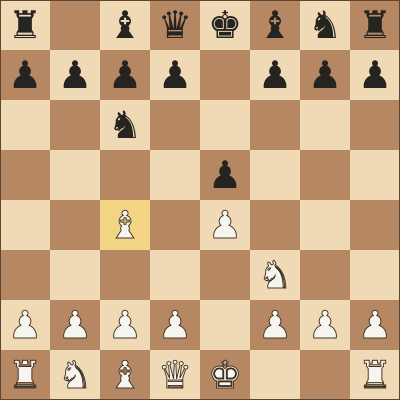
The Italian Game begins 1.e4 e5 2.Nf3 Nc6 3.Bc4 — White's bishop (highlighted on c4) eyes the a2-g8 diagonal and the f7 square, the weakest point in Black's camp. Everything in the opening flows from this idea.
ECO Codes
C50–C59 — covering the Giuoco Piano, Evans Gambit, and Two Knights Defense
The Moves
1.e4 e5 2.Nf3 Nc6 3.Bc4 — develop the knight, then aim the bishop at f7
Character
Open, classical, tactical — easy to learn, rich enough for World Champions
Famous Players
Greco, Anderssen, Morphy, Kasparov (Evans Gambit), Carlsen, Caruana
Why 3.Bc4 — the bishop that stares at f7
After 1.e4 e5 2.Nf3 Nc6, White has developed a knight and attacked the e5 pawn; Black has defended it. On move three White must decide where to put the king's bishop. The Italian Game answers 3.Bc4, placing the bishop on the long a2-g8 diagonal. From c4 the bishop does two jobs at once: it fights for the centre and it points directly at f7 — the only square in Black's position defended by nothing but the king.
This is why the Italian is so instructive. Every idea in the opening connects to that one target. The Fried Liver Attack sacrifices a knight on f7. The Evans Gambit gives up a pawn to build a centre that opens lines toward f7. Even the quiet modern lines keep the bishop trained on that diagonal for the whole middlegame. Learn the Italian and you learn how a bishop, a knight, and a pawn break can combine into a real attack.
The two roads: Giuoco Piano and Two Knights
Black has two main replies. 3...Bc5 mirrors White and enters the Giuoco Piano — a calm, classical fight where both bishops rake the centre. 3...Nf6 is the Two Knights Defense, an immediate counterattack on White's e4 pawn that invites the sharpest lines in the whole opening, including the Fried Liver.
The Giuoco Piano — 3...Bc5
The classical main line. Black answers symmetrically, developing the bishop to c5 where it mirrors White's bishop and eyes Black's own target on f2. The position is balanced and rich; modern grandmasters treat it as a slow positional battle, while club players can still chase the older, sharper d4 lines.
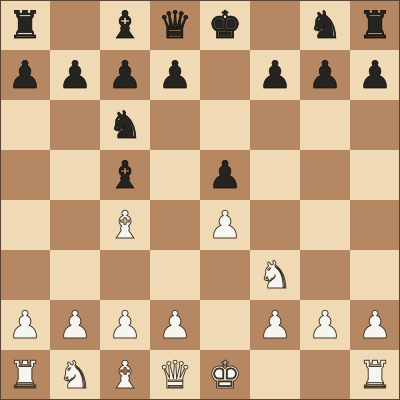
After 1.e4 e5 2.Nf3 Nc6 3.Bc4 Bc5 — the Giuoco Piano. Both bishops are aimed at the opponent's f-pawn. From here White chooses the slow 4.c3 and d3 (the modern Giuoco Pianissimo) or the older 4.c3 Nf6 5.d4 for an open fight.
The Two Knights Defense — 3...Nf6
Instead of copying White, Black counterattacks the e4 pawn immediately with the king's knight. This is the fighting choice. It invites White to play the aggressive 4.Ng5, hitting f7 a second time and threatening the Fried Liver — but it also gives Black active piece play and counter-chances if White is not precise.
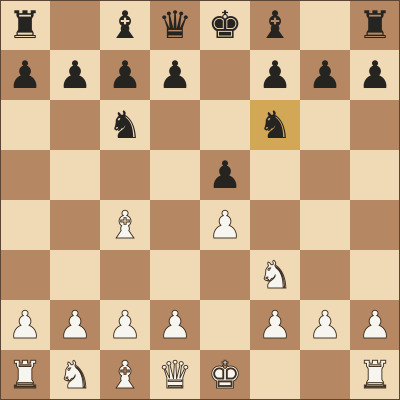
After 3.Bc4 Nf6 — the Two Knights Defense. Black's knight (highlighted on f6) attacks e4 and dares White into complications. The critical try is 4.Ng5, the gateway to the Fried Liver Attack covered in Part 2.
The Italian Game's key ideas for both sides
White's Plan
White develops quickly, castles, and builds toward a central break with c3 and d4 (or the patient d3 build-up). The long-term dream is to open the centre while the bishop on c4 and a knight combine against f7.
- Put the bishop on c4 and pressure f7
- Prepare the d4 break with c3, or build slowly with d3
- Castle kingside and bring a rook to e1 or d1
- In sharp lines, sacrifice on f7 to expose the king
Black's Plan
Black develops naturally, fights for the centre, and aims to neutralize the bishop's pressure on f7 — often by castling quickly, playing ...d6 and ...a6, or counterattacking e4 in the Two Knights.
- Mirror with ...Bc5, or counterattack with ...Nf6
- Castle early to take the king off the a2-g8 diagonal
- Challenge the centre with ...d5 at the right moment
- In the Two Knights, accept sharp play for active pieces
Four centuries of the Italian
The Italian Game is among the oldest recorded openings. It was analyzed by Polerio and Greco in the late 1500s and early 1600s — Gioachino Greco's brilliant miniatures with the bishop on c4 are still shown to beginners today. Through the romantic era it was the main battleground of attacking chess, with Anderssen and Morphy producing immortal games out of its open positions.
Gioachino Greco
The 17th-century Italian master whose recorded games defined early opening theory. His quick attacks against f7 with Bc4 and Ng5 are the ancestors of every Fried Liver played since.
Garry Kasparov
Kasparov stunned the chess world by reviving the 19th-century Evans Gambit at the top level in the 1990s, beating Anand with it and proving the old gambit still had venom.
Magnus Carlsen
Carlsen helped bring the slow Giuoco Pianissimo (c3, d3) back into elite practice, using its quiet build-up to grind out wins from seemingly equal positions.
Italian Game — FAQ
Is the Italian Game good for beginners?
Yes — it is one of the best first openings. The moves are natural, the plans are easy to grasp, and the open positions teach calculation. Most coaches recommend the Italian as a new player's introduction to 1.e4.
What is the difference between the Italian Game and the Ruy Lopez?
Both start 1.e4 e5 2.Nf3 Nc6. The Italian plays 3.Bc4, aiming at f7; the Ruy Lopez plays 3.Bb5, pressuring the c6 knight. The Italian is more direct and tactical; the Ruy Lopez is more strategic and a touch more testing.
What is the Fried Liver Attack?
It arises after 3.Bc4 Nf6 4.Ng5 d5 5.exd5 Nxd5 6.Nxf7 — White sacrifices a knight on f7 to drag the king out. It is one of chess's most famous attacks. Black can sidestep it entirely with the 5...Na5 line; full coverage is in Part 2.
What is the Giuoco Piano?
The Giuoco Piano (the quiet game) is the main line: 3.Bc4 Bc5. Both bishops take active diagonals. Modern play favors the slow 4.c3 and d3 build-up; the older 4.c3 Nf6 5.d4 leads to sharper, more open positions.
What is the Evans Gambit?
The Evans Gambit is 3.Bc4 Bc5 4.b4, sacrificing a pawn to gain time and build a big centre with c3 and d4. A romantic-era favorite revived by Kasparov, it is still a dangerous practical weapon.
3.Bc4 — the defining move. The bishop's diagonal toward f7 is the thread that connects every Italian Game idea, from the quiet lines to the Fried Liver.
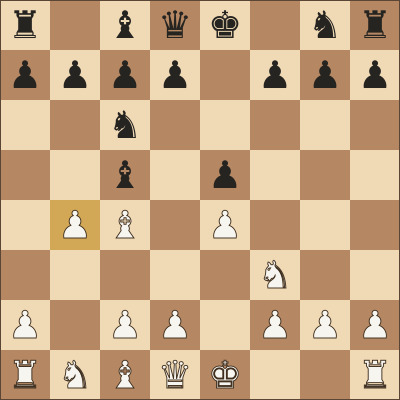
The Evans Gambit (4.b4): a pawn sacrifice to seize the centre and the initiative. Kasparov's 1995 win over Anand proved the old romantic gambit still bites.
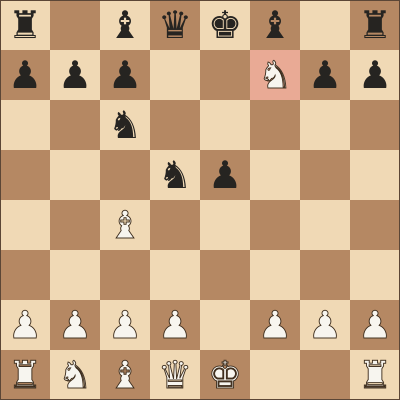
The Fried Liver (6.Nxf7): a knight sacrifice that exposes the Black king. Chess's most famous beginner attack — thrilling to play and a perfect lesson in initiative.
- Greco, G. (c. 1620). Collected games and analysis (the earliest Italian Game miniatures).
- Beim, V. (2011). Chess Recipes from the Grandmaster's Kitchen (Italian themes).
- Emms, J. (2010). Starting Out: The Italian Game. Everyman Chess.
- ECO classification C50–C59. Online: Lichess opening explorer (Italian filter).
Every opening belongs to a family — browse the three theme clusters: Romantic & Attacking Gambits · Flank & Hypermodern Systems · Solid Defenses.
The Italian Game is one of the openings covered on this site
From the Ruy Lopez to the Sicilian and Queen's Gambit, each opening guide includes board diagrams, strategic ideas, history, famous games, and a full FAQ section.