
En Passant
En passant — French for "in passing" — is chess's most misunderstood rule. A pawn that sprints two squares past an opposing pawn can be captured as if it had moved only one. It must be done immediately, or the right is gone forever. Beginners forget it, endgames turn on it, and championships have been decided by it.
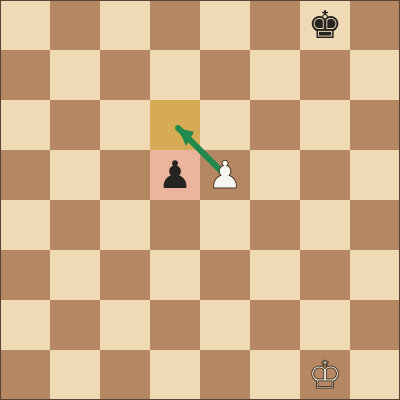
En passant governs one of the most surprising captures in chess — a phantom diagonal that removes a pawn from a square it no longer occupies. It exists to keep the two-square pawn advance from dodging a pawn that controls its path.
Condition
An enemy pawn advances two squares from its starting rank and lands directly beside your pawn
The Capture
Your pawn moves diagonally to the square the enemy pawn passed over — removing that pawn from the board
Timing
Must be played immediately on the very next move — the right expires if you play anything else first
Notation
Written like any diagonal capture, e.g. exd6 — the older suffix "e.p." is now optional
What en passant actually is
Every player learns that a pawn may advance one or two squares on its first move. What often gets glossed over is the consequence of that two-square advance: it creates the opportunity for a very specific capture. En passant exists precisely because the double-step was added in the late medieval period — without it, a pawn could leap past a square controlled by an enemy pawn and escape capture entirely. The rule closed that loophole.
When a pawn advances two squares from its starting position and lands directly beside an enemy pawn, that enemy pawn may capture it diagonally onto the square it passed through. The capture must be made on the immediately following move — and only that move.
Step by step
- Your pawn sits on the fifth rank (rank 5 for White, rank 4 for Black).
- The opponent advances a pawn two squares from its starting rank, landing right beside yours.
- You capture by moving your pawn diagonally onto the square the enemy pawn passed through. The captured pawn is removed from its current square — not from the square your pawn lands on.
- If you play any other move first, the en passant opportunity disappears permanently.
The critical moment — White plays exd6
White's pawn stands on e5. Black has just pushed the d-pawn two squares, from d7 to d5, landing beside White's pawn. On this move only, White may capture exd6: the White pawn moves diagonally to d6 (highlighted) and the Black pawn on d5 is removed from the board.
White pawn e5, Black pawn just landed on d5 (from d7). White's only chance to capture en passant is right now: exd6. The pawn moves to the highlighted d6 square and the d5 pawn is captured — even though White's pawn never lands on d5.
The notation
In algebraic notation, en passant is written like any diagonal capture. If your e-pawn captures a pawn that moved to d5, the move is exd6 — your pawn goes to d6, the square the enemy pawn skipped over. The suffix e.p. is sometimes added for clarity in older texts, but modern notation omits it because the destination square makes the capture unambiguous.
Why this rule exists
Medieval chess was a slower, more methodical game. Pawns advanced only one square at a time, which made the opening a patient, grinding affair. As the two-square first move spread through Europe in the 13th–15th centuries to speed up the opening, a pawn on its starting square could suddenly jump to the fourth rank in one move.
The problem was obvious to anyone who played: a pawn could now bypass the square controlled by an enemy pawn on the fifth rank. Before the change, that controlling pawn was a genuine threat — after it, the enemy pawn simply leapt over the danger zone. En passant was introduced as a direct corrective measure, preserving the principle that a pawn should not be able to slip past a pawn guarding its advance.
Regional adoption
En passant was not adopted everywhere at once. Different regions accepted it at different times during the 15th and 16th centuries, leading to confused international play. By the time standardized tournament rules were codified in the 19th century the rule was firmly enshrined — but it kept its reputation as an obscure law that trips up players who do not know its origins.
When en passant wins and loses games
Most players meet en passant rarely enough that it surprises them when it appears. At the club level it is routinely missed — either the capturing player forgets the rule, or the defending player pushes a pawn two squares without noticing the en passant possibility. At the grandmaster level, en passant positions are calculated carefully because they appear often in pawn endgames and can be the difference between a win and a draw.
Pawn endgames
En passant matters most in king-and-pawn endgames. When both sides have passed pawns racing to promote, using en passant to eliminate the opponent's passer can flip the result. A single pawn is often the deciding factor in the endgame, and en passant is sometimes the only way to create or keep that advantage.
Opening preparation
En passant is also a calculated part of some opening systems. The French Defense frequently produces positions where a timely en passant disrupts the opponent's pawn structure, and in the Caro-Kann, the ...c5 break followed by d5 can create en passant chances that shift the pawn dynamics fundamentally.
The Lucena and Philidor positions
Classic endgame theory — the Lucena winning method, Philidor's drawing technique — can hinge on whether en passant is available as a resource. A pawn on the fifth rank that keeps an opponent's pawn from advancing may be the linchpin of a setup. Knowing the exact rules, the timing requirement above all, separates players who hold drawn endgames from those who blunder into losing ones.
How players get it wrong
The most common error is simply forgetting the rule exists. A player sees the opponent advance a pawn two squares, registers it as an ordinary pawn move, and replies with their own move — permanently surrendering the en passant right. The fix is a small habit: when an opponent pushes a pawn two squares, pause and ask, "Is one of my pawns on the fifth rank beside it?"
The opposite error is attempting en passant when the conditions are not met — capturing a pawn that advanced two squares several moves earlier, or when your own pawn is not on the correct rank. Neither is legal. En passant has strict preconditions that must all be satisfied at the same time, on the same move.
The "forgot to take" problem in online chess
Fast time controls create a specific hazard: a player sees the opportunity, hesitates while calculating whether it helps, runs low on time, and plays something else. The right expires not because they declined it but because the clock forced a different move. The lesson is to evaluate en passant quickly — once available, the capture usually has a clear-cut assessment that does not require deep calculation.
En Passant — FAQ
Can I decline to take en passant?
Yes. En passant is always optional — you are never forced to capture. Many positions call for declining it, for example when taking would create a doubled pawn, open a file toward your own king, or spoil a pawn structure that is better left intact. Evaluate whether the capture improves your position before taking automatically.
Can a piece other than a pawn capture en passant?
No. En passant is exclusively a pawn-captures-pawn rule. No knight, bishop, rook, queen, or king has this ability under any circumstances. Only a pawn on the correct rank, beside the pawn that just advanced two squares, may make the capture.
Can I go back and take en passant after another move?
No. The right to capture en passant expires the instant you play any other legal move. It is a one-time, immediate option — its defining characteristic. Once you complete a different move over the board, the chance is gone for good.
Does en passant work on both sides of the board?
Yes. Any pawn on the fifth rank (rank 5 for White, rank 4 for Black) can capture en passant when an adjacent enemy pawn advances two squares. The rule is symmetrical — it applies on any file and for either color.
Can en passant expose a king to check?
In very rare positions, yes. If the captured pawn was shielding your king along a rank, removing it could leave your king in check — in which case the en passant capture is illegal, exactly like any other move that exposes your king. This "discovered check via en passant" is a famous curiosity but almost never appears in real games.
- FIDE Laws of Chess, Article 3.7 (the en passant capture).
- Murray, H.J.R. (1913). A History of Chess. Oxford University Press.
- Dvoretsky, M. (2014). Dvoretsky's Endgame Manual. Russell Enterprises.
- Silman, J. (1998). The Complete Book of Chess Strategy. Siles Press.
Pawn Mastery — Part 1 of 7
En passant is where the Pawn Mastery series begins. Continue with the Poisoned Pawn, or jump into the full opening guides — each with board diagrams, strategy, history, and a complete FAQ.