
Anti-Sicilian Systems
Alapin (2.c3), Grand Prix Attack (2.Nc3 3.f4), Smith-Morra Gambit, and the Closed Sicilian — complete coverage of every major system White uses to avoid Open Sicilian theory.
Alapin: B22
Grand Prix: B23
Smith-Morra: B21
Skip the Najdorf,
Dragon, and Open
Sicilian complexity.
The Open Sicilian (1.e4 c5 2.Nf3 followed by 3.d4) leads to the Najdorf, Dragon, Scheveningen, and Classical — the most theoretically dense positions in all of chess. A prepared Najdorf player has memorized 20-30 moves of forcing lines; to compete at the highest level, White must match that preparation. The Anti-Sicilian systems are White's practical answer: play for a slight advantage in a position where Black's specific Sicilian preparation is worthless. The tradeoff is that White gives up the theoretical advantage of the Open Sicilian but gains enormous practical value.
The Alapin Variation: 2.c3
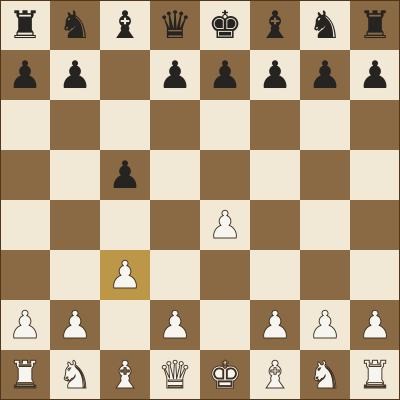
After 1.e4 c5 2.c3 — the Alapin tabiya. White's c3 pawn (highlighted) supports an upcoming d4, aiming for a broad pawn center. Black must strike immediately with 2...d5 or 2...Nf6 to prevent White from consolidating.
The Alapin is White's most principled Anti-Sicilian. The idea is simple: play 2.c3 to support d4, achieving the ideal pawn center with e4-d4 that White normally cannot build against the Sicilian. The tradeoff: c3 takes away the best square for White's queenside knight.
After 2...d5 3.exd5 Qxd5, Black places the queen on d5 — a temporary outpost that White cannot easily challenge. After 4.d4, Black plays 4...Nf6 developing naturally and the queen moves when attacked. Black's position is solid and fully equal with correct play.
The 2...Nf6 approach leads to positions resembling the Advance French after 3.e5 Nd5. Black has the ...d6 break to challenge White's center. After 6...d6 7.Bc4 Nb6 8.Bb3 dxe5 9.dxe5, the position is sharp and double-edged. Players who know the Advance French pawn structure will be comfortable as Black here.
Alapin — White's Plan
- Achieve the broad e4-d4 center
- Develop Nf3, Bd3 or Bc4 quickly
- Castle kingside and build piece activity
- The c3 knight square issue is compensated by the center
- After dxc5, piece activity down the open d and c files
Alapin — Black's Counter
- 2...d5 immediately — most principled challenge
- Queen on d5 after exd5 Qxd5 is temporarily active
- 2...Nf6 for French-like structure
- Target the isolated d-pawn after exchanges
- The lack of Nc3 means White's queenside is slightly passive
The Grand Prix Attack: 2.Nc3 then 3.f4
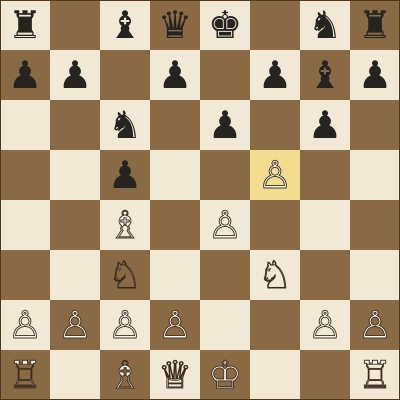
The Grand Prix Attack builds a fearsome kingside attacking formation: Nc3, f4, Nf3, and either Bc4 or Bb5. The f4-f5 advance is White's key idea — blowing open the kingside before Black can organize counterplay. This was popularized at British Grand Prix tournaments in the 1980s and is still widely used at club level and in rapid chess.
After 5.Bb5, White pins the Nc6 and prepares a swift attack. If Black takes with 5...Nd4, White can sacrifice with 6.0-0! getting dangerous attacking compensation. The resulting positions are sharp and concrete — White's initiative can be decisive if Black doesn't respond precisely.
Black's most effective counter to the Grand Prix is the ...g6 fianchetto, reaching Dragon-like positions where the Bg7 neutralizes White's attacking intentions. Once the dark-squared bishop is on g7, the f4-f5 advance becomes less effective. Black can challenge with ...d5 or ...e5 to undermine White's center.
The Grand Prix is most dangerous when Black plays a natural-looking setup like 2...d6 3.f4 Nc6 4.Nf3 Nf6 5.Bc4 e6? — the e6 pawn blocks Black's own defensive bishop and allows 6.f5! with a devastating attack. The key lesson: against the Grand Prix, Black must either fianchetto (...g6) or play an early ...e5 to stop f5. A passive setup with ...e6 without ...g6 or ...e5 is a common mistake at club level and can lead to a quick loss.
The Smith-Morra Gambit: 2.d4 cxd4 3.c3
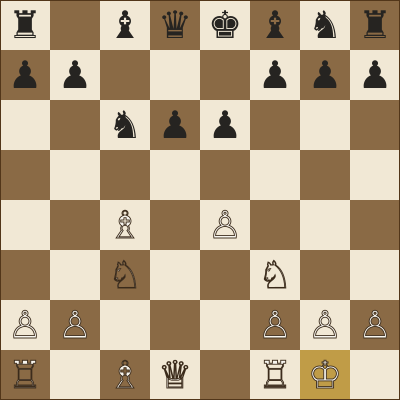
The Smith-Morra Gambit offers a pawn to develop all pieces rapidly and generate immediate pressure on Black's position. After 3...dxc3 4.Nxc3, White has both knights out, the bishop pointed at f7, and castling is imminent. Black, who took the pawn, must be very precise or face an overwhelming initiative.
Why the Smith-Morra Works
- White is 2–3 moves ahead in development
- The open c-file is immediately pressured
- Black's queenside is undeveloped when White castles
- Bc4 targets the f7 weakness immediately
- Surprise value is enormous — most Sicilian players haven't studied it
Black's Best Defense
- The Siberian Defense: 5...e5 — giving the pawn back for equal chances
- Classical setup: 5...d6 6...e6 7...Be7 — solid but must be precise
- Declining with 3...Nf6 — avoid accepting the gambit entirely
- 3...d3 Declining — sidestep with the d-pawn going forward
- The Scheveningen setup after accepting is most reliable
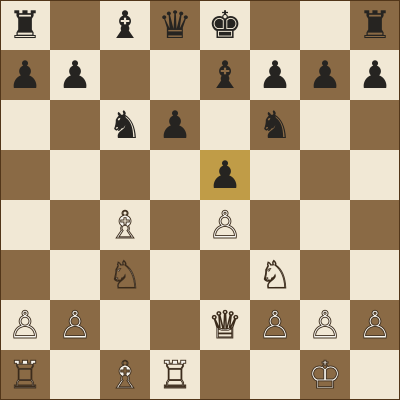
In the classical defense, Black develops solidly with ...d6, ...e6, ...Be7, and ...Nf6. After 9...e5, Black challenges the center and gives White less attacking space. White's plan is to pressure the d6-pawn with pieces on d1 and the c-file. Black's setup is solid but requires precise knowledge — the typical Smith-Morra trap involves Nd5 followed by Nxf7 sacrifices if Black is passive.
Black can decline the gambit with 3...Nf6, not capturing on c3. After 4.e5 Nd5 5.Nf3, the position resembles the Alapin with Black having an extra tempo. This is a fully sound approach — Black avoids all of White's gambit preparation while reaching playable positions.
The Closed Sicilian: 2.Nc3 then 3.g3
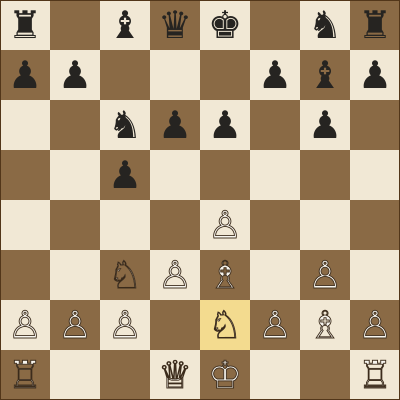
The Closed Sicilian is White's most solid Anti-Sicilian. By building the g3-Bg2 structure, White avoids all Open Sicilian theory and creates a setup reminiscent of the King's Indian Attack. The position is fundamentally different from the Open Sicilian — there's no early d4 break, and the game becomes a strategic battle of plans.
White's typical plan: complete development with Nge2, 0-0, then prepare f4 and f5 for a kingside attack. Meanwhile Black counterattacks on the queenside with ...d6, ...a6, ...b5, and tries to open the c-file with ...c4 or ...b4. The Closed Sicilian naturally leads to slower, strategic battles where understanding of pawn structure matters more than memorization.
Closed Sicilian — White's Plan
- Complete development: Nge2, 0-0
- Build the f4-f5 kingside attack
- If Black plays ...e5, White exchanges to open diagonals for the Bg2
- The Bg2 becomes extremely powerful if the center opens
- d3 pawn keeps the position flexible — White can push to d4 later
Closed Sicilian — Black's Counter
- Queenside expansion: ...a6-...b5-...b4
- ...d5 break in the center if White delays f4
- ...e5 to challenge f4 — stops f5 but gives White an open diagonal
- Place pieces actively: ...Nd4 is a key outpost
- Keep the position closed — White's Bg2 wants open lines
Choosing Your Anti-Sicilian: A Practical Guide
Which Anti-Sicilian is right for you depends on your playing style:
| System | Style | Theory Required | Best For |
|---|---|---|---|
| Alapin (2.c3) | Positional/Strategic | Medium | Players who want a solid center without gambits |
| Grand Prix (2.Nc3 3.f4) | Aggressive/Attacking | Low-Medium | Attacking players who want to attack before Black organizes |
| Smith-Morra Gambit | Tactical/Initiative | High (gambit lines) | Players willing to study the gambit lines deeply for maximum surprise |
| Closed Sicilian (3.g3) | Strategic/Slow | Low | Players who prefer long positional games; good vs. unprepared opponents |
At grandmaster level, the Alapin is the most respected Anti-Sicilian — players like Nigel Short and Michael Adams have used it consistently to avoid Sicilian theory while maintaining genuine winning chances. The Smith-Morra is occasionally seen in serious play (Marc Esserman has made it a serious weapon) but is most effective as a surprise weapon at club level. The Grand Prix and Closed Sicilian are primarily club-level weapons — at the elite level, Black's preparation is too complete for these systems to generate meaningful advantage without specific preparation.
How Black Should Approach All Anti-Sicilians
vs. Alapin (2.c3)
Play 2...d5 immediately — most principled. After 3.exd5 Qxd5 4.d4, develop naturally with 4...Nf6 5...e6 or 5...Bg4. Target the isolated d-pawn in endgames. Alternatively 2...Nf6 3.e5 Nd5 for French-like positions. Never play passive moves against the Alapin — challenge the center from move 2.
vs. Grand Prix (2.Nc3 3.f4)
Fianchetto with 3...g6 immediately, or play 3...e5 to prevent f5. Never allow the position to become passive with ...e6 before ...g6 — that invites the f4-f5 assault. The dragon bishop on g7 is Black's best defensive piece against White's kingside attack.
vs. Smith-Morra (2.d4 cxd4 3.c3)
Either decline with 3...Nf6 (safest) or accept and play the Scheveningen-like setup with ...d6-...e6-...Be7-...Nf6. The key: don't be passive on the queenside — White's development lead punishes slow play. The ...e5 counter is often the best neutralizing plan after accepting the gambit.
vs. Closed Sicilian (3.g3)
Play for queenside counterplay with 3...g6 4...Bg7 (mirror White's fianchetto) or 3...e6 4...d5. The key: prevent White's f4-f5 attack by either playing ...e5 to stop f5, or expanding so quickly on the queenside that White cannot organize the attack. The Nd4 outpost is particularly valuable in these structures.
The Universal Principle
Against any Anti-Sicilian: don't play passive moves. The reason White avoids the Open Sicilian is that Black has a very active game there — Anti-Sicilians work by inducing Black to play a less active setup. Challenge the center, develop quickly, and look for your key counter-move (usually ...d5 or ...e5 at some point).
Move Order Awareness
White can reach Anti-Sicilian setups via multiple move orders: 1.e4 c5 2.Nc3 avoids committing to f4 or g3 immediately, waiting to see Black's setup. After 2...d6, White might play the Grand Prix; after 2...Nc6 or 2...e6, White can choose any system. Black must have a clear plan against all of these rather than specific move sequences.
Champions of the Anti-Sicilian Systems
Nigel Short — Alapin Specialist
Short has used the Alapin as a primary weapon throughout his career, winning high-profile games against world-class players. His understanding of the resulting positions — where White maintains a solid center while pressuring Black's queenside — is exemplary. Short's Alapin games demonstrate that this is not a "drawing weapon" but a genuine fighting system with real winning potential.
Marc Esserman — Smith-Morra Evangelist
Esserman's book Mayhem in the Morra transformed the Smith-Morra's reputation from a dubious club gambit to a theoretically respectable weapon. He demonstrated that at the GM level, the initiative from the gambit can be sufficient compensation even against the best defensive setups. His work revealed that Black's "best" defenses are harder to execute than previously thought.
Frequently Asked Questions
1.e4 c5 2.c3 — White prepares d4 to build the ideal center. After 2...d5 3.exd5 Qxd5 4.d4, Black has the queen on d5 and a solid position. The Alapin avoids all Open Sicilian theory while offering White a real game. Black's two main responses are 2...d5 (most principled) and 2...Nf6 (French-like). Nigel Short and Michael Adams are its top practitioners at GM level.
1.e4 c5 2.Nc3 3.f4 — White attacks the kingside before Black gets organized. The f4-f5 advance is the key idea. Black's best counter is 3...g6 (fianchetto the bishop to neutralize the attack) or 3...e5 (stop f5). Playing 3...e6 without the ...g6 fianchetto is the main mistake — it allows f4-f5 with a powerful attack. The Grand Prix is most effective in rapid/blitz chess against unprepared opponents.
Yes — at club level and in rapid chess it is excellent. After 1.e4 c5 2.d4 cxd4 3.c3 dxc3 4.Nxc3, White has all pieces developing rapidly while Black has just taken a pawn. At GM level, precise defense equalizes, but the defense is tricky to find over the board. Marc Esserman's Mayhem in the Morra is the definitive guide showing it's more than a club weapon. Black can decline with 3...Nf6 to sidestep the gambit entirely.
1.e4 c5 2.Nc3 3.g3 — White builds a King's Indian Attack structure with fianchettoed bishop. No early d4; instead White prepares f4 and a slow kingside attack. Black counters with queenside expansion (...b5, ...b4) or the early ...d5 break. The Closed Sicilian leads to long strategic battles — good for players who prefer understanding over memorization. Bobby Fischer used it regularly as White.
Best is 2...d5 immediately. After 3.exd5 Qxd5 4.d4 Nf6 5.Nf3 e6, Black has a solid, comfortable game — the queen on d5 is temporarily active and moves when attacked. The second-best option is 2...Nf6 3.e5 Nd5, reaching French-like positions. Never play passively against the Alapin — challenge the center immediately on move 2.
Four major systems: Alapin (2.c3) — solid center preparation; Grand Prix Attack (2.Nc3 3.f4) — aggressive kingside assault; Smith-Morra Gambit (2.d4 cxd4 3.c3) — pawn for rapid development; Closed Sicilian (2.Nc3 3.g3) — strategic fianchetto system. Each requires different preparation from Black. Against all four, the universal principle is the same: don't play passively — challenge White's setup from the start.
Further Reading & Study
Books
- Esserman, Mayhem in the Morra — definitive Smith-Morra guide
- Palliser, Beating Unusual Chess Openings — covers all Anti-Sicilians from Black's side
- Emms, The Alapin Sicilian — comprehensive White repertoire
Online Resources
- Lichess.org — B21/B22/B23 explorer
- Chessable — Anti-Sicilian courses (both sides)
- YouTube — Smith-Morra trap collections
Model Games
- Short – various (Alapin structure games)
- Esserman – various (Smith-Morra attacking games)
- Fischer – Closed Sicilian games (strategic masterclasses)
Opening analysis based on current grandmaster practice and classical games. ECO classifications B21–B25 from standard references.