The King's Indian Defense
Surrender the center — then destroy it. The King's Indian Defense is one of the most dynamic weapons in chess: Black allows White to build a massive d4-e4 pawn center with the fianchettoed Bg7 aiming right at it. Fischer and Kasparov won World Championship games with it. It's the weapon of choice for players who refuse to play for a draw.
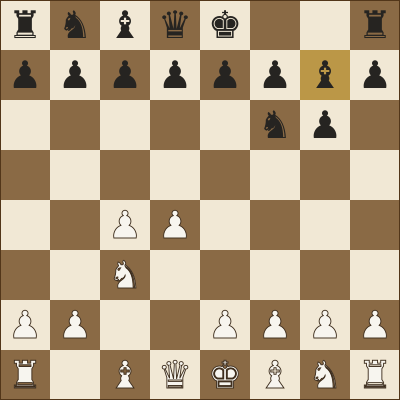
The King's Indian begins with 1...Nf6, 2...g6, and 3...Bg7 — the fianchetto bishop looks seemingly harmless until Black's counterattack begins in earnest around move 10–15.
A three-part deep dive on the KID
ECO Code
E60–E99 — one of the richest ECO ranges, covering dozens of named sub-variations
The Setup
1.d4 Nf6 2.c4 g6 3.Nc3 Bg7 — fianchetto bishop on g7, flexible pawn structure
Key Idea
Allow White's d4-e4 center, then counterattack it with ...e5 or ...c5 at the critical moment
Famous Practitioners
Fischer, Kasparov, Tal, Bronstein, Geller, Reshevsky — the KID is an attacking player's weapon
Surrender the center — then counterattack it
The King's Indian is built on a counter-intuitive idea: give White everything in the center, then attack it from the flanks. Black's first moves — 1...Nf6, 2...g6, 3...Bg7 — complete the kingside fianchetto. Black then typically plays 4...d6 and 5...0-0, establishing the classic King's Indian setup before launching counterplay.
White builds an imposing pawn center with d4 and e4. Black responds with 6...e5 (or 6...c5) to strike back. The resulting positions are among the most dynamic and complex in all of chess — White attacks on the queenside while Black counterattacks on the kingside, and the game is often decided by which attack arrives first.
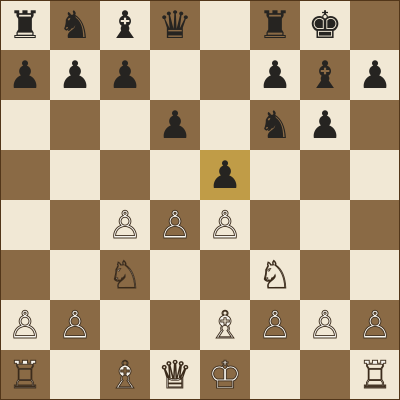
After 6...e5 — the main Classical KID — Black immediately challenges the center. A pawn tension arises: if White plays d5, the position becomes closed and both sides advance pawns on their respective wings. If White exchanges with dxe5, Black recaptures and gains central activity.
After 1.d4 Nf6 2.c4 g6 3.Nc3 Bg7 — the KID setup
After 1.d4 Nf6 2.c4 g6 3.Nc3 Bg7 — the King's Indian setup. The highlighted bishop on g7 (the fianchetto) defines the opening. Black's setup is flexible — the exact pawn formation is determined over the next few moves.
Classical KID tabiya after 7.0-0
After 1.d4 Nf6 2.c4 g6 3.Nc3 Bg7 4.e4 d6 5.Nf3 0-0 6.Be2 e5 7.0-0 — the Classical King's Indian tabiya. Black's e5 advance (highlighted) stakes a claim in the center. The game now divides sharply: White attacks queenside with c5, Black attacks kingside. The g7 fianchettoed bishop becomes a long-range weapon.
Classical, Sämisch, and Four Pawns Attack
6.Be2 — The Classical Variation
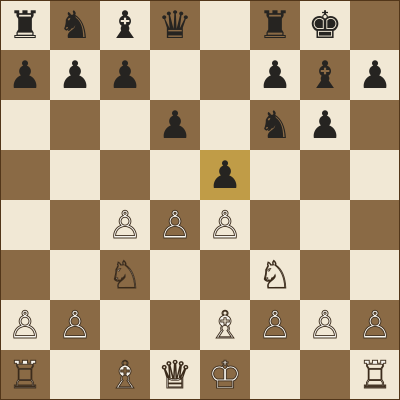
White develops solidly with 6.Be2 and castles. After Black plays 6...e5, White typically advances with d5, creating a closed center. Both sides then advance on opposite wings — White plays c4-c5 on the queenside, Black plays ...f5-f4 on the kingside. The race to attack is direct and fierce. The Mar del Plata Variation (7...Nc6 8.d5 Ne7) leads to the sharpest Classical KID positions.
5.f3 — The Sämisch Attack
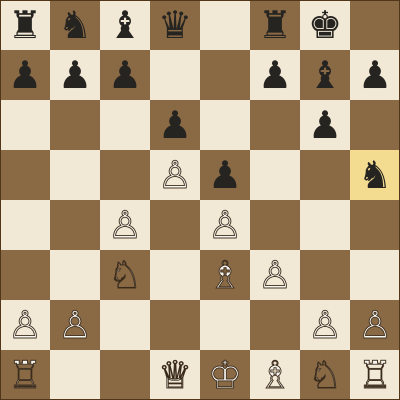
White plays 5.f3, preventing ...Nxe4 and preparing a kingside pawn storm with g4-g5. The Sämisch is one of the most aggressive systems against the KID. Black must counterattack quickly or face a crushing White kingside assault. The resulting positions are tactical from the very early middlegame, with both sides attacking at full speed.
5.f4 — The Four Pawns Attack
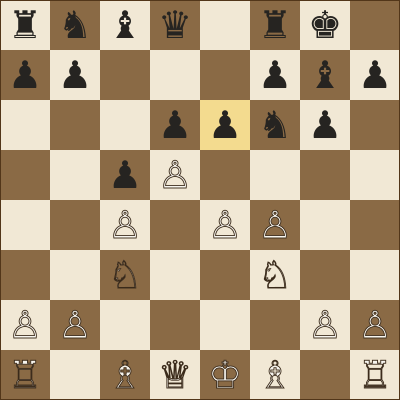
White builds a massive pawn wall with e4, d4, c4, and f4 — the "four pawns." It is extremely ambitious and commits White to a direct attack. Black must break the center immediately with ...c5 or ...e6, or face a suffocating position. The Four Pawns Attack is high-risk, high-reward, and leads to the most complex and unbalanced positions of any KID variation.
The weapon of the world's greatest attackers
Bobby Fischer
Fischer used the KID throughout his rise to the World Championship. His collection of KID wins — particularly in the Classical variation against Spassky and Geller — remain some of the most instructive attacking games in chess history. Fischer's KID preparation helped him clinch his 1972 match victory.
Garry Kasparov
Kasparov's record in the King's Indian is the greatest of any player in history. He compiled more than 50 annotated KID wins across his career. In his World Championship matches, Kasparov would spring deep KID preparations that opponents — even at the highest level — could not handle over the board.
Mikhail Tal
Tal's KID games were famous for sacrificial brilliance. Where others played the KID technically, Tal used it as a launching pad for spectacular piece sacrifices. His KID wins from the 1950s and 1960s — full of unexpected queen sacrifices and tactical fireworks — influenced an entire generation of chess players.
King's Indian Defense — FAQ
What is the King's Indian Defense?
The KID is Black's answer to 1.d4 based on 1...Nf6 2...g6 3...Bg7 — the fianchetto. Black allows White to build a large pawn center with d4 and e4, then counterattacks it with ...e5 or ...c5. It leads to dynamic, double-edged positions and is a favorite of attacking players who want to fight for a win with Black.
Is the King's Indian Defense good?
Yes — the KID is theoretically sound and used at the highest levels. Fischer, Kasparov, and Tal all built championship careers around it. It requires dynamic play and precise counterattacking timing, which makes it more demanding than solid alternatives. But for players with attacking instincts, the KID provides the richest winning chances of any defense against 1.d4.
What is the Classical King's Indian?
The Classical arises after 1.d4 Nf6 2.c4 g6 3.Nc3 Bg7 4.e4 d6 5.Nf3 0-0 6.Be2 e5. White builds a solid center and castles. After Black plays 6...e5, White usually closes the center with d5, and both sides advance on opposite wings — a direct race between White's queenside attack and Black's kingside counterattack.
What is the Sämisch Attack against the King's Indian?
The Sämisch is White's most aggressive system: after 5.f3, White prevents ...Nxe4 and prepares a kingside pawn storm. It is one of the sharpest KID variations, requiring immediate counterplay from Black. Black must act quickly with ...c5, ...e5, or ...a5 or face a crushing attack. The Sämisch is the line that most tests Black's theoretical preparation.
Who plays the King's Indian Defense?
The KID has been championed by the world's greatest attacking players. Bobby Fischer, Garry Kasparov, Mikhail Tal, David Bronstein, and Efim Geller all used it as their primary weapon against 1.d4. In modern chess, players like Teimour Radjabov and Hikaru Nakamura continue the KID tradition at the top level.
Is the King's Indian good for beginners?
Not ideal for beginners — the KID's counterattacking plans require precise timing and tactical awareness. Allowing White a large center and then attacking it is an advanced concept. Beginners on 1.d4 systems are better served starting with the Nimzo-Indian or Queen's Gambit Declined, then graduating to the KID once they have a solid foundation in positional chess.
The KID creates genuinely double-edged positions where both sides have attacking chances. It is not an opening for the faint-hearted.
Kasparov's 5 World Championship matches produced dozens of KID games. His 1993–1995 preparation in the Classical KID remains the deepest ever assembled.
The KID fianchetto bishop on g7 can remain "dormant" for 15 moves — then become the most powerful piece on the board once the center opens.
- Kasparov, G. (2014). Kasparov on the King's Indian. Everyman Chess.
- Gallagher, J. (1993). Starting Out: King's Indian Defence. Everyman Chess.
- Fischer, R. (1969). My 60 Memorable Games. Simon & Schuster. (Several KID games annotated.)
- Chess Informant Database — ECO E60–E99.
Every opening belongs to a family — browse the three theme clusters: Romantic & Attacking Gambits · Flank & Hypermodern Systems · Solid Defenses.
Seven opening guides on michaelpaycer.com
From the Ruy Lopez to the London System, each opening guide includes board diagrams, history, strategic ideas, and a full FAQ.