
Pawn Structures
Pawns are the soul of chess. They move slowly and never go backward, so the shape they form is the most permanent feature of any position — the skeleton the whole game hangs on. Master a few key structures — the isolated queen's pawn, the passed pawn, the pawn chain — and you will understand why the pieces go where they go.
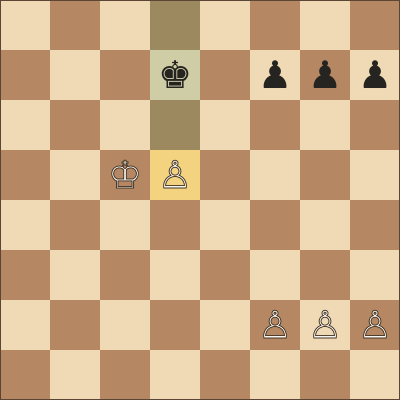
A passed pawn on d5 — no enemy pawn can stop it from advancing toward promotion. Pawn structures like this quietly decide more games than any tactic; understanding them is the heart of chess strategy.
Why pawns rule
Pawns move slowly and never retreat — the structure is the position's permanent skeleton
The IQP
An isolated d-pawn: a weakness to target, but a source of space and active piece play
The passed pawn
Nothing in its way to promotion — a passed pawn must be pushed
Strategy = pawns
Where to attack, which files to seize, what endgame looms — the pawns tell you
The Isolated Queen's Pawn (IQP)
An isolated queen's pawn is a d-pawn with no friendly pawns on the neighboring c- and e-files to support it. It is the most famous double-edged structure in chess. In the endgame it can be a chronic weakness, because only pieces can defend it and the square in front of it makes a perfect blockade post for the enemy. But in the middlegame the very same pawn grants extra central space and two beautiful open files for rooks and an attack. Whole opening systems — lines of the Queen's Gambit, the Caro-Kann Panov, and others — are built around playing for or against the IQP.
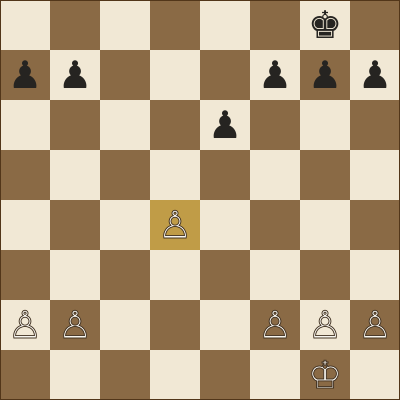
The isolated queen's pawn. White's pawn on d4 (highlighted) has no c- or e-pawn to defend it. The owner plays for piece activity and a kingside attack down the open files; the defender blockades the pawn and aims for an endgame where it falls.
The Passed Pawn
A passed pawn has no enemy pawn in front of it on its own file or either adjacent file — nothing can stop it but enemy pieces. Passed pawns grow more dangerous the further they advance and the fewer pieces remain, which makes them decisive in endgames. The old maxim is literally true: a passed pawn must be pushed. Often the defender is forced to sacrifice a whole piece just to prevent one from promoting to a queen.
A passed pawn on d5 (highlighted), with a clear path to promotion — no black pawn guards the c-, d-, or e-files in front of it. The enemy king must blockade it, tying itself down, while the rest of the board decides the game.
Pawn chains, doubled and isolated pawns
The pawn chain
A diagonal line of pawns defending one another, like the e6-d5 chain of the French Defense. The golden rule, from Aron Nimzowitsch: attack a pawn chain at its base — the rearmost, undefended pawn — because the whole chain rests on it. Chains define where each side attacks: you play toward the side your pawns point.
Doubled and isolated pawns
Doubled pawns (two on one file) can't defend each other and are often targets — but the capture that doubled them opens a file for your rook. Isolated pawns have no neighbors to protect them. Both are usually small weaknesses, but in the right position the open lines and central control they bring are worth the cost.
Pawn Structures — FAQ
What is an isolated queen's pawn (IQP)?
A d-pawn with no friendly pawns on the c- or e-files to defend it. It is double-edged: a potential endgame weakness, but a source of space and open lines for active middlegame play. Whether it is strong or weak depends entirely on piece activity.
What is a passed pawn?
A pawn with no enemy pawns in front of it on its file or the adjacent files, so nothing can block or capture it on the way to promotion. Passed pawns are powerful, especially in endgames — the defender often must give up a piece to stop one queening.
Are doubled pawns bad?
Not always. They cannot defend each other and can become targets, but the capture that created them opens a file for a rook, and they can control key central squares. Their value depends on the position.
Why do pawn structures matter so much?
Because pawns are the slowest, least flexible pieces, the structure is the most permanent feature of a position — the skeleton of the whole game. It tells you which squares are strong, which files to use, where to attack, and what endgame is coming. Strategy is largely the art of handling pawns.
The isolated queen's pawn — a weakness to blockade, or a springboard for space and attack. The most instructive structure in chess.
The passed pawn — unstoppable by enemy pawns, decisive in the endgame. A passed pawn must be pushed.
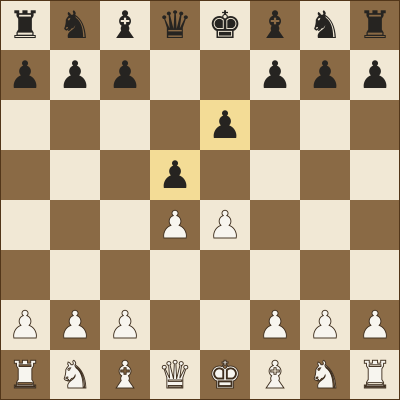
The pawn chain — interlocking pawns like the French's e6-d5. Attack the chain at its base, and play toward the side it points.
- Nimzowitsch, A. My System (the classic treatment of pawn chains and blockade).
- Soltis, A. Pawn Structure Chess. Random House.
- Kmoch, H. Pawn Power in Chess.
Diagrams are illustrative teaching positions created for this guide.
You've finished the Chess Fundamentals series
With tactics, mating patterns, and pawn structures under your belt, the opening guides will make far more sense — every opening is really a fight to reach a favorable structure. Put it all together in the opening deep dives.