
Caro-Kann Advance Variation
Short System, Botvinnik-Carls counter, the h4 gambit, and every tool Black needs — a complete repertoire guide for 3.e5 Bf5.
Caro-Kann:
Advance Variation
3.e5 Bf5
Counter the e5 chain.
Almost every line
leads here for Black.
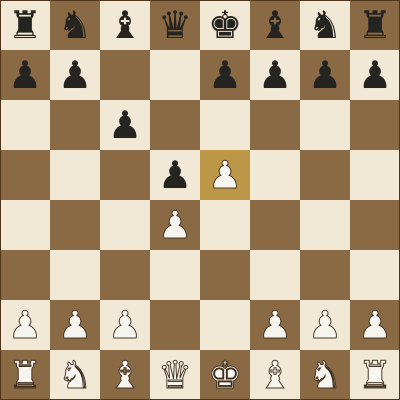
The Advance Variation is a structure where White grabs space early with 3.e5, pushing Black's bishop out and claiming the center. This page is written entirely from Black's point of view — how to counter White's aggression, exploit the overextended e5-pawn, and reach the endgame with a clear structural advantage. The Advance is one of the most instructive systems in all of chess for understanding pawn structure, counterplay, and long-term planning.
The Advance Tabiya: After 3.e5 Bf5
After 1.e4 c6 2.d4 d5 3.e5 Bf5 — the Advance Variation tabiya. Black's bishop on f5 (highlighted) has escaped the pawn chain before it closed. White has space, Black has the active bishop and the key counter-idea: ...c5!
The move 3.e5 is White's most space-grabbing response in the Caro-Kann. White pushes Black back and stakes a claim on e5 — but in doing so, overstretches. Black's counter is elegant: 3...Bf5 immediately develops the c8-bishop before the e6 pawn shuts the diagonal. This is the defining move of the Advance Caro-Kann and the reason it is superior to the analogous French position: there is no "bad bishop" problem.
Black's plan from this point is almost always the same: develop normally with ...e6, then strike the center with ...c5. The e5-pawn that looks powerful is actually a target — it requires constant defense and gives Black a long-term structural objective.
The Short System: 4.Nf3 e6 5.Be2
Named after Nigel Short, this is White's most principled and theoretically demanding approach to the Advance. White develops solidly — 4.Nf3 adds a defender to e5, and 5.Be2 prepares kingside castling while staying flexible. This is not a quiet setup: Short used it aggressively, planning g4 and a kingside attack once castled.
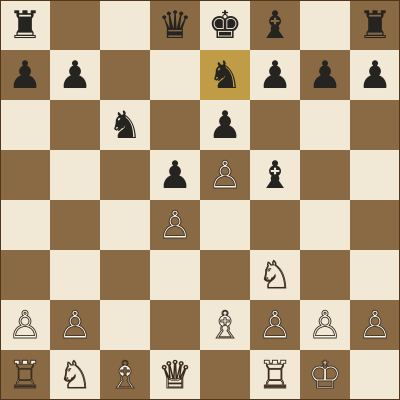
Black's 5...c5! is the key response — the most principled counter to the Short System. Black immediately challenges White's center before castling. After 6.0-0 Nc6 7.c3, Black can choose between 7...cxd4 (releasing the tension) or maintaining it with 7...Qb6.
After 7...cxd4 8.cxd4 Nge7
Black trades the c-pawn for White's d-pawn, reaching a position where White has an isolated pawn on d4 — but also strong piece activity. After 9.Nc3, Black plays 9...Nf5 targeting the d4-pawn. The game becomes a fight over the isolated pawn, similar to the Panov-Botvinnik structure but with reversed roles.
After 7...Qb6 8.Nc3 cxd4
Black keeps pressure on b2 and d4 with the queen before releasing tension. After 8.Nc3 cxd4 9.Na4 Qd8, Black retreats the queen but has forced White's knight to an awkward square. The resulting positions offer Black excellent counterplay with the active bishop pair.
Instead of the immediate ...c5, Black delays with 5...Nd7 6...Ne7, developing the knights first. The knight on e7 can go to g6 to attack White's e5-pawn, or to f5 to pressure d4. After ...h6 (to stop Bg5) and ...c5, Black has a flexible setup with multiple plans. Karpov used similar structures to great effect.
The Botvinnik-Carls: 3...c5!? Immediate Counter
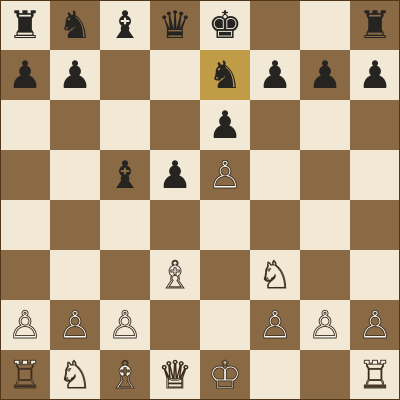
The Botvinnik-Carls is Black's most aggressive response to the Advance — instead of developing the bishop first with 3...Bf5, Black immediately strikes the center with 3...c5!. White typically takes with 4.dxc5, and Black recaptures after 4...e6 5.Nf3 Bxc5, developing naturally and targeting e5 immediately.
The resulting positions are rich and dynamic. Black has active piece play from the start, the bishop is well-placed on c5, and the e5-pawn is already under pressure. The tradeoff: Black has no pawn on c6, so the center is more open and White has more attacking chances. Tactical players who prefer fighting positions early will enjoy this approach.
Why Play Botvinnik-Carls?
- Avoids the theory-heavy Short System lines
- Active bishop on c5 from the start
- Forces White to make an early decision
- Rich tactical play from move 3
- Suits aggressive, attacking Black players
The Tradeoff
- White can decline with 4.c3 or 4.Nf3
- More open position = more White attacking chances
- Less solid than the classical ...Bf5 approach
- If White handles it well, the position can become sharp
- Best for players who have studied it deeply
Handling 4.c3 — the Solid Fortify-d4 Setup
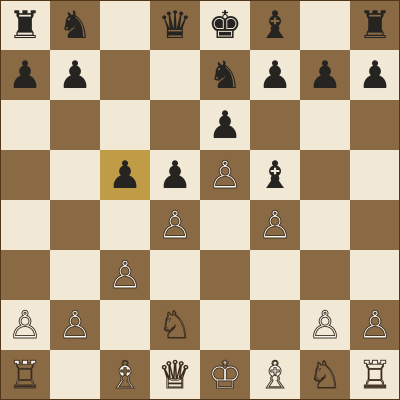
After 4.c3, White fortifies the d4-pawn and prepares a solid setup, often planning h4 to attack the Bf5. It is less ambitious than 4.h4 or 4.Nc3, but sturdy — White wants a slow game with a space edge. Black's best response remains the same: complete development and counter with ...c5.
Black's most solid plan: 4...e6 first to solidify the position, then 5...c5 striking the center. After 6.Ngf3 Nc6 7.Nb3, Black has a comfortable game with natural development. The bishop on f5 remains active, and Black can castle queenside if needed to avoid White's kingside ambitions.
Handling the Tal Variation: 4.h4
One of White's most aggressive tries in the Advance is 4.h4 — the Tal Variation, which Mikhail Tal unleashed against Botvinnik in their 1961 World Championship rematch — immediately threatening h5 to trap or exchange the Bf5. This is critical to handle correctly — many Black players panic and lose the bishop prematurely. The correct response is counterintuitive but strong.
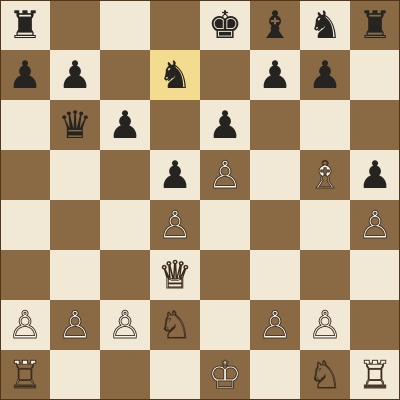
Black plays 4...h5!, meeting the aggression directly. Black keeps the bishop and creates a fixed pawn on h5 that becomes a future target. After 5.Bd3 Bxd3 6.Qxd3, the exchange simplifies the position and Black has no structural problems. White has committed the h-pawn but Black is solid.
After 4...h5! — Black's Plan
- Keep the Bf5 — don't exchange it for nothing
- Play ...e6 to solidify and prepare ...c5
- ...Nd7-Nb6 or ...Ne7-Nf5 to pressure White
- Black's h5-pawn is a future weakness for White to attack
- Eventually Black can play ...g6-...Bg7 to complete the kingside
What NOT to Play Against 4.h4
Avoid 4...Bg6? which allows 5.h5 Bh7 6.e6 — a powerful pawn thrust that destroys Black's structure. Also avoid 4...Bh7? 5.e6! with the same problem. Black must keep the bishop on the f5-h7 diagonal active, not retreat it to h7 where e6 becomes devastating.
White's 4.Nc3 Variation and Transpositions
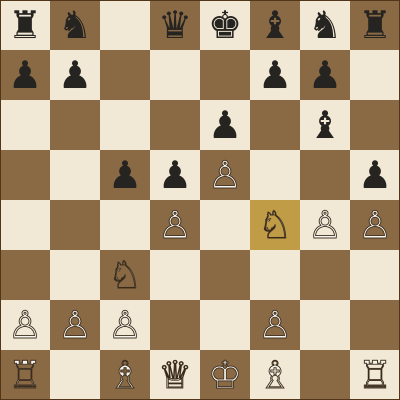
White can develop naturally with 4.Nc3, heading toward the mainline Classical setup but in the Advance context. After 4...e6 5.g4 Bg6, White pushes aggressively. This is where the game becomes particularly sharp — Black must choose between keeping the bishop with 5...Bg6 (accepting White's space) or grabbing the pawn with 5...Bxg4??, which simply loses a piece to 6.Qxg4.
Black retreats the bishop to g6, not to h7 yet. After 6...c5 7.h4 h5 8.Nf4 Bh7, the bishop is on h7 but the position is very different — the g4-g5 advance is not coming because h4 is played. Black has a solid setup and the ...c5 break has already challenged the center.
Black's Long-Term Plans: Pawn Structure and the Endgame
One of the Advance Caro-Kann's most instructive features is the endgame — where Black's structural advantages often become decisive. Understanding this endgame is essential for choosing the right plans in the middlegame.
| Structure | Black's Asset | White's Weakness | Plan |
|---|---|---|---|
| c6-d5-e6 + e5 pawn | Solid queenside, active Bf5 | Overextended e5 | ...c5 counter, target e5 |
| IQP on d4 (after ...cxd4) | Blockader on d5 | Isolated d4-pawn | Exchange pieces, reach the endgame |
| Symmetrical (both d-pawns gone) | Bishop pair potential | White's extra pawn has no support | Piece activity, exploit open files |
| Passed d5 pawn | Passed pawn + active pieces | Must stop the d-pawn | Support ...d4 advance |
In the Advance Caro-Kann endgame, Black's bishop on f5 or g6 is almost always better than White's minor pieces that had to defend e5. When pieces come off the board, Black's solid pawn structure and active bishop often convert to a win. This is why Karpov — a supreme endgame technician — loved the Advance: the opening naturally leads to endings he excelled at. If you aim for the endgame in the Advance Caro-Kann, you are following in Karpov's footsteps.
The ...c5 Break: Black's Universal Weapon
Understanding when to play ...c5 is as important as knowing that you should. Here is a move-order guide for the most common setups:
Play ...c5 Immediately (Move 3 or 4)
Against 4.c3 or in the Botvinnik-Carls (3...c5), striking immediately is strong. White hasn't completed development and can't defend d4 and e5 simultaneously. The sooner ...c5 comes, the more disruption it causes.
Delay ...c5 Until Developed
Against the Short System (4.Nf3 e6 5.Be2), Black can delay with 5...Nd7 or 5...Ne7 first. With all pieces in place, the ...c5 break is even more powerful because Black has reinforcements ready for the resulting complications.
After 6.dxc5, Black plays 6...Nd7 rather than immediately recapturing. The e5-pawn is now hanging with the d-pawn gone. After 7.0-0 Nxe5 8.Nxe5 Qc7, Black wins the e5-pawn back, leaving the position roughly equal but with Black's solid structure. This is a reliable equalizing line.
Variation Reference: What White Plays and How Black Responds
4.Nf3 e6 5.Be2 (Short System)
Best: 5...c5! immediately, or 5...Nd7 first. After 6.0-0, play 6...Nc6 or 6...cxd4. Aim for an IQP position where you blockade d4 with a knight.
4.c3 (Solid System)
Best: 4...e6 then 5...c5 quickly. After 5.Nd2, Black plays 5...c5 striking immediately. After 5.f4 (more aggressive), Black still plays 5...c5 — the same counter works everywhere.
4.h4 (Tal Variation)
Best: 4...h5! Keep the bishop. After 5.Bd3 Bxd3 6.Qxd3, trade the bishops and develop solidly. Never play 4...Bg6?? allowing 5.h5 Bh7 6.e6!.
4.Nc3 (Development)
Best: 4...e6 5...c5 with the same plan. If White plays 5.g4, respond 5...Bg6 keeping the bishop. Black's plan is the same in every line.
4.Be3 (Positional)
Best: 4...e6 5...c5. White's Be3 is a slow development — Black exploits this by striking the center before White's setup is complete. After 5.Nd2 c5 6.c3 Nc6, Black has excellent counterplay.
3...c5!? (Botvinnik-Carls)
If you want aggression: Skip 3...Bf5 entirely and play 3...c5! immediately. White must respond. After 4.dxc5 e6 5.Nf3 Bxc5, you have active piece play and a direct fight from move 3.
Champions of the Advance Caro-Kann
Anatoly Karpov — The Endgame Master
Karpov's treatment of the Advance Caro-Kann as Black is the gold standard. He never tried to "refute" White's aggressive play — instead, he accepted White's space, developed solidly, played the ...c5 break at the optimal moment, and steered the game toward endgames where his superior technique prevailed. Studying Karpov's Advance Caro-Kann games is the single best investment for anyone who wants to play this system as Black.
Key principle: "Don't fight the e5 pawn with tactics. Fight it with strategy — undermine it with ...c5, blockade d4, and outplay White in the endgame."
Tigran Petrosian — The Defensive Genius
Petrosian used the Advance Caro-Kann as a defensive weapon against stronger players who wanted open positions. His patience was legendary — he would accept White's space advantage and simply wait for the moment to strike. Petrosian's games in this system demonstrate that the Advance is not a passive defense but an active weapon that defeats impatient attacking play.
Key principle: "The e5-pawn is White's biggest weakness, not Black's. Let White overextend, then exploit the weaknesses left behind."
Viswanathan Anand — The Preparation Specialist
Anand used the Advance Caro-Kann in his World Championship matches, having prepared deep novelties that surprised well-prepared opponents. His games demonstrate that the Advance is not just a "solid but boring" system — with preparation, Black can create imbalances and win outright. Anand's 2010 match preparation included multiple Advance lines as a surprise weapon against Topalov.
Frequently Asked Questions
After 3.e5 Bf5, the best plan is the ...c5 counter-strike. In the Short System after 4.Nf3 e6 5.Be2, Black plays 5...c5! immediately. Against 4.c3, the same idea: 4...e6 5...c5. The counter is universal — once you understand that ...c5 is always coming, the Advance Caro-Kann becomes easy to play as Black because all variations lead to the same type of positions.
After 3.e5 Bf5 4.Nf3 e6 5.Be2 — Nigel Short's solid but testing approach. White develops quietly, plans to castle, and then attack with g4. Black must counter immediately with 5...c5! to disrupt White's plans. After 6.0-0 Nc6 7.c3, Black can take with 7...cxd4 reaching an IQP position, or build tension with 7...Qb6. Both are playable.
3.e5 c5!? — instead of developing the bishop first, Black immediately strikes with the c-pawn. After 4.dxc5 e6 5.Nf3 Bxc5, Black has active piece play and puts immediate pressure on e5. This is the aggressive alternative for players who want to create an early fight rather than the classical ...Bf5 development.
Play 4...h5! — the counterintuitive but correct move. Black meets aggression with aggression, keeping the bishop on f5. After 5.Bd3 Bxd3 6.Qxd3, the exchange is fine for Black. The key mistake to avoid is 4...Bg6?? allowing 5.h5 Bh7 6.e6! — a devastating pawn sacrifice that destroys Black's pawn structure.
Black typically has c6-d5-e6 pawns — solid, French-like, but without the bad bishop that plagues French players. Once Black plays ...c5, the structure becomes more dynamic. In the endgame, Black's structure is inherently sound while White's overextended center becomes a liability. The Advance Caro-Kann is one of the best openings for learning pawn structure and long-term planning.
There is one plan — ...c5 — that works against almost everything White plays. Once you internalize this, the Advance Caro-Kann requires very little specific memorization. You understand the principle and apply it. The positions are solid, not easily lost by tactical blunder, and the endgames favor Black when both sides play correctly. It's a reliable system that rewards strategic understanding over memorization.
Further Reading & Study
Books
- Houska, Play the Caro-Kann — excellent Advance coverage
- Schandorff, Playing the Caro-Kann
- Karpov games collections — study the Advance endgames
Online Resources
- Lichess.org — B12 explorer, filter Advance lines
- Chessable — Caro-Kann Advance courses
- YouTube — Karpov's Advance Caro-Kann game analyses
Model Games
- Karpov – various, 1974-2005 (masterclass in the Advance endgame)
- Anand – Topalov, 2010 WCh (Short System preparation)
- Petrosian – various (defensive mastery in the Advance)
Opening analysis based on current grandmaster practice and classical games. ECO classification B12 from standard references.