
Checkmate Patterns
Every game of chess ends one way: the king is trapped. Almost every checkmate is a recognizable shape that repeats game after game. Learn the classic patterns — the back-rank mate, the smothered mate, and the ideas behind them — and you will both deliver mate sooner and smell danger earlier.
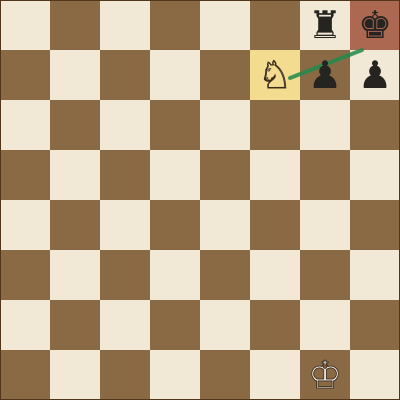
The smothered mate: a lone white knight on f7 delivers checkmate because the black king on h8 is hemmed in by its own rook and pawns. Patterns like this repeat in thousands of games — once you know the shape, you see it everywhere.
What is checkmate?
The king is in check and has no legal move to escape — the game ends instantly
It's all patterns
Nearly every mate is a recognizable shape that repeats across thousands of games
Two famous ones
The back-rank mate and the smothered mate — both punish a trapped, boxed-in king
Defense too
Knowing the patterns lets you sense danger and create an escape square in time
The Back-Rank Mate
The most common checkmate in all of chess. After both sides castle, the king sits on the back rank behind a wall of its own pawns. Those pawns keep the king safe from a frontal attack — but they also trap it. If a rook or queen reaches the back rank with no defender to stop it, the king has nowhere to go: it cannot move forward (its own pawns block it) and it cannot move along the rank (the rook covers it). Checkmate.
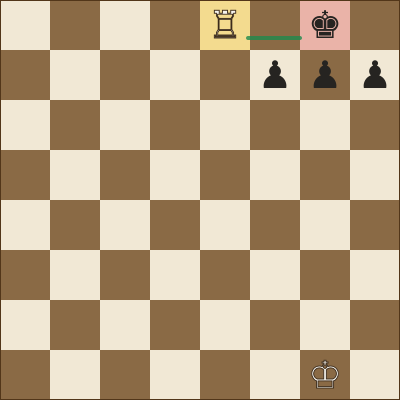
A back-rank mate. White's rook reaches e8 and checks along the eighth rank to the king on g8 (highlighted). The king is sealed in by its own pawns on f7, g7, and h7 — there is no escape. This is why experienced players make a small 'luft' escape square in time.
The Smothered Mate
The most beautiful pattern in chess. A knight delivers checkmate to a king that is completely boxed in by its own pieces — it is literally smothered. The knight's attack cannot be blocked, and because every escape square is occupied by a friendly piece, the king cannot run. The classic delivery uses a queen sacrifice to force the defender's own rook to block the king's last flight square, setting up the knight's final, silent blow.
A smothered mate. The white knight on f7 checks the black king on h8 (highlighted). The king cannot move: g8 is blocked by its own rook, and g7 and h7 by its own pawns. The knight's check cannot be blocked or captured — pure, geometric checkmate.
Other patterns worth knowing
The two-rook ladder
Two rooks (or a rook and queen) drive the enemy king to the edge of the board, one cutting off a rank or file while the other checks, marching the king to its doom like climbing rungs of a ladder. It is the first mate every player should master, because it works with no help from the enemy position.
Queen-and-king mate
The essential endgame mate: the queen boxes the lone king toward the edge while your own king steps up for support, until the queen delivers mate with the king guarding it. Knowing how to do this cleanly — without stalemating — is a basic skill every player needs.
Checkmate Patterns — FAQ
What is a back-rank mate?
A rook or queen mates along the opponent's first rank while their king is trapped behind its own unmoved pawns. The king can't go forward (pawns block it) or sideways (the rook covers the rank). It is one of the most common ways games end — which is why players make a 'luft' escape square.
What is a smothered mate?
A checkmate by a knight against a king completely surrounded by its own pieces, so it has no flight square. The classic version sacrifices the queen to force the defender to box in its own king, then the knight delivers an unstoppable mate.
How do I avoid getting checkmated on the back rank?
Make 'luft' — push the pawn in front of your king one square to give it an escape hatch. Keep a piece guarding your back rank, and stay alert whenever the opponent's rook or queen lines up against your first rank. One move of prevention stops a huge share of losses.
Why is learning checkmate patterns important?
Because chess is won by checkmating the king, and almost every mate is a recognizable pattern. Knowing them helps you spot mating chances faster and sense danger sooner. Pattern recognition is the most efficient path to improvement.
The back-rank mate — the king sealed behind its own pawns, the rook delivering mate along the open first rank. The most common mate in chess.
The smothered mate — a knight checkmating a king boxed in by its own pieces. The most elegant pattern on the board.
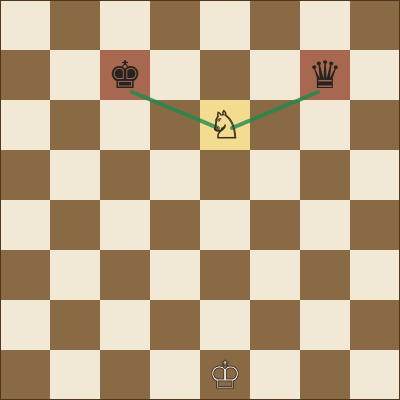
Many mates begin with a tactic — a fork or a check that drags the king into the open before the net closes.
- Renaud, G. & Kahn, V. The Art of Checkmate.
- Polgar, L. Chess: 5334 Problems, Combinations and Games (mating patterns).
- Lichess.org mate-in-one and mate-in-two puzzle sets.
Diagrams are illustrative teaching positions created for this guide.
From mating the king to mastering the pawns
Tactics and mates decide attacks — but the long strategic game is shaped by pawns. Part 3 covers the structures that quietly decide most games: the isolated queen's pawn, the passed pawn, and the pawn chain.
Continue to Part 3: Pawn Structures → · Back to Part 1: Tactics →