
The Caro-Kann Defense
1.e4 c6 — the most solid of all defenses to 1.e4. The Caro-Kann supports the d5 pawn advance without blocking the c8 bishop, giving Black a harmonious, slightly passive but rock-solid position. Karpov built his World Championship reign on it. If you want to play 1.e4 from the Black side without entering a tactical firefight, this is the opening.
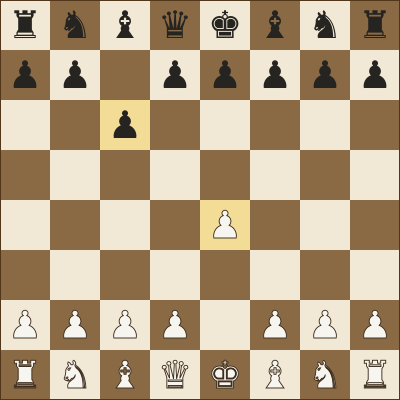
The Caro-Kann begins 1.e4 c6 — Black prepares 2...d5 to challenge the center while keeping the c8 bishop's diagonal open. Unlike the French Defense, Black's c-pawn supports d5 without closing in the queen's bishop.
A three-part deep dive on 1.e4 c6
ECO Code
B10–B19 — Caro-Kann Defense, covering all major variations: Classical, Advance, Exchange, Panov
The Moves
1.e4 c6 2.d4 d5 — Black supports d5 with c6, keeping the bishop diagonal open
Key Idea
Solid center with ...d5, active bishop on f5 (Classical), and long-term pawn structure superiority
Famous Practitioners
Karpov, Petrosian, Botvinnik, Anand, Carlsen — the Caro-Kann is the "grandmaster's defense"
Solid as a rock, with an active bishop
The Caro-Kann's key idea is in its first move: 1...c6. Unlike the French (1...e6 then 2...d5), the Caro-Kann supports d5 with the c-pawn, crucially keeping the c8 bishop's diagonal on f5 or g4 open. Black avoids the passive "bad bishop" problem that plagues French Defense players.
After 1.e4 c6 2.d4 d5, Black has set up a classical center. In the main lines (3.Nc3 dxe4 4.Nxe4), Black exchanges center pawns and develops the bishop: 4...Bf5. This bishop on f5 is one of the most actively placed pieces in any defense to 1.e4 — it supports the ...e6 pawn and controls the d3, e4, and g4 squares.
Black's position is solid but slightly passive. The trade-off is clear: Black rarely fights for a large advantage in the opening, but almost never gets a bad position. The Caro-Kann is the defense of players who trust their endgame and positional technique over opening fireworks.
After 1.e4 c6 2.d4 d5 — the Caro-Kann pawn structure
After 1.e4 c6 2.d4 d5 — the Caro-Kann position. The highlighted c6 pawn (Black's first move) defines the opening — it supports d5 without closing the c8 bishop's diagonal. White must now decide: exchange (3.exd5), advance (3.e5), or develop (3.Nc3 or 3.Nd2).
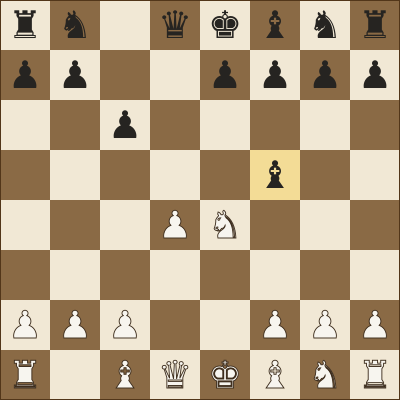
Classical Caro-Kann after 4.Nxe4 Bf5
After 1.e4 c6 2.d4 d5 3.Nc3 dxe4 4.Nxe4 Bf5 — the Caro-Kann Classical. The bishop on f5 (highlighted) is Black's key asset: it develops freely outside the pawn chain, a luxury Black rarely enjoys. White typically continues 5.Ng3 Bg6 6.h4 h6 7.Nf3 Nd7 8.h5 Bh7 — the main theoretical battleground.
Classical, Advance, Exchange, and Panov Attack
3.Nc3 dxe4 4.Nxe4 Bf5 — the Caro-Kann bishop
The Classical Caro-Kann is defined by 4...Bf5, the active bishop development. White typically plays 5.Ng3 to challenge the bishop, and after 5...Bg6, White plays 6.h4 in the main line — a pawn advance to attack the bishop and generate kingside pressure. Black responds 6...h6, and both sides develop. The resulting positions are slightly better for White due to space but extremely solid for Black.
3.e5 — White advances the pawn
White plays 3.e5, advancing the pawn before Black can challenge it. The position resembles the French Advance but Black has a key difference: after 3...Bf5, the c8 bishop is already developed — the French Defense's main headache. Black then plays ...c5 to challenge White's d4 pawn and equalize. The Advance Caro-Kann is sharp and requires precise handling from both sides.
3.exd5 cxd5 4.c4 — the Panov gambit idea
After 3.exd5 cxd5, White plays 4.c4 — the Panov Attack. This transforms the Caro-Kann into positions resembling an IQP (Isolated Queen's Pawn) game. White accepts an isolated d4-pawn in exchange for active piece play and attacking chances; Black blockades d5 and aims to trade down toward a favorable endgame. The Panov is one of the sharpest tries against the Caro-Kann and leads to dynamic, double-edged positions quite unlike the solid Classical main line.
The "grandmaster's defense" to 1.e4
Anatoly Karpov
Karpov's Caro-Kann games are some of the most beautifully played positional chess in history. As World Champion from 1975 to 1985, Karpov used the Caro-Kann as his primary weapon against 1.e4. His Classical Caro-Kann games — particularly his handling of the bishop and the endgame — remain model examples studied in every advanced chess training curriculum.
Tigran Petrosian
The "Iron Tiger" Petrosian was famous for impenetrable defensive play, and the Caro-Kann was his natural habitat. Petrosian's Caro-Kann positions were virtually impossible to attack — he would absorb White's initiative and then slowly outplay opponents in complex endgames. His style — prophylaxis, solidity, precision — perfectly matched the Caro-Kann's character.
Viswanathan Anand
Five-time World Champion Anand used the Caro-Kann throughout his career when he needed security with Black. Anand's preparation in the Advance Variation and the Two Knights line was deep and precise. His games in the Caro-Kann demonstrated that the opening, while solid, can generate active counterplay when the center opens.
Caro-Kann Defense — FAQ
What is the Caro-Kann Defense?
The Caro-Kann is a chess opening for Black against 1.e4, beginning with 1...c6. Black prepares 2...d5 to challenge the center, supporting the d5 pawn with the c-pawn rather than with ...e6 (as in the French). This keeps the c8 bishop's diagonal open, allowing 4...Bf5 in the Classical variation. The Caro-Kann is renowned for its solidity and long-term structural soundness.
Is the Caro-Kann good?
Yes — the Caro-Kann is one of the most theoretically sound defenses to 1.e4, used by world champions including Karpov, Botvinnik, and Petrosian. It leads to solid, harmonious positions without major tactical risks. The trade-off is that Black rarely gets an early initiative — the Caro-Kann is for players who trust their positional technique and endgame over early tactical complications.
What is the Classical Caro-Kann?
The Classical arises after 1.e4 c6 2.d4 d5 3.Nc3 dxe4 4.Nxe4 Bf5 — Black develops the bishop actively before closing the position. The f5 bishop is the signature piece of the Classical Caro-Kann. White plays 5.Ng3 to challenge it, and after 5...Bg6, the main line continues 6.h4 h6 7.Nf3. Both sides develop in a solid, slightly imbalanced position with White having a slight edge in space.
What is the Advance Caro-Kann?
The Advance arises after 3.e5 — White advances the e-pawn before exchanging. Unlike the Classical, Black cannot exchange pawns immediately. Black plays 3...Bf5 to develop the bishop before the position closes, then ...e6 and ...c5 to undermine White's center. The Advance leads to positions resembling the French Advance but with Black's c8 bishop already active — a crucial difference.
Who plays the Caro-Kann Defense?
The Caro-Kann is associated with world-class positional players. Anatoly Karpov is its most famous practitioner. Tigran Petrosian, the "Iron Tiger," used it extensively. In modern chess, Magnus Carlsen, Viswanathan Anand, and Peter Svidler have all played the Caro-Kann — typically when they need a reliable, solid option with Black in must-draw or must-not-lose situations.
Is the Caro-Kann good for beginners?
The Caro-Kann is a good choice for beginners who want a solid defense against 1.e4 without entering the massive theory of the Sicilian. The Classical variation teaches fundamental positional concepts: bishop placement, pawn structure, and avoiding tactical traps. It requires more patience than the Sicilian but rewards understanding over memorization. Players who enjoy positional chess and endgames will find the Caro-Kann a natural fit.
The Caro-Kann creates solid pawn structures that are difficult to undermine — Karpov's mastery of the endgame in these positions was unmatched.
The bishop on f5 in the Classical Caro-Kann is one of the most actively placed pieces in any defense to 1.e4 — it controls key squares without being easily traded.
Petrosian's Caro-Kann positions were virtually impossible to crack — his games remain the gold standard for defensive technique at the world championship level.
- Schandorff, L. (2010). Playing the Caro-Kann. Quality Chess.
- Neishtadt, Y. (1984). The Caro-Kann Defence. Pergamon Press.
- Karpov, A. (1994). Caro-Kann Defence: Classical Variation. Batsford. (Model games annotated.)
- Chess Informant Database — ECO B10–B19.
Seven opening guides on michaelpaycer.com
Ruy Lopez, Sicilian, Queen's Gambit, King's Indian, London System, Caro-Kann, French Defense — all with board diagrams and full strategy guides.