
The King's Gambit
There is no opening in chess more willing to fight. With 1.e4 e5 2.f4, White offers a pawn and declares war. The f-pawn sacrifice opens a file, accelerates development, and creates immediate attacking chances against Black's king — in exchange for structural weakness and a soft f2 square. Everything is sharp; nothing is quiet. The King's Gambit has been decisive at the highest levels for over four centuries.
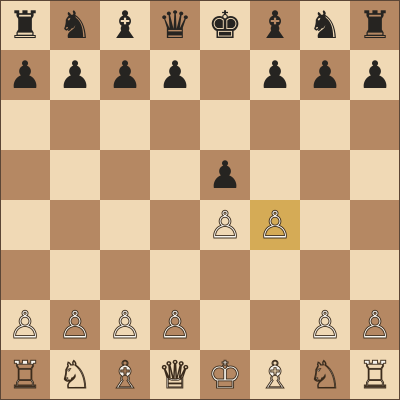
The King's Gambit begins 1.e4 e5 2.f4 (highlighted) — White genuinely offers the f-pawn. Black can accept with 2...exf4 or decline; after the capture the f-file opens, pointing straight at f7, the weakest square near Black's king.
The Moves
1.e4 e5 2.f4 — White offers the f-pawn to open the f-file and attack
ECO Codes
C30–C39 — Open Game / King's Gambit
Black's Replies
2...exf4 (Accepted); 2...Bc5 (Classical Declined); 2...d5 (Falkbeer Counter-Gambit)
Famous Players
Anderssen, Morphy, Chigorin, Spassky, Shirov — chess's great attackers
What happens after 1.e4 e5 2.f4
The position after 2.f4 confronts Black with an immediate decision. The gambit is real: White genuinely sacrifices the f4 pawn, which Black can capture and hold (for a few moves at least). The question is not whether White gets compensation — White does — but whether it outweighs the material deficit. That question has been debated for 400 years.
After 1.e4 e5 2.f4 (highlighted), White offers the f-pawn. Black accepts with 2...exf4 or declines. After the capture, the f-file opens toward f7 — White's primary attacking lane.
Once f4 is played, White wants to: (1) play Nf3 to control e5 and d4; (2) advance d4 to seize the centre; (3) castle and bring a rook to the f-file; (4) use the open f-file and the diagonal toward f7 to attack Black's king. The f-file and f7 are White's primary targets.
Four centuries of fighting chess
The King's Gambit first appeared in 16th-century manuals and reached its peak in the 19th century — the Romantic era, when sacrificial brilliance was prized above all. Adolf Anderssen, whose "Immortal" (1851) and "Evergreen" (1852) games remain the most famous ever played, built much of his play on King's Gambit ideas; Paul Morphy used it to dazzling effect before retiring at 21; Zukertort and the first World Champion Steinitz both played it extensively.
Decline and revival
Ironically, Steinitz's own positional revolution — chess as the accumulation of small advantages rather than brilliant attack — undermined the gambit, and by 1920 it was considered outdated in elite circles. Then Boris Spassky, World Champion in 1969, revived it: his 1960 win over Bronstein is one of the finest King's Gambit games ever played.
The modern verdict
Today the King's Gambit is rare at the very top, where computers have mapped Black's precise defenses — Fischer's 1961 "Bust" argued 2...exf4 3.Nf3 d6! gives Black a safe edge. But below the elite, and in rapid and blitz, it remains a dangerous, thrilling practical weapon.
Accept or decline — Black's decision
The King's Gambit forces Black to choose immediately: accept and defend with precision, or decline and face a well-prepared White centre. Neither path is easy.
King's Gambit Accepted — 2...exf4
Taking the pawn gives Black an extra pawn and the f-file, but surrenders the centre and lets White develop fast. After 3.Nf3, White controls d4 and prepares the central advance, while Black must decide whether to hold the f4 pawn, return it, or use it for counterplay. This is the sharpest, most theoretically complex branch — covered in Part 2.
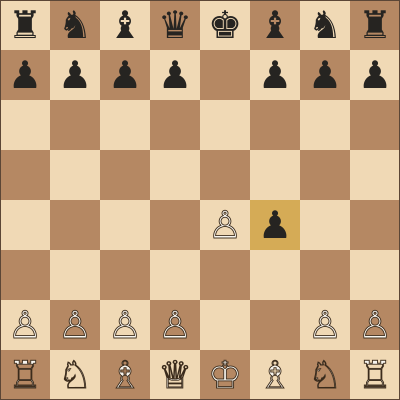
King's Gambit Accepted: 2...exf4 (the black pawn on the highlighted f4 square). Black is a pawn up and cramps White with the f4-pawn, but White will play 3.Nf3 and d4 to seize the centre and attack.
Classical Declined — 2...Bc5
The Classical Defense declines the gambit and develops the bishop to c5, eyeing f2 and keeping the centre balanced. It is solid and reliable; White still has chances but must work harder.
Falkbeer Counter-Gambit — 2...d5
The most combative decline: Black ignores f4 and strikes the centre. After 3.exd5, play is sharp and often inverted — Black creates the pressure. The Falkbeer has been analyzed for 170 years and remains fully viable.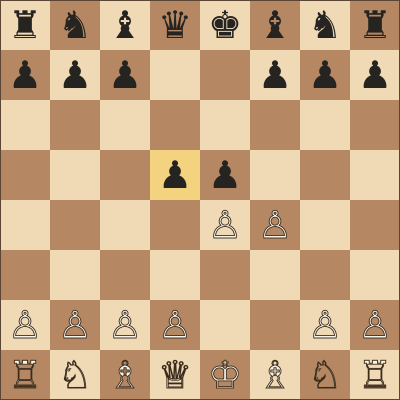
The Falkbeer Counter-Gambit: 2...d5 (highlighted). Black ignores the offered f-pawn and counterattacks the centre, flipping the initiative — White must know the theory to avoid coming out worse.
What White is trying to achieve
The f-file as a weapon
Once Black captures on f4 and White opens or recaptures, the f-file becomes an attacking lane. A rook on f1 (or f3 after castling) aims at f7 — traditionally Black's weakest point. Many King's Gambit games end with a rook or queen on the f-file delivering decisive threats.
Central control after d4
White's main positional goal after the sacrifice is d4, building two central pawns on e4 and d4. If White achieves this while Black is busy holding f4, the strong centre compensates the pawn — and often more.
Development and attacking tempo
Every move Black spends holding f4 is a move not developing. After 2...exf4 3.Nf3 g5?!, White plays 4.h4 and the cost of Black's defensive moves begins to tell — White's pieces flow out while Black's king grows exposed. The King's Gambit attacks don't wait for the endgame; they arrive in the middlegame.
King's Gambit — FAQ
Is the King's Gambit still played at the top level?
Rarely, but yes — most often in rapid and blitz, where preparation depth matters less and tactical vision is rewarded. In classical chess it is rare because Black has precise computer-mapped defenses. Below the very top it is fully viable and dangerous, especially against opponents who have not studied it.
Does White have to sacrifice the f4 pawn permanently?
Not always. In many Accepted lines White recovers it within a few moves. In others — especially 2...exf4 3.Nf3 g5, where Black holds with the g-pawn — the f4 pawn is a lasting material edge for Black, and White must generate attacking compensation without recovering it.
What is the best response to the King's Gambit for Black?
Theory has no unanimous answer, which is part of the appeal. The Accepted with solid development is fully viable; the Classical Declined (2...Bc5) is reliable; the Falkbeer (2...d5) is sharp and aggressive. Players choose based on style and preparation.
Who are the greatest King's Gambit players in history?
Anderssen and Morphy in the Romantic era, Spassky in the 20th century (his 1960 win over Bronstein is a classic), and modern creative players like Shirov and Short. The gambit's spirit aligned with attacking geniuses like Tal.
2.f4 — the gambit announces White's intentions on move two: this game will be a fight, not a technical exercise.
Accepted (2...exf4) — Black grabs a pawn and cramps White with the f4-pawn; White gets the centre, development, and the open f-file toward f7.
The Falkbeer (2...d5) — Black's combative decline, striking the centre and flipping the initiative back at White.
- Gallagher, J. (1992). Winning with the King's Gambit. Batsford.
- Kasparov, G. My Great Predecessors, Vol. IV (Spassky's King's Gambit games).
- Fischer, R. "A Bust to the King's Gambit" (American Chess Quarterly, 1961).
- ECO classification C30–C39.
Every opening belongs to a family — browse the three theme clusters: Romantic & Attacking Gambits · Flank & Hypermodern Systems · Solid Defenses.
King's Gambit — Part 1 of 3
Now that you know the ideas, dive into the lines. Part 2 covers the Accepted main lines, the Classical Declined, and the Falkbeer in detail.