Queen's Gambit Declined
The most classical answer to the Queen's Gambit — 1.d4 d5 2.c4 e6 — a fortress of solidity. The Orthodox/Capablanca freeing system, the Exchange Variation with its famous minority attack, and the rock-solid Lasker Defense.
Exchange: D35–D36
Orthodox: D50–D63
Lasker: D53–D57
...e6 supports d5
and Black unravels
with ...c6, ...dxc4, ...Nd5.
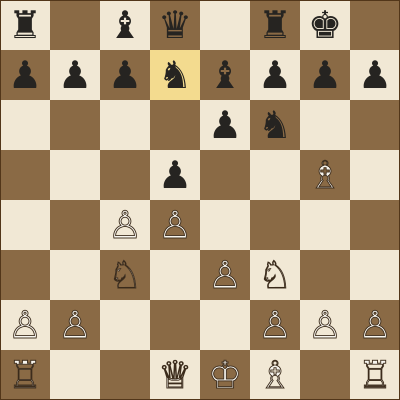
No opening has anchored more World Championship matches than the Queen's Gambit Declined. Black's ...e6 accepts one small concession — a temporarily passive light-squared bishop — in exchange for a centre so solid it is almost impossible to break down. The entire art of the QGD is unravelling: freeing the position with ...c6, ...dxc4 and ...Nd5, or striking with the ...e5 or ...c5 breaks at exactly the right moment. Master the QGD and you master classical chess.
The Orthodox / Capablanca System
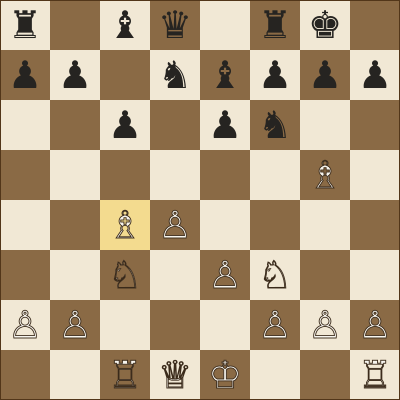
The classical main line. After the standard development 4.Bg5 Be7 5.e3 0-0 6.Nf3 Nbd7, Black adopts Capablanca's freeing manoeuvre: ...c6, ...dxc4 to open the position for the bishop, and ...Nd5 to trade pieces and relieve the cramp. Understanding this unravelling plan is the key to playing the QGD well — it turns a passive setup into a fully equal, resilient game.
The Exchange Variation & Minority Attack
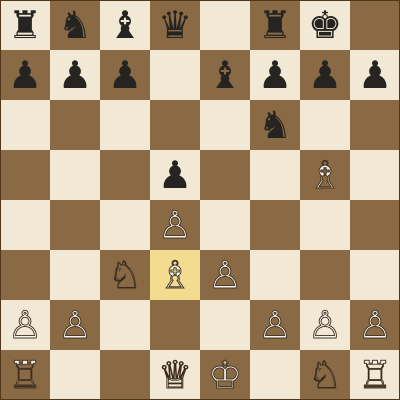
By exchanging on d5, White creates the Carlsbad pawn structure and aims for the famous minority attack: advancing b4-b5 to create a weakness on Black's queenside (typically a backward c6-pawn). Black counters with kingside play (...Ne4, ...f5) or central action (...c5). The Exchange Variation is one of the most instructive strategic battles in all of chess — a textbook study in structure-based planning.
The Lasker Defense
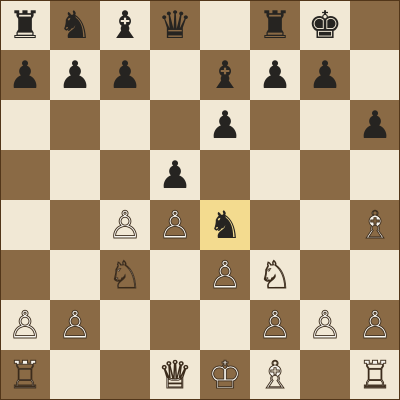
Emanuel Lasker's solution to the QGD's cramp: trade pieces. With ...h6, ...Ne4, and often ...Nxg5 and ...dxc4, Black liquidates into a comfortable, slightly passive but extremely solid position that is notoriously difficult to lose. The Lasker Defense remains the choice of players who want an ironclad, low-risk equalizer with Black.
Champions of the QGD
José Raúl Capablanca
Capablanca's handling of the QGD defined the freeing manoeuvre that bears his name. His effortless, classical technique in these positions remains the model every student studies.
Anatoly Karpov
Karpov used the QGD as a fortress across his championship reign, demonstrating how Black's solidity could be converted into patient, grinding wins in the endgame.
Frequently Asked Questions
The QGD arises after 1.d4 d5 2.c4 e6 — Black declines the gambit by supporting the d5-pawn with ...e6 rather than capturing on c4. It is the most classical and solid answer to the Queen's Gambit, prioritizing a rock-solid centre. The one concession is that ...e6 temporarily blocks Black's light-squared bishop.
In the Exchange Variation (4.cxd5 exd5), White advances the b-pawn to b4-b5 — a 'minority' of pawns attacking Black's queenside 'majority' — to provoke a weakness, usually a backward pawn on c6. It is one of chess's classic structure-based plans, taught in every strategy textbook.
The Lasker Defense (7...h6 8.Bh4 Ne4) relieves Black's cramped position by trading pieces. After liquidating on g5 and c4, Black reaches a very solid, low-risk position. It is the choice of players who value safety and want a reliable equalizer against 1.d4.
Because it is almost impossible to break down. The QGD has anchored more World Championship matches than any other defense — Capablanca, Karpov, Kasparov, Anand, and Carlsen have all relied on it. It rewards deep positional understanding over memorization.
Both are excellent. The QGD (2...e6) is the most solid and classical but accepts a passive light-squared bishop. The Slav (2...c6) keeps that bishop active but allows different structures. Many elite players use both, choosing based on White's setup and the situation.