
The London System
The London System is 1.d4 with an early Bf4 — and it has become one of the most popular openings in chess at every level. Solid, low-theory, and surprisingly effective: the London works against virtually everything Black can throw at it, which is precisely why Magnus Carlsen plays it in World Championship matches.
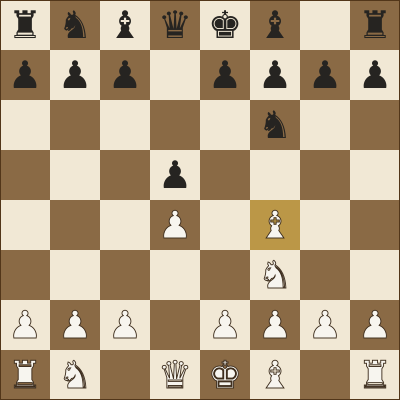
The London System setup — d4, Nf3, Bf4, e3, Nbd2, c3 — creates a reliable, virtually unbeatable structure that can be reached against almost any Black defense.
A three-part deep dive on the London
ECO Code
D02–D05 — though the London can transpose into many ECO ranges depending on Black's response
The Moves
1.d4 d5 2.Nf3 Nf6 3.Bf4 — White develops the bishop before closing the center
Key Idea
Develop solidly to d4, Nf3, Bf4, e3, Be2, Nbd2, c3 — the "London formation" requires minimal theory
Famous Practitioners
Magnus Carlsen, Fabiano Caruana, Vladimir Kramnik, and millions of club players worldwide
The most reliable system on 1.d4
The London System's genius is its universality. White plays d4, Nf3, Bf4, e3, and Bd3 (or Be2) in some order — and this formation works against virtually everything Black can play. There is no need to memorize 20-move variations in the Nimzo-Indian, King's Indian, or Grünfeld. The London answers them all with the same solid setup.
White's structure is extraordinarily difficult to undermine. The Bf4 bishop supports the e5 and d6 squares. The e3 pawn supports d4. The c3 pawn holds the d4-e3 chain. White's king castles safely and then slowly improves piece positions while watching for Black to overextend.
What the London sacrifices in dynamism it gains in reliability. It is virtually impossible to go badly wrong in the opening — and that is an enormous advantage for players who prefer grinding out small advantages over the full course of the game.
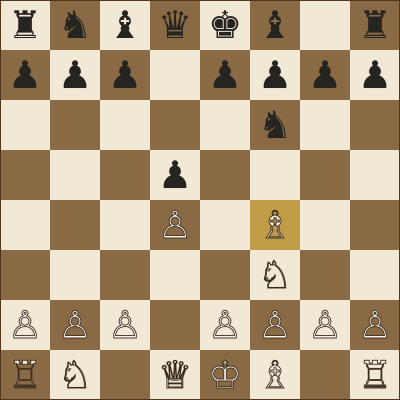
After 1.d4 d5 2.Nf3 Nf6 3.Bf4 — the London bishop
After 1.d4 d5 2.Nf3 Nf6 3.Bf4 — the London bishop (highlighted on f4) defines the opening. White will complete development with e3, Be2/Bd3, Nbd2, and c3, creating the classic London formation.
The London pyramid after 6.Bd3
After 1.d4 d5 2.Nf3 Nf6 3.Bf4 e6 4.e3 Be7 5.Nbd2 0-0 6.Bd3 — the London formation is almost complete. The bishop on f4 (highlighted) defines the system. White will play c3 and 0-0; Black will respond with c5 or b5 to challenge the center. The key feature is White's solid triangle of pawns on d4, e3, and the bishop completing the structure.
Plans for both sides
White's Plans
- Complete the London formation: e3, Bd3 (or Be2), Nbd2, c3, 0-0
- Place the knight on e5 via Nd2-f1-e3-d5 or Nf3-e5 when possible
- Use the h3-g4 pawn storm for a kingside attack in some lines
- Play e4 as a central break after completing the standard setup
- Exploit Black's passive placement if Black plays too mechanically
Black's Plans
- The sharpest response: 3...c5 or 3...Bf5, challenging White's bishop
- Play ...e6, ...Be7, 0-0, and ...c5 to undermine the d4 pawn
- Use the ...Nbd7-b6 route to pressure d4 and c4
- Play ...Nh5 to trade off the Bf4 bishop at the cost of tempo
- The most ambitious: play ...e5!? to immediately disrupt White's center
The classic London formation
After Black plays 3...e6, a typical continuation follows. When Black challenges with ...Bd6 (trying to exchange the Bf4), White either exchanges (5.Bxd6) or retreats (5.Bg3). After the bishop exchange, White's Bd3 controls the center and supports the e4 advance. This position is playable for both sides with slight endgame preferences for White due to the bishop pair in some lines.
3...c5 — immediate central counterplay
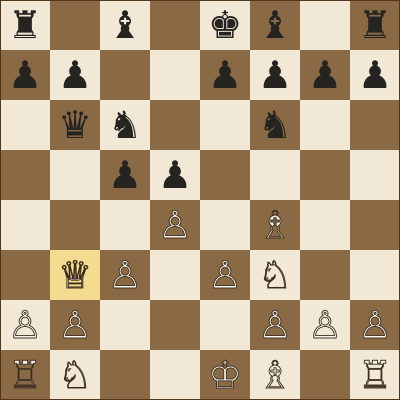
With 3...c5, Black immediately pressures d4. If White plays dxc5, Black responds with ...e6 and quickly recovers the pawn. White typically continues with 4.e3 and maintains the pawn on d4 with c3. Black then generates queenside pressure with ...Qb6, forcing White to be precise. This line requires more preparation from White than the standard 3...e6 lines.
From obscurity to World Championship
Historical Roots
The London System gets its name from its use in London tournaments in the 1920s. Players like Réti and Bogoljubov used early Nf3-Bf4 setups in the 1920s and 1930s. For decades it was considered somewhat passive and was used mostly by solid positional players seeking draws. Its reputation changed completely in the 2010s.
Magnus Carlsen
Carlsen legitimized the London at the elite level, using it in World Championship matches and online events. His success with the London in 2017–2020 sparked an enormous wave of London System adoption at every level of chess. Carlsen's London games show how to use the system's solidity not for draws, but as a foundation for long-term positional pressure.
Vladimir Kramnik
Former World Champion Kramnik also contributed to the London's revival. Kramnik, known for the deepest opening preparation in chess history, chose the London specifically to sidestep theoretical battles in his later career. His reasoning: "I prefer to start the middlegame, not the endgame of a theoretical debate." The London lets him do exactly that.
London System — FAQ
What is the London System?
The London System is a solid, low-theory opening for White based on 1.d4 followed by an early Bf4, typically after 2.Nf3 and 3.Bf4. White builds a reliable pawn structure with d4, e3, c3 and develops pieces to Nf3, Bd3/Be2, and Nbd2. The London works against virtually all Black defenses, making it one of the most practical and versatile openings at every level.
Is the London System good?
Yes — the London is sound and effective. It is used by world-class players including Magnus Carlsen and provides a solid foundation without demanding deep memorization. It is particularly effective at club and amateur level where opponents are unlikely to know the specific anti-London setups. At the elite level, well-prepared opponents can equalize, but the London remains a legitimate choice at any level.
Why is the London System so popular?
The London's popularity exploded in the 2010s for practical reasons: Magnus Carlsen played it, it requires minimal theory, the setup is nearly identical against all Black responses, and it avoids the massive theoretical battles required by the Queen's Gambit or 1.e4 openings. It is the ideal "practical weapon" for players who want to play chess rather than memorize opening theory.
What are the main plans in the London?
White's standard plan is to complete the formation: d4, Nf3, Bf4, e3, Bd3, Nbd2, c3, 0-0. After that, White looks for the e4 break, a kingside attack with h3-g4, or centralization of the knights. Black's main counterplay comes from ...c5 to pressure d4, or ...Bf5 to try to exchange the London bishop.
Does Magnus Carlsen play the London System?
Yes — Carlsen has used the London System at the highest levels, including World Championship matches. His adoption of the London in the mid-2010s legitimized it as a world-class weapon and inspired millions of players worldwide to add it to their repertoires. Carlsen uses the London to reach complex middlegame positions without relying on deep opening preparation.
Is the London good for beginners?
The London System is one of the very best openings for beginners on 1.d4. The setup is nearly identical against all Black responses, which means beginners can focus on learning plans and piece coordination rather than memorizing variations. The solid pawn structure teaches fundamental positional concepts, and it is very difficult to get a bad position out of the opening as White.
The London creates solid, closed positions where long-term piece improvement matters more than early tactics — perfect for positional players.
The Bf4 bishop is the defining piece of the London System — supporting d4, controlling the e5 square, and creating long-term structural pressure.
Magnus Carlsen's London System games showed that solid openings are not boring — they can be the foundation for some of the most creative chess in the world.
- Sverre, J. (2018). A Complete Guide to the London System. Quality Chess.
- Kovačević, V. (2014). The London System in 12 Practical Lessons. Chess Informant.
- Palliser, R. (2009). Beating Unusual Chess Openings. Everyman Chess. (Anti-London setups covered.)
- Chess Informant Database — ECO D02–D05.
Every opening belongs to a family — browse the three theme clusters: Romantic & Attacking Gambits · Flank & Hypermodern Systems · Solid Defenses.
Seven opening guides on michaelpaycer.com
From the Ruy Lopez to the French Defense, each guide includes board diagrams, history, strategic ideas, and a complete FAQ.