Catalan, Bogo-Indian & Neo-Indian Systems
The fianchetto systems — the Catalan's powerful long diagonal, the Bogo-Indian bishop check, the Nimzo-Indian pin, and the Queen's Indian flank control. Complete coverage of White's and Black's best ideas.
Catalan: E00–E09
Bogo-Indian: E11
Nimzo-Indian: E20–E59
The fianchetto bishop
controls the long
diagonal permanently.
The Catalan Opening represents a fundamental shift in how to play the Queen's Gambit. Traditional Queen's Gambit theory involves Nc3 — the queenside knight developing naturally. The Catalan instead plays 3.g3, fianchettoing the king bishop to g2. The Bg2 controls the entire a8-h1 diagonal from a safe position and puts permanent pressure on d5. White doesn't try to win material or launch a kingside attack — the long-term positional pressure of the Bg2 bishop is the weapon. Against Black's efforts to hold d5 or release the tension, White maintains structural advantages that convert in the endgame. This patient, strategic approach is why Magnus Carlsen and all modern World Champions use the Catalan.
The Catalan Opening: 3.g3
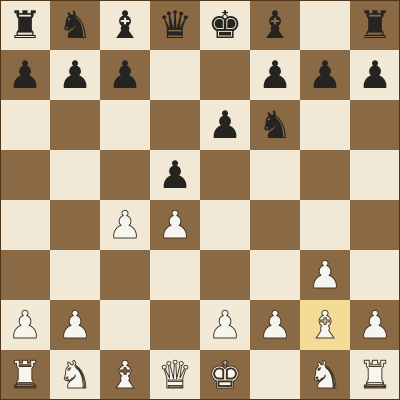
After 1.d4 Nf6 2.c4 e6 3.g3 d5 4.Bg2 — the Catalan tabiya. The Bg2 (highlighted) defines the opening's character — a powerful bishop on the long diagonal that will pressure d5 and the entire a8-h1 line throughout the game.
The Bg2 is the soul of the Catalan. Unlike most bishops in the Queen's Gambit, which struggle to find active squares, the Catalan bishop on g2 is permanently active — pointing down the a8-h1 diagonal toward Black's queenside. The c4-d4 pawn center gives White control of the center, and the Bg2 adds long-range pressure that Black must constantly address.
Open Catalan — White's Compensation
After Black captures the c4-pawn with 5...dxc4, White has given up a pawn but gains: the Bg2 now has a completely open diagonal; White's pieces develop rapidly; the b7-pawn becomes a long-term target. Black must play very precisely to hold the extra pawn — typically using ...a6-...b5 to support it. White's compensation is long-term positional pressure rather than an immediate attack.
Closed Catalan — Strategic Battle
If Black maintains the tension with 5...0-0, the game becomes a long strategic battle. Black has options: ...c5 to challenge the center, ...c6 (transposing toward Semi-Slav structures), or ...dxc4 later when it seems favorable. White simply completes development and waits — the Bg2 always has its target on d5 or the queenside, and the pressure never dissipates. Karpov and Kramnik have used the Closed Catalan to grind opponents down in famous endgames.
One of the Catalan's most important strategic features is that the Bg2 bishop tends to get stronger as pieces are exchanged. In most openings, fewer pieces means less activity. In the Catalan, the endgame bishop on g2 controls more key squares with fewer obstacles. This makes the Catalan exceptionally effective for converting small advantages in the endgame — exactly the technique at which players like Karpov and Kramnik excelled. The Catalan became the "engine's favorite" opening for White in the computer era precisely because its long-term structural advantages are difficult to neutralize even with perfect play.
The Bogo-Indian Defense: 3.Nf3 Bb4+
The Bogo-Indian is Black's response to 3.Nf3 rather than 3.Nc3. By playing 3...Bb4+, Black checks — forcing White to block with either 4.Bd2 (most common) or 4.Nbd2. This is related to the Nimzo-Indian (where the check comes against Nc3) but arises from a different move order.
The Bogo-Indian is a practical, solid choice. Black gets a comfortable game without entering the heavy theory of the Nimzo-Indian or Semi-Slav. After the bishop retreats or is exchanged, Black typically fianchettoes to b7 and builds a solid defensive setup. The positions are less forced than in the Nimzo, giving Black more flexibility and making it a good "know the ideas" rather than "know the lines" opening.
The Nimzo-Indian Defense: 3.Nc3 Bb4
The Nimzo-Indian is arguably the most important response to 3.Nc3 in the Queen's Gambit complex. By playing 3...Bb4, Black pins White's Nc3 and creates the threat of doubled pawns after ...Bxc3+. White must decide how to handle the pin: allow it, prevent it with Qc2, or allow doubled pawns in exchange for the bishop pair.
Nimzo 4.Qc2 — Classical
White prevents doubled pawns with Qc2 — if Black exchanges, White recaptures with the queen and avoids the c3 weakness. After 4...0-0 5.a3 Bxc3+ 6.Qxc3 b6, Black has given up the bishop pair but White's pawn structure is intact. The Classical Nimzo is solid and modern — Magnus Carlsen plays both sides.
Nimzo 4.e3 — Rubinstein
White plays solidly with 4.e3, accepting that Black can double the pawns with ...Bxc3 bxc3. White gets the bishop pair in compensation — the two bishops in an open position are typically very powerful. The Rubinstein Nimzo was Petrosian's favorite and remains one of the most reliable variations.
Nimzo 4.a3 — Sämisch
The aggressive Sämisch (4.a3) forces the exchange immediately — Black must take on c3 or lose tempo with the bishop. After 5.bxc3 0-0 6.f3, White builds the e4-d4 pawn center despite the doubled c-pawns. The position becomes aggressive and tactical — White sacrifices structural integrity for central dominance.
The Queen's Indian Defense: 3.Nf3 b6
The Queen's Indian Defense is Black's response to 3.Nf3 (when White avoids Nc3 to prevent the Nimzo-Indian). Black fianchettoes the queen's bishop to b7, controlling the e4 square from afar. The idea is hypermodern: rather than occupying the center with pawns, Black controls key squares with pieces.
Vladimir Kramnik's innovation — 4...Ba6 — attacks the c4-pawn immediately rather than developing to b7. After 5.Qc2 (protecting c4), the bishop retreats to b7 and Black has effectively forced White to play Qc2 before being ready for it. This subtle move-order gain gives Black more options. Kramnik used 4...Ba6 in his World Championship matches, making it one of the most analyzed Queen's Indian lines.
Queen's Indian — Black's Strategy
- The Bb7 bishop controls e4, preventing White's central expansion
- After ...c5 or ...d5, Black challenges the center
- The Ba6 system (Kramnik) immediately targets c4
- Black typically plays for queenside pawn activity
- The Queen's Indian is one of the most reliable 1.d4 Nf6 systems at any level
Neo-Indian Philosophy
The "Neo-Indian" systems — Nimzo, Queen's Indian, Bogo-Indian — all share the same philosophy: instead of fighting for the center with pawns early (1...d5), Black fights for the center with pieces. The fianchetto bishops (Bb7, Bg7) and the Bb4 pin all control key central squares from afar. This hypermodern approach was developed by Nimzowitsch, Réti, and others in the 1920s and has proven fully viable at the highest level ever since.
Choosing Between the Systems: A Decision Tree
| After 3.Nf3 (avoiding Nc3) | Black's Choice | Character |
|---|---|---|
| 3...b6 | Queen's Indian | Hypermodern fianchetto; controls e4 from b7; strategic |
| 3...Bb4+ | Bogo-Indian | Solid bishop check; less theory than Nimzo; reliable |
| 3...d5 | Back to QGD/Slav territory | Classical central pawn approach |
| After 3.Nc3 (allowing Nimzo) | Black's Choice | Character |
|---|---|---|
| 3...Bb4 | Nimzo-Indian | Pin the knight; create structural pressure; dynamic |
| 3...d5 | QGD (see Part 2) | Classical central defense |
| 3...c5 | Benoni family | Aggressive central counter |
The practical choice between Nimzo-Indian and Queen's Indian often depends on White's move order. Many Black players maintain a Nimzo+QID repertoire: Nimzo if White plays Nc3, Queen's Indian if White plays Nf3. This covers all possibilities against 1.d4 without needing to study the QGD or Slav.
Move Order Tricks and Transpositions
A crucial meta-point: by playing 1...Nf6 before 2...e6, Black avoids many of White's forcing tries in the QGD proper. If Black plays 1...d5 immediately, White can play the Exchange QGD, the Catalan (after ...Nf6 and ...e6 come later), or various others. The Nf6-first move order gives Black much more flexibility to choose between Nimzo-Indian, Queen's Indian, Bogo-Indian, or even the Benoni.
Champions of the Catalan and Neo-Indian Systems
Magnus Carlsen — Catalan Master
Carlsen has used the Catalan as one of his primary White weapons throughout his World Championship reign. His approach is characteristic: the Catalan's long-term pressure suits his "never lose, always press" philosophy. In endgames arising from the Catalan, Carlsen's technical superiority is at its most devastating.
Vladimir Kramnik — Neo-Indian Theorist
Kramnik was the leading theorist of the Queen's Indian Defense (including the 4...Ba6 innovation) and used the Nimzo-Indian as Black throughout his career. His Catalan games as White were also landmark contributions to theory. Perhaps more than any other player, Kramnik shaped how the modern 1.d4 Nf6 openings are played at the elite level.
Tigran Petrosian — Bogo-Indian Pioneer
Petrosian's use of the Bogo-Indian and Nimzo-Indian as Black reflected his prophylactic style — making small, precise moves that prevented White from developing any attacking chances. His endgame technique in these positions was extraordinary. The Bogo-Indian's solid, uncompromising character suited Petrosian's "don't let them attack you" philosophy perfectly.
Frequently Asked Questions
1.d4 Nf6 2.c4 e6 3.g3 — White immediately fianchettoes the king bishop to g2. The Bg2 controls the entire a8-h1 diagonal and puts permanent pressure on d5. White combines the Queen's Gambit center (c4+d4) with the fianchetto bishop setup. The Catalan leads to structural battles where the long-term bishop advantage matters more than immediate tactics. Magnus Carlsen uses the Catalan as one of his primary weapons.
Open Catalan: Black captures 4...dxc4, taking the c-pawn. White gives it up voluntarily — the Bg2 opens the long diagonal in compensation. Black tries to hold the pawn with ...a6-...b5. Closed Catalan: Black maintains 4...Be7 5...0-0 without capturing. The game becomes a slow strategic battle where White applies long-term pressure with the Bg2 and Black tries to neutralize with ...c5 or ...dxc4 at a favorable moment.
1.d4 Nf6 2.c4 e6 3.Nf3 Bb4+ — Black checks with the bishop when White has played Nf3 (not Nc3). The Bogo-Indian is a solid, less theoretical alternative to the Nimzo-Indian. After 4.Bd2 a5 (Petrosian's system) or 4.Nbd2, Black achieves a comfortable position. The key appeal: less theory than the Nimzo while achieving similar strategic goals — control of central squares and piece activity.
1.d4 Nf6 2.c4 e6 3.Nc3 Bb4 — Black pins the Nc3, preventing e4 and threatening doubled pawns after ...Bxc3+. White must choose: allow doubled pawns (Rubinstein 4.e3), prevent them (Classical 4.Qc2), or force the exchange immediately (Sämisch 4.a3). In exchange for the bishop, Black gets a solid pawn structure and piece activity. Virtually every modern World Champion has used the Nimzo-Indian as Black.
1.d4 Nf6 2.c4 e6 3.Nf3 b6 — Black plans to fianchetto the queen's bishop to b7, controlling e4 from afar. This is Black's response when White plays Nf3 (avoiding Nc3 to prevent the Nimzo). The Queen's Indian is hypermodern: Black controls the center with pieces rather than pawns. Kramnik's 4...Ba6 innovation (attacking c4 immediately) is the modern main line. The QID is one of the most reliable 1.d4 defenses at all levels.
Many players play both: Nimzo-Indian when White plays 3.Nc3 (the pin is very effective), Queen's Indian when White plays 3.Nf3 (avoiding Nc3 to sidestep the Nimzo). This Nimzo+QID repertoire covers all of White's responses to 1.d4 Nf6 2.c4 e6 without needing to study the QGD or Slav. The combination is very popular at the GM level — it's the repertoire of choice for players who want solid, understanding-based defenses rather than memorization-heavy systems.
Further Reading & Study
Books
- Negi, 1.d4 Volume 2 — White's perspective on Nimzo and QID
- Schandorff, Playing 1.d4: The Queen's Gambit — includes Catalan
- Bologan, The Nimzo-Indian Defense — Black's comprehensive guide
Online Resources
- Lichess Opening Explorer — E00–E59
- Chessable — Catalan and Nimzo-Indian courses
- Kramnik's annotated Queen's Indian games (many available online)
Model Games
- Carlsen — various (Catalan endgame masterclasses)
- Kramnik — various (Queen's Indian 4...Ba6 system)
- Petrosian — various (Bogo-Indian and Nimzo prophylaxis)
Opening analysis based on current grandmaster practice. ECO E00–E09 (Catalan), E11 (Bogo-Indian), E15–E19 (Queen's Indian), E20–E59 (Nimzo-Indian) from standard references.