
The Dutch Defense
The one Black answer to 1.d4 that fights for the initiative from move one — 1...f5. Stake out kingside space and play for a direct attack. Three great systems: the Leningrad, the Stonewall, and the Classical.
Leningrad: A87–A89
Stonewall: A90–A95
Classical: A96–A99
Stake out space and
play for ...e5 or a
direct kingside attack.
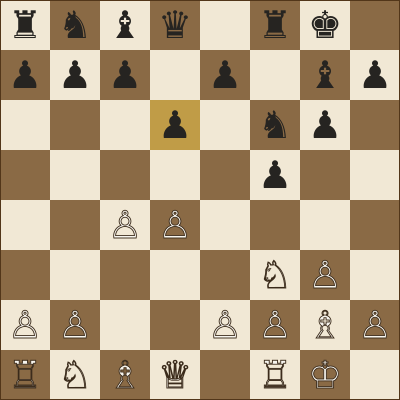
Most defenses to 1.d4 accept some passivity — the QGD is solid but cramped, the Slav sound but quiet, even the King's Indian cedes the centre first. The Dutch is different: with 1...f5 Black grabs kingside space and declares an intention to attack. The cost is honest — the f-pawn loosens Black's king and the e6/e5 squares — but in return Black gets an unbalanced game where both sides play for a win. It is the choice for players who hate drawing with Black, and it splits into three characterful systems, each with its own pawn structure and plan.
The Leningrad Dutch
The most dynamic Dutch. Black fianchettoes in King's-Indian style — ...g6 and ...Bg7 — then plays for the ...e5 break and a kingside pawn storm. The g7-bishop and the f5-pawn give real attacking chances against White's king, and the system rewards aggressive, initiative-based play.
The Stonewall Dutch
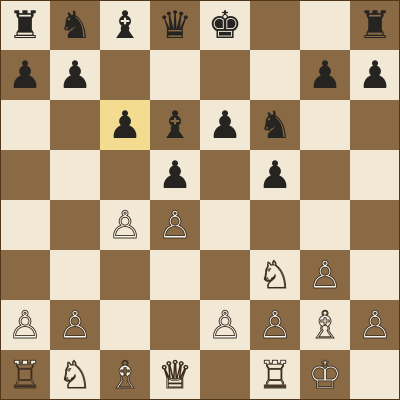
The most distinctive structure in chess: a granite wall on d5-e6-f5, permanently renouncing e4 (and the c8-bishop's scope) for a rock-solid kingside bind and the e4-outpost for a knight. The plan is thematic — ...Bd6, ...Qe7/Qe8-h5, ...Ne4 and a kingside attack. Hugely popular at club level because the plans are so clear, and a genuine grandmaster weapon in the right hands.
The Classical Dutch
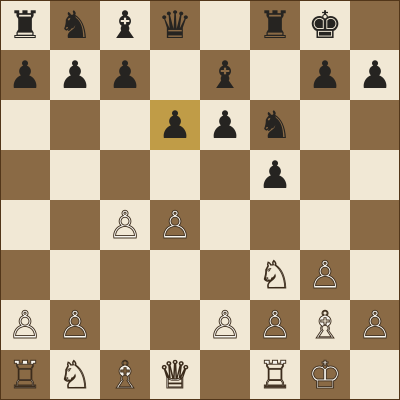
The flexible middle path. Black plays ...e6, ...Be7 and ...d6, keeping options open and aiming for ...e5 in the centre rather than committing to the wall or the fianchetto. It leads to rich, maneuvering middlegames and suits players who want the Dutch's fighting spirit with a more classical setup.
The Anti-Dutch: the Staunton Gambit
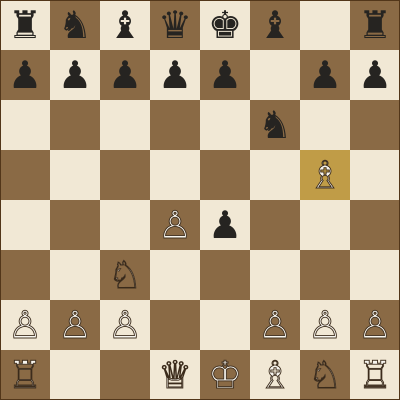
White's most aggressive try sacrifices the e-pawn to rip the position open before Black is developed. After 2...fxe4 3.Nc3 and Bg5, White plays for rapid development and attack on the weakened king. It's the one line every Dutch player must know — but with accurate play Black is fine. White also has quieter Anti-Dutch tries (2.Bg5, 2.Nc3), but the Staunton is the critical test.
Frequently Asked Questions
The Dutch Defense arises after 1.d4 f5 — Black grabs kingside space and plays for a direct attack rather than the symmetry of 1...d5 or the restraint of the Indian defenses. It is the sharpest, most unbalancing answer to 1.d4, splitting into the Leningrad, Stonewall, and Classical systems.
The Stonewall is the Dutch system where Black builds a pawn wall on d5, e6, and f5, renouncing the e4-square for a solid kingside bind and a knight outpost on e4. Its clear plan (...Bd6, ...Qe8-h5, ...Ne4, kingside attack) makes it very popular at club level and a real grandmaster weapon.
The Leningrad fianchettoes the bishop to g7 (like a King's Indian) and plays for the ...e5 break and a kingside pawn storm. It is the most dynamic, aggressive Dutch, favoured by attacking players who want unbalanced positions with Black.
Yes — all three systems are sound and played at grandmaster level, though the Dutch is riskier than the QGD or Slav because 1...f5 loosens Black's king. That unbalance is the point: it's the anti-drawing weapon for players who want to win with Black. Knowing the Anti-Dutch lines, especially the Staunton Gambit, is essential.
The Staunton Gambit is 1.d4 f5 2.e4!?, sacrificing a pawn to open the position before Black develops. After 2...fxe4 3.Nc3 Nf6 4.Bg5, White plays for rapid development and attack. It's critical theory for Dutch players, but Black equalizes with accurate defence, often returning the pawn.