The French Defense
1.e4 e6 — one of the oldest and most combative responses to 1.e4. The French Defense creates immediate pawn tension and forces a strategic battle from move 2. Black accepts a slightly passive setup, including a notorious "bad bishop" on c8, in exchange for a rock-solid structure and active queenside counterplay. Korchnoi built his entire career on it.
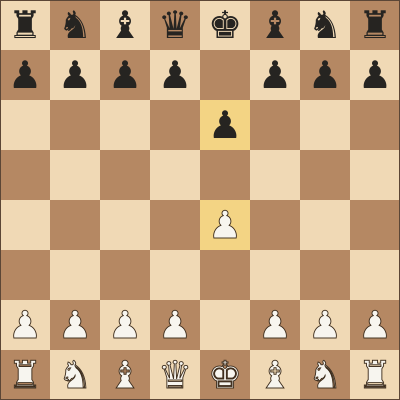
The French Defense begins 1.e4 e6 — Black prepares 2...d5 to challenge the center and create a pawn chain battle. The resulting positions are rich and strategically complex, with sharp attacking possibilities for both sides.
A three-part deep dive on 1.e4 e6
ECO Code
C00–C19 — one of the most theoretically developed responses to 1.e4, with decades of top-level analysis
The Moves
1.e4 e6 2.d4 d5 — Black sets up the French pawn chain, challenging White's center immediately
Key Idea
Solid e6-d5 pawn chain + queenside counterplay with ...c5. Trade-off: "bad" c8 bishop locked behind e6
Famous Practitioners
Korchnoi, Botvinnik, Larsen, Uhlmann, Nimzowitsch — the French is a fighter's defense
The pawn chain battle
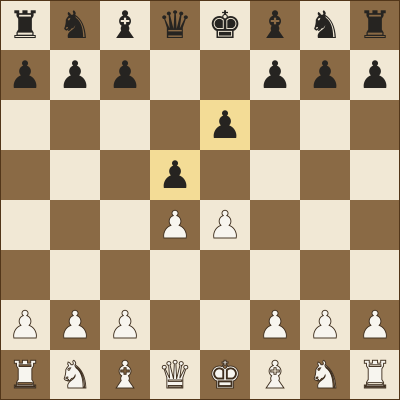
The French Defense is built on a concrete strategic plan. After 1.e4 e6 2.d4 d5, Black has established a pawn chain d5-e6. In the Advance Variation (3.e5), this becomes a fixed chain: White's pawns on d4-e5 face Black's pawns on d5-e6. Both sides now fight to undermine the other's chain: White plays f4-f5 to attack the e6 pawn; Black plays ...c5 to attack d4.
The main weakness of the French Defense is well-known: the c8 bishop, blocked by the e6 pawn, is often called the "bad bishop." Black must find ways to activate it — via ...b6-Bb7, ...Bd7-b5, or waiting for the center to open. This bishop problem defines much of French Defense strategy and is the reason the Caro-Kann (which avoids it) is considered more comfortable for Black.
What Black gets in return is a solid, resilient structure. The French is almost impossible to smash open by force, and Black's queenside counterplay is real and dangerous. In the Winawer, Black creates concrete tactical complications from the very first few moves.
After 1.e4 e6 2.d4 d5 — the French structure
After 1.e4 e6 2.d4 d5 — the French Defense pawn structure. The highlighted e6 pawn (Black's defining first move) creates the French pawn chain. The c8 bishop, blocked by this pawn, is the notorious "bad bishop" that Black must work to activate throughout the game.
French Defense with 4.e5 — the pawn advance
After 1.e4 e6 2.d4 d5 3.Nc3 Nf6 4.e5 Nfd7 — the Steinitz Variation. White's e5 advance (highlighted) seizes space but fixes the pawn structure. Black's knight retreats to d7, preparing the c5 break to attack White's pawn chain at its base. This leads to the sharpest French positions.
Winawer, Advance, Classical, and Exchange
3.Nc3 Bb4 — Black pins the knight
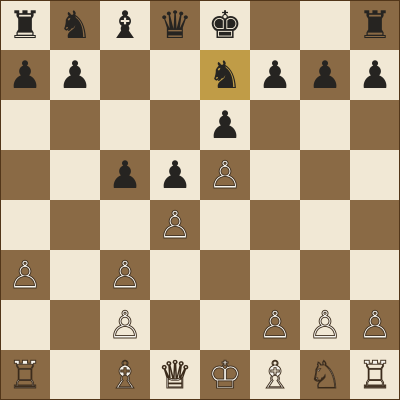
In the Winawer, Black pins White's c3 knight with the bishop. After 4.e5 c5 5.a3 Bxc3+ 6.bxc3, Black has traded the bishop for the knight, giving White the bishop pair but damaging the c-pawn structure. The resulting positions are among the most complex in all of chess — White has two bishops and attacking chances; Black has solid structure and queenside play. The Winawer was Viktor Korchnoi's signature weapon for 40 years.
3.e5 — White advances, grabs space
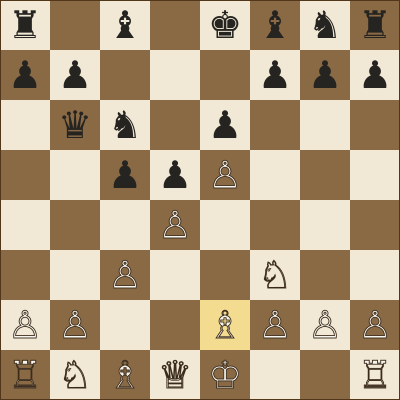
White plays 3.e5, creating a fixed pawn chain. Black immediately attacks the chain with 3...c5. Both sides have clear plans: White plays f4-f5 to attack the kingside; Black plays ...Nc6-b4 and ...c4 to create queenside pressure. The Advance French is excellent for beginners precisely because the plans are straightforward. Evgeny Sveshnikov and John Watson have written extensive guides to this system — Sveshnikov from White's side, Watson from Black's. At elite level, it was Sveshnikov who made the Advance French fashionable again in the 1990s.
3.Nc3 Nf6 4.Bg5 — the Classical French
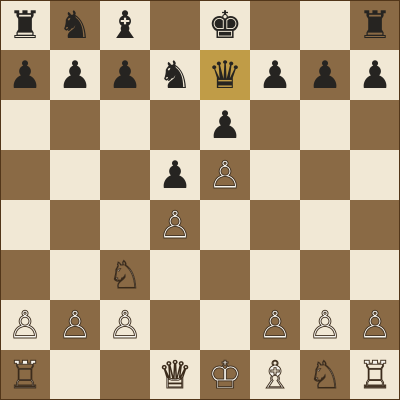
In the Classical, Black plays 3...Nf6 rather than the Winawer's 3...Bb4. White plays 4.Bg5, pinning the f6 knight. After 4...Be7 5.e5 Nfd7 6.Bxe7 Qxe7, the position is closed and strategic. Black typically plays ...c5, ...Nc6, and ...f6 to undermine White's e5 pawn. The Classical leads to deep positional battles and was championed by Mikhail Botvinnik.
3.exd5 exd5 — the symmetric structure
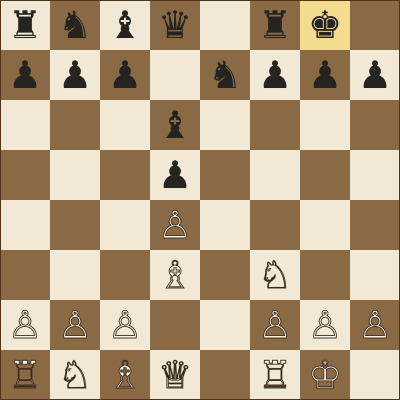
White exchanges pawns with 3.exd5, creating a symmetric structure. Black recaptures 3...exd5, and the position resembles a Symmetrical Queen's Gambit Exchange. White no longer has the kingside space advantage but gets a solid endgame. The Exchange French is played mostly by White players who want to avoid French theory — it leads to very dry, equal positions and is not recommended for players who want dynamic play from White.
Plans for both sides in the French
White's Plans
- Kingside attack: f4-f5, Qh5, Ng5 or Nh3-f4-g6
- In the Advance: f4 and a queenside minority attack (b4-b5)
- Exploit the d6 or d7 outpost after ...c5xd4
- Bishop pair advantage in the Winawer
- Control the e5 square — a permanent outpost for White's knight
Black's Plans
- Attack White's d4 pawn with ...c5, ...Nc6, and ...Qb6
- Activate the "bad" c8 bishop via ...Bd7-b5 or ...b6-Bb7
- Play ...f6 to undermine White's e5 pawn in the Advance
- In the Winawer: queenside counterplay with ...a5, ...b5, and ...Qa5
- Push the c-pawn to c4 to gain queenside space after the center closes
One of chess's oldest and most tested defenses
Viktor Korchnoi
Korchnoi was the French Defense's greatest champion. He played the Winawer for over 40 years and built his fighting style around its complex, imbalanced positions. Korchnoi's French games from his World Championship Candidates matches in the 1970s and 1980s are among the most deeply analyzed games in chess history. He described the French as "my best friend."
Mikhail Botvinnik
Six-time World Champion Botvinnik used the French Classical as part of his preparation for championship matches. His French games were remarkable for depth and preparation — Botvinnik typically arrived at the board with 20-25 moves memorized in the French. His analyses of French Defense positions remain reference works in chess literature.
Aaron Nimzowitsch
The creator of hypermodern chess theory, Nimzowitsch was an early French Defense specialist and theoretician. His idea of "blockading" the central pawn chain — a key French concept — influenced how the entire opening was understood. The Nimzowitsch Variation (3.e5) is named after him. His 1927 book My System includes extensive French Defense analysis.
French Defense — FAQ
What is the French Defense?
The French Defense is a chess opening for Black against 1.e4, beginning with 1...e6 and 2...d5. Black creates a pawn chain (e6-d5) that challenges White's center. Black accepts a slightly passive setup — the c8 bishop is blocked by the e6 pawn — in exchange for solid structure and queenside counterplay with ...c5. The French is one of the oldest and most theoretically developed responses to 1.e4.
What is the Winawer Variation?
The Winawer arises after 3.Nc3 Bb4, where Black pins White's knight. After 4.e5 c5 5.a3 Bxc3+ 6.bxc3, Black has given White the bishop pair but damaged the c-pawn structure. The Winawer leads to extremely complex, double-edged positions — one of the most theoretically rich variations in chess. It was Viktor Korchnoi's signature weapon for four decades.
What is the "bad bishop" in the French Defense?
The "bad bishop" is Black's c8 bishop, locked behind the e6 pawn. Since Black plays 1...e6, the c8 bishop has no diagonal and is often the worst-placed piece on the board throughout the game. Black's main task is activating it — via ...Bd7-b5, ...b6-Bb7, or waiting for the pawn structure to open. This bishop problem is the French Defense's defining structural challenge.
What is the Advance Variation of the French?
After 3.e5, White pushes the e-pawn forward, creating a fixed pawn chain. Black attacks immediately with 3...c5. White's plan is f4-f5 on the kingside; Black's plan is ...c4 and ...Nc6-b4 on the queenside. The Advance French is excellent for beginners because the strategic plans are transparent and the positions are less theoretically demanding than the Winawer or Classical.
Who plays the French Defense?
The French is associated with fighting players who love complex, imbalanced positions. Viktor Korchnoi was its greatest practitioner. Mikhail Botvinnik, Bent Larsen, Wolfgang Uhlmann, and Aaron Nimzowitsch were famous French players from the 20th century. In modern chess, Etienne Bacrot and Nikita Vitiugov play the French regularly. Magnus Carlsen and Fabiano Caruana have also employed it occasionally.
Is the French Defense good for beginners?
The French Defense is a good choice for beginners who want a solid, fighting defense against 1.e4. The plans are clearer than the Sicilian Defense: Black always plays ...c5 to challenge the center. The Advance Variation is particularly beginner-friendly. The main challenge is learning to handle the passive c8 bishop — but this makes the French an excellent teaching tool for pawn structure and long-term piece coordination.
The French Defense pawn chain creates a strategic battle that lasts well into the endgame — perfect for players who enjoy positional chess over tactical melee.
The Winawer Variation leads to some of the most complex and theoretically analyzed positions in chess — 20-25 forced moves of theory followed by deep middlegame complications.
Korchnoi played the French Defense for over 40 years, taking it to multiple World Championship Candidates matches. His games in the Winawer remain the deepest French analyses ever produced.
- Watson, J. (1996). Play the French. 3rd ed. Everyman Chess. (The definitive English-language French guide.)
- Korchnoi, V. (1977). Chess is My Life. Batsford. (Chapters on Korchnoi's Winawer preparation.)
- Nimzowitsch, A. (1927). My System. (French Defense concepts and blockade strategy.)
- Chess Informant Database — ECO C00–C19.
Every opening belongs to a family — browse the three theme clusters: Romantic & Attacking Gambits · Flank & Hypermodern Systems · Solid Defenses.
Seven opening guides on michaelpaycer.com
Ruy Lopez, Sicilian, Queen's Gambit, King's Indian, London System, Caro-Kann, and French Defense — all with board diagrams, strategy, and history.