
The English Opening
1.c4 — the flank opening that controls the centre from the side. Instead of occupying the middle with a pawn, White fights for the d5 square and develops with flexible, fluid plans. It is one of the hardest openings to prepare against, because it can transpose into half a dozen others — and it has been a favorite of World Champions from Botvinnik to Kasparov to Carlsen.
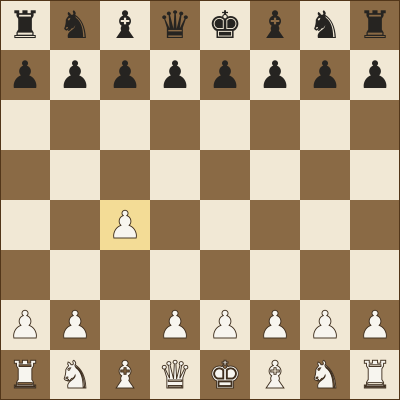
The English Opening begins with 1.c4 (highlighted) — a flank pawn that fights for the central d5 square without committing a centre pawn. From here White develops flexibly with g3, Bg2, Nc3, and Nf3, keeping the game's character open.
ECO Codes
A10–A39 — covering the Reversed Sicilian, Symmetrical, and Anglo-Indian systems
The Move
1.c4 — a flank pawn that fights for d5 without occupying the centre
Character
Flexible, positional, transpositional — control before commitment
Famous Players
Staunton, Botvinnik, Korchnoi, Kasparov, Carlsen, Caruana
Controlling the centre from the flank
Classical opening theory says: occupy the centre with pawns. The English politely disagrees. With 1.c4, White grabs influence over the key d5 square from the side, keeps the centre pawns mobile, and refuses to reveal a plan until Black commits first. The bishop usually goes to g2 on the long diagonal, the knights to c3 and f3, and only later does White decide whether to strike with d4, e4, or a slow queenside expansion.
This is hypermodern chess — the idea that the centre can be controlled by pieces and flank pawns rather than occupied outright. It makes the English supremely flexible and notoriously annoying to face, because the same first move can lead to a Sicilian-style attack, a Catalan squeeze, or a King's Indian structure depending on what Black does.
The transposition web
The English is less an opening than a doorway. Play 1.c4 and later d4, and you may reach a Queen's Gambit or Catalan. Meet 1...Nf6 and ...g6 and you can transpose to a King's Indian reversed. This flexibility is the whole point — and the reason understanding structures beats memorizing lines.
The Reversed Sicilian — 1...e5
Black's most direct reply is to grab the centre with 1...e5. The result is a Sicilian Defense with colors reversed and an extra tempo for White. White can borrow Black's best Sicilian ideas — but a move ahead and with the initiative. This is one of the most respected and most-played answers to the English.
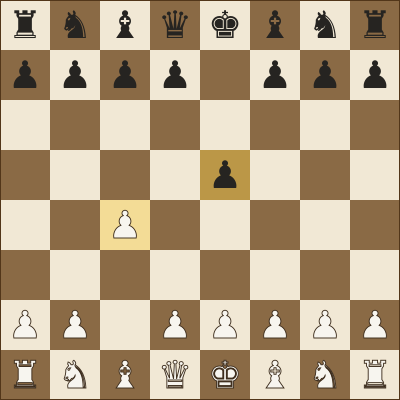
After 1.c4 e5 — the Reversed Sicilian. It is a Sicilian with the board turned around and White a tempo up. White typically plays g3, Bg2, Nc3, and aims for the d5 break or a kingside fianchetto squeeze.
The Symmetrical English — 1...c5
Black can also mirror White exactly with 1...c5. The Symmetrical English is solid and balanced; both sides fianchetto and maneuver, and the player who first finds a constructive plan — often a timely d4 or b4 break — takes the initiative. It frequently leads to the famous Hedgehog structures covered in Part 3.
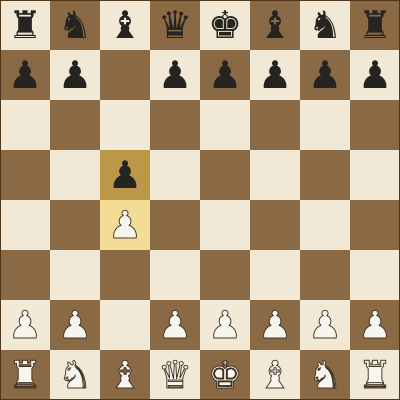
After 1.c4 c5 — the Symmetrical English. Mirror-image pawns and a long strategic battle. Whoever breaks the symmetry constructively (with d4, b4, or a well-timed knight maneuver) usually seizes the edge.
The English Opening's key ideas for both sides
White's Plan
White fights for d5, fianchettoes the king's bishop, and keeps the centre flexible — striking with d4 or e4 only when it is most effective. Queenside expansion with b4 and a slow squeeze are recurring themes.
- Control d5 with c4, Nc3, and the g2 bishop
- Fianchetto with g3 and Bg2 on the long diagonal
- Expand on the queenside with b4 and a4
- Choose the moment for d4 or e4 to open the centre
Black's Plan
Black must decide how to meet the flank strategy: grab the centre with ...e5 (Reversed Sicilian), mirror with ...c5 (Symmetrical), or steer toward an Indian setup with ...Nf6 and ...g6. Each fights the d5 plan differently.
- Claim the centre with ...e5 and active pieces
- Or mirror with ...c5 and play for symmetry-breaking
- Contest d5 with ...Nf6, ...d5, or ...e6 setups
- Watch for transpositions into familiar defenses
From Staunton to the modern elite
The opening takes its name from Howard Staunton, the leading English player of the 1840s, who employed 1.c4 in his 1843 match against Saint-Amant. For a long time it was considered offbeat, but the hypermodern revolution of the 1920s — and especially Mikhail Botvinnik's deep strategic treatment — established it as a fully respectable World Championship weapon. Today it is one of the most common first moves at the very top of the game.
Mikhail Botvinnik
The patriarch of Soviet chess made the English a championship weapon and lent his name to the Botvinnik system (c4, Nc3, g3, Bg2, e4), a rock-solid setup still played today.
Garry Kasparov
Kasparov used the English as a flexible surprise weapon throughout his career, exploiting its transpositional tricks to dodge his opponents' deepest preparation.
Magnus Carlsen
Carlsen turns to 1.c4 constantly, precisely because it leads to fresh, less-analyzed middlegames where his understanding can outplay even well-prepared rivals.
English Opening — FAQ
What is the English Opening?
The English Opening is 1.c4 — a flank opening that fights for the d5 square instead of occupying the centre with a pawn. Named after Howard Staunton, it is flexible, positional, and famously transpositional. It is a mainstay of elite play.
Is the English Opening good for beginners?
It can be, but it is less forcing than 1.e4. It rewards understanding of plans and structures over memorized tactics, so it suits patient, positional players. Beginners who want sharp tactics may prefer the Italian Game.
Why is 1...e5 called the Reversed Sicilian?
After 1.c4 e5, the position is a Sicilian Defense with colors reversed and White a tempo up. White gets to use Sicilian attacking ideas with the initiative, which is why it is one of the most respected replies.
Does the English transpose into other openings?
Constantly. Depending on move order, 1.c4 can transpose into the Queen's Gambit, the Catalan, the King's Indian, and the Nimzo-Indian. This flexibility is its greatest strength — and the reason understanding structures matters more than memorizing one line.
1.c4 — the flank pawn that controls d5 from the side. Flexible, hypermodern, and the gateway to a web of transpositions.
The Reversed Sicilian (1...e5): a Sicilian with the board turned around and White a tempo up — Black's most direct, most respected reply.
The Symmetrical English (1...c5): mirror-image pawns and a deep strategic battle decided by who breaks the symmetry first.
- Botvinnik, M. — collected games and the Botvinnik system in the English.
- Kosten, T. (1999). The Dynamic English. Gambit.
- Marin, M. (2009). A Grandmaster Repertoire: The English Opening. Quality Chess.
- ECO classification A10–A39. Online: Lichess opening explorer (English filter).
Every opening belongs to a family — browse the three theme clusters: Romantic & Attacking Gambits · Flank & Hypermodern Systems · Solid Defenses.
The English Opening is one of the guides on this site
From 1.e4 classics like the Ruy Lopez and Italian to 1.d4 systems and now the flank openings, each guide includes board diagrams, plans, history, and a full FAQ.