Rome · Stoicism · The network behind the Meditations
The Circle Around Marcus Aurelius
He is remembered as a solitary philosopher writing to himself in a tent on the frontier. That image is powerful and incomplete. Marcus was shaped by teachers, family, generals, and enemies — and their stories cross. Here are the twenty people who made the philosopher-emperor.
The Meditations is the strongest source we have for Marcus Aurelius's inner life, and its very first book is not philosophy in the abstract — it is a roll call of debts. Marcus opens by naming the people he learned from, one by one, and saying exactly what each gave him. To understand him, then, you start where he started: with the circle.
This hub gathers twenty of the most important figures across four circles — teachers, family, military commanders, and enemies — and reads each one through the lens of Marcus: what they gave him, how they shaped his decisions, and what they reveal about the man. Some strengthened him. Some instructed him. Some disappointed him. Some betrayed him. Some died for him. And one, his son Commodus, became the greatest contradiction in his legacy.
A word on the evidence. Marcus's own Meditations is our best witness for his teachers and family. Cassius Dio is essential for the wars, commanders, and enemies, though parts survive only through later epitomes. The Historia Augusta preserves valuable material but is notoriously unreliable and is flagged as such below. For officers like Maximianus and Fronto, inscriptions do most of the work. Where no secure quotation of a figure survives, none is invented.
The insight
Treat these twenty not as isolated biographies but as one connected network. Marcus is the hub — but the spokes cross each other. The same person moves from ally to enemy, general to emperor, daughter to conspirator, philosopher to state official.
The spokes cross each other
The reason a hub-and-spoke map is worth building for Marcus is that the spokes do not stay in their lanes. Follow the chain:
Rusticus gives Marcus Epictetus. The teacher hands the emperor a dead slave's Discourses, and the Meditations is downstream of that gift.
Antoninus Pius teaches Marcus to rule — a decade of apprenticeship in the palace.
Marcus shares power with Lucius Verus instead of eliminating a rival, inventing sustained joint rule.
Verus's Parthian War elevates Avidius Cassius and Marcus Claudius Fronto — two soldiers made by the same eastern campaign.
Cassius later betrays Marcus, declaring himself emperor on a false rumor of Marcus's death.
Faustina is implicated by some hostile ancient sources in that rebellion — on uncertain evidence.
Pompeianus marries Marcus's daughter Lucilla and becomes one of his most trusted generals.
Pertinax fights under Marcus and, thirteen years after Marcus dies, briefly becomes emperor himself.
Commodus succeeds Marcus and breaks with everything his father stood for; Lucilla and Pompeianus are later drawn into opposition against him.
One rebellion, one marriage, one gift of a book — each ripples across the whole circle. That is why the network is more interesting than any single life inside it.
The crossing spokes: Rusticus hands Marcus Epictetus; Antoninus teaches him to rule; the shared throne with Lucius Verus feeds the war that raises Avidius Cassius, who betrays him; Pompeianus marries Lucilla; and Commodus inherits it all.Circle I
Teachers & philosophers
The men who turned a bookish prince into a practicing Stoic. Marcus names them at the very front of the Meditations.
Across all four circles, the ten people who most directly formed Marcus Aurelius rank roughly as follows — a judgment, not a fact, and offered as one:
Junius Rusticus — his most important direct philosophical mentor.
Antoninus Pius — his model of practical leadership and imperial conduct.
Epictetus — the deepest indirect influence on the Meditations.
Domitia Lucilla — his earliest moral model: piety, generosity, simplicity.
Faustina the Younger — wife of roughly thirty years, mother of his children, campaign companion.
Claudius Maximus — his human model of self-mastery and integrity.
Apollonius of Chalcedon — his model of constancy under grief, pain, and illness.
Commodus — his son, successor, and greatest historical problem.
Tiberius Claudius Pompeianus — trusted general, field commander, son-in-law.
Avidius Cassius — the general whose betrayal put Marcus's philosophy to the test.
Beyond these ten, a wider world of figures — Hadrian, the tutors Fronto and Herodes Atticus, the physician Galen, and his daughter Lucilla — fills in the empire around him.
Sources
Marcus Aurelius, Meditations, Book I (MIT Classics).
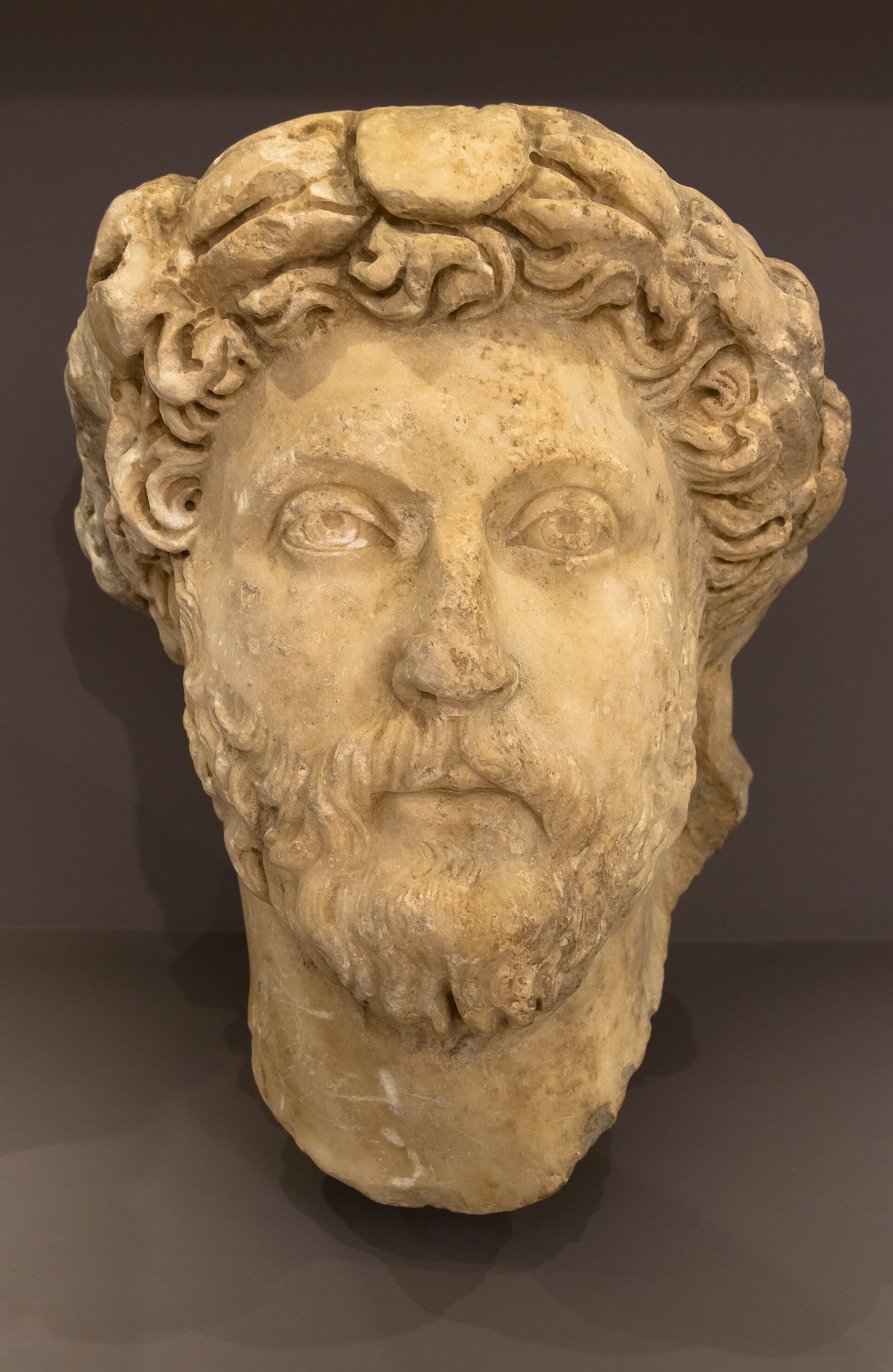 Marcus Aurelius