Rusticus
His most important mentor
Epictetus
Inherited, never met
Apollonius & Maximus
Constancy and self-government
Sextus
Warmth without weakness
How to read Marcus through his teachers
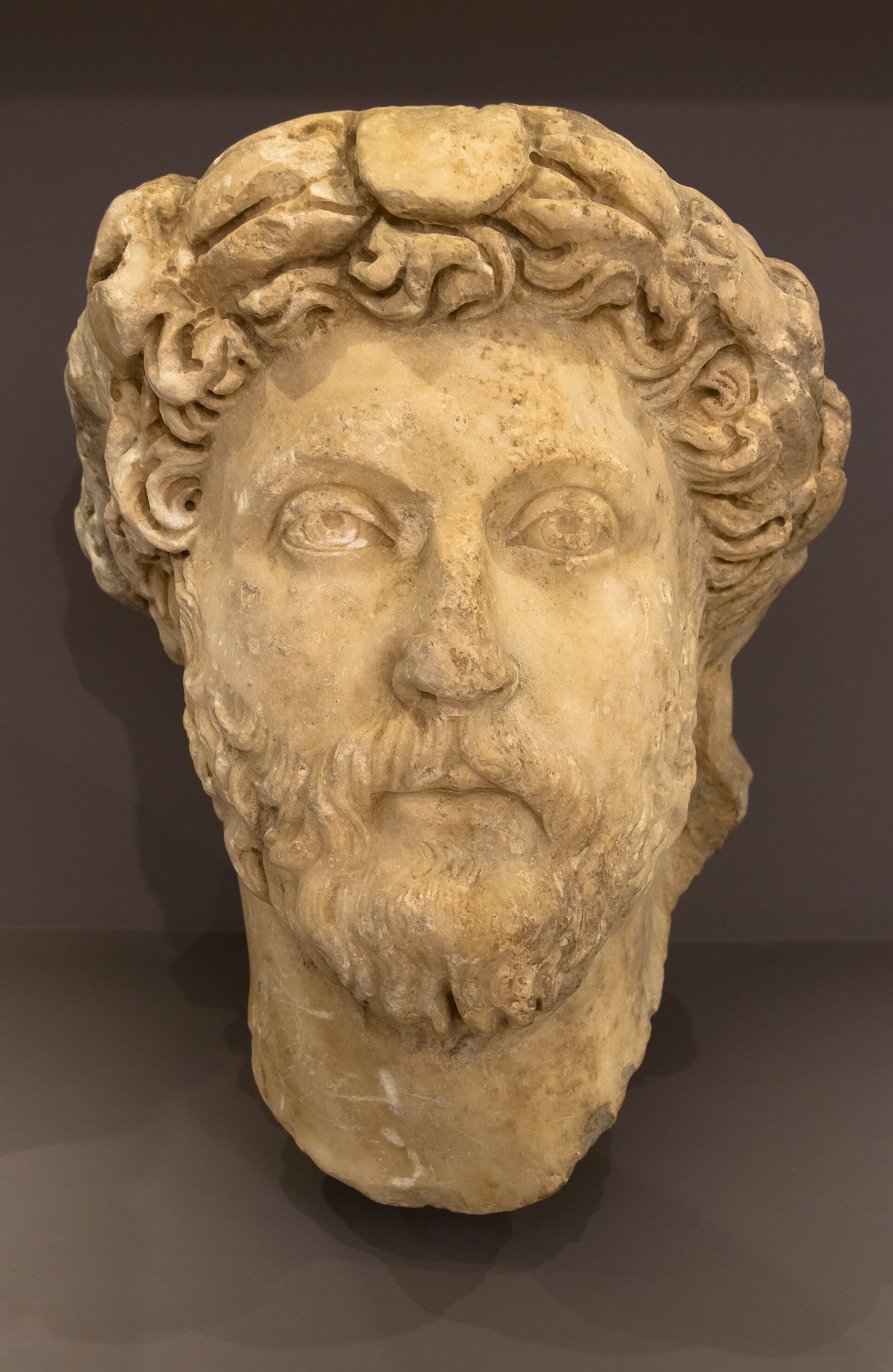
Book I of the Meditations is a strange and moving thing: an emperor listing, one by one, the people he learned from and the single quality he took from each. It is the closest Marcus comes to autobiography, and it tells us that he did not think of his character as self-made. He thought of it as assembled — borrowed, piece by piece, from teachers he watched closely.
This page reads five of those teachers through the lens of Marcus: what they gave him, enough of their own story to stand on its own, and the honest limits of what we can know. Two of them — Rusticus and Epictetus — have their own full pages, so they appear here in brief. The other three — Apollonius, Claudius Maximus, and Sextus — get their full treatment below.
A word on the evidence. Almost everything here rests on Marcus's own testimony in Meditations Book I, supplemented by the Historia Augusta, which is valuable but notoriously unreliable and flagged as such. None of these teachers left surviving philosophical writings of their own; we know them mainly through the gratitude of their most famous student. Where no secure quotation survives, none is invented.
The insight
Each teacher gave Marcus one thing the others could not. Rusticus gave him self-scrutiny and Epictetus. Apollonius gave him constancy under pain. Maximus gave him self-government made visible in a living man. Sextus gave him warmth. Take any one away and the emperor of the Meditations is harder to explain.
Teacher I
Junius Rusticus
His most important direct mentor — and the hinge on which the whole story turns.
Of all Marcus's living teachers, Quintus Junius Rusticus has the strongest claim to being the one who converted philosophical interest into disciplined Stoic practice. He was an unusual figure: a serious Stoic and a senior statesman at once, twice consul and later urban prefect of Rome. What he taught was never merely academic, because it came from a man carrying real public weight. Marcus credits him with the habit that runs through the entire Meditations — scrutinizing his own character honestly, without flattery — and with the single gift that mattered most: access to the teachings of Epictetus.
“character required improvement and discipline.”
Marcus Aurelius, on Rusticus · Meditations I
Honesty requires the other half of the record: as urban prefect, Rusticus presided over the trial that condemned the Christian philosopher Justin Martyr to death. It does not erase what he gave Marcus, but it complicates any portrait of him as an unblemished sage. His full story — the gift of Epictetus, the complication, and why he ranks first — has its own page.
Teacher II
Epictetus
The teacher Marcus never met — his inheritance, not his acquaintance.
Epictetus belongs on any list of Marcus's teachers, but with a crucial asterisk: the two never met. Born into slavery in Phrygia around the middle of the first century AD, Epictetus won his freedom, taught in Rome, and later founded a school at Nicopolis. He had died before Marcus could have studied with him. What Marcus received was not a living voice but a book — the Discourses, recorded by the pupil Arrian — placed in his hands by Rusticus. This is inheritance, not tutelage, and it is the deepest indirect current beneath the Meditations.
“The things in our control are by nature free.”
Epictetus · Enchiridion, opening
That single sentence — the division between what is and is not in our power — is the spine of Epictetus's thought, and Marcus quotes or echoes him repeatedly. The irony is exact and worth sitting with: the former slave taught the emperor how to be free. Epictetus deserves to be read in his own right, not only as an influence on someone more famous.
Teacher III
Apollonius of Chalcedon
The living proof that a man can stay himself through pain, illness, and grief.
Apollonius was a Greek Stoic summoned into the imperial household to help educate Marcus and Lucius Verus, and Marcus kept studying with him even after entering Antoninus Pius's family. His importance to Marcus was not a treatise — none of his writings survive — but a demonstration. Marcus remembered watching Apollonius hold himself steady through severe pain, long illness, and the death of a child, and taking from him the lesson he names most simply:
“Freedom of will.”
Marcus Aurelius, on Apollonius · Meditations I
What made this teaching stick was that it was embodied. Marcus did not learn from Apollonius that endurance is theoretically possible; he saw a specific person refuse to let circumstances dictate his character, in success and adversity alike. That is one of the deepest themes of the Meditations, and here Marcus points to the man in whom he first watched it work.
The honest limits are real. We know far more about the qualities Marcus admired than about Apollonius's actual doctrines, and even his geography is uncertain — ancient sources link him variously to Chalcedon, Chalcis, or Nicomedia. Marcus grouped him with Rusticus and Maximus among the great blessings of his life, which tells us how much the example weighed, even as the philosopher himself stays half in shadow.
Teacher IV
Claudius Maximus
Self-government made visible — the philosophy actually lived, not merely argued.
Gaius Claudius Maximus was a Roman senator, provincial governor, military veteran, and philosophical teacher, traditionally identified as a Stoic. Inscriptions preserve his public career, but Marcus's memories have nothing to do with his offices. What Marcus took from Maximus was a way of being a person, summed up in his opening tribute:
“From Maximus I learned self-government.”
Marcus Aurelius · Meditations I
The tribute goes on to describe a rare combination: strength joined to humanity, self-mastery without coldness, dignity without arrogance, seriousness without gloom, forgiveness without weakness, humor without cruelty. Maximus was not remembered for inventing a system. He was remembered for actually living one — the kind of man who did not have to recover his character after losing it, because his character simply held. Marcus also recalled how Maximus bore illness and personal loss without ceasing to be himself.
As with the others, no writings survive, and historians cannot always match the Maximus of the Meditations to every similarly named official in the record. But that scarcity almost proves the point: what Marcus needed from Maximus was not a book. It was the sight of self-government in a working human being — proof that the Stoic ideal was reachable because someone he knew had reached it.
Teacher V
Sextus of Chaeronea
The warmth the sterner picture of Stoicism can leave out.
Sextus was a Greek philosopher from Chaeronea, traditionally described as a nephew or grandson of Plutarch. Marcus kept learning from him well into adulthood; Philostratus preserves the memorable image of the aging emperor still going to Sextus for instruction. From him Marcus took a quality that the disciplined image of Stoicism can sometimes lack:
“Benevolent disposition.”
Marcus Aurelius, on Sextus · Meditations I
What Sextus showed Marcus was how philosophy should reach into ordinary life — into family, friendship, conversation, the handling of anger, the whole texture of dealing with other people. Marcus admired his fatherly household, his dignity without affectation, his care for friends, and above all his patience with ignorant and opinionated people. This is the teacher who kept Marcus's Stoicism from curdling into contempt: the reminder that a disciplined man need not become cold, distant, or superior.
Sextus is the hardest of the five to pin down. The Historia Augusta calls him a Stoic, but other traditions pull him toward Platonism or try to merge him with Sextus Empiricus and Pyrrhonism, and even the works attributed to him are uncertain. The evidence does not support a clean label — and that is fine. What Marcus took from him was not a doctrine but a temperature: warmth, held steady, as part of a serious life.
What the five add up to
Read together, these teachers form a single education. Rusticus supplied the discipline and the door to Epictetus; Epictetus supplied the underlying architecture of freedom. Apollonius showed constancy under suffering, Maximus showed self-government in a whole life, and Sextus made sure none of it hardened into coldness. Marcus did not receive a philosophy so much as a set of living examples — and then spent the rest of his life trying to become the man they had shown him he could be.
Sources
- Marcus Aurelius, Meditations, Book I (MIT Classics).
- Epictetus, Enchiridion (MIT Classics).
- Historia Augusta, Marcus Antoninus — used with caution.
- Internet Encyclopedia of Philosophy, "Marcus Aurelius"; entries on Apollonius of Chalcedon, Claudius Maximus, and Sextus of Chaeronea.
 Marcus Aurelius