The first circle gathers the twenty people closest to Marcus. This second ring is looser but real: the emperor whose decision made Marcus's whole life possible, the two tutors who shaped how he thought and wrote, the physician who treated him through a plague, the daughter who married into — and later conspired against — his own succession, and the loyal general who helped save the throne. Read them the same way: through what they meant to Marcus. Where no secure quotation of a figure survives, none is invented here.
Power & blood
Hadrian
Marcus owed his throne to a chain of adoptions that Hadrian set in motion. In AD 138 the ailing emperor adopted Antoninus Pius on one condition: that Antoninus in turn adopt both Marcus and Lucius Verus. In a single stroke Hadrian arranged two successions ahead. Marcus was a teenager when this settled his future, and the Historia Augusta — a source to treat with caution — reports he received the news with something less than joy. Whatever Marcus felt about the man himself, Hadrian is the reason the bookish boy became the philosopher-emperor at all.
Marcus Annius Verus
Marcus's birth father died when he was a small child, and he was raised largely in the household of his paternal grandfather, who shared the family name Annius Verus and had reached the consulship three times. In the opening lines of the Meditations, Marcus's very first debts of character — a good disposition and command of his temper — are credited to this grandfather. It is a small but telling fact that the roll call of influences on the most famous Stoic in history begins not with a philosopher but with the old man who brought him up. (The name is confusingly common in the family: it belonged to his father and, later, to one of his own short-lived sons.)
Marcus's daughter is one of the clearest cases of a spoke that crosses others. She was married to his co-emperor Lucius Verus; after his death she was married again, to Tiberius Claudius Pompeianus, one of Marcus's most trusted generals. Then, under her brother Commodus, she was drawn into a conspiracy against him and paid for it with her life. Through Lucilla, three of the people around Marcus — a co-emperor, a top general, and the disastrous heir — are tied into a single, tragic thread.
The mind
Marcus Cornelius Fronto
Fronto was the most celebrated Latin orator of his generation and Marcus's tutor in rhetoric — and, unusually for this cast, we can still hear their friendship. A large body of their correspondence survives, recovered from a reused manuscript in the nineteenth century, and it shows a warm, teasing, affectionate bond between teacher and prince. It also records a quiet turning point: over time Marcus's heart moved from rhetoric toward philosophy, and the letters trace that drift with real tenderness. Fronto gives us the rarest thing in this whole story — the private, human Marcus, before he was a monument.
Herodes Atticus
If Fronto trained Marcus's Latin, Herodes Atticus trained his Greek. He was a fantastically wealthy Athenian sophist and public benefactor, a man who financed monuments across the Greek world, and one of the leading rhetoricians of the age. His relationship with the imperial house was long and not always smooth — a bitter dispute involving Herodes eventually landed in front of Marcus himself for judgment. He is a reminder that Marcus's education was Greek as much as Roman, and that his teachers were public heavyweights, not quiet academics.
Claudius Severus
Among the teachers Marcus thanks at the front of the Meditations is a Severus — generally identified with the Peripatetic (Aristotelian) philosopher and consul Gnaeus Claudius Severus, whose family was joined to Marcus's by marriage. Marcus credits him with a political education as much as a philosophical one: a love of kin, truth, and justice, and an ideal of a state governed by equal laws and free speech, learned through the examples of famous Roman opponents of tyranny. The exact identification is debated by scholars, but the lesson is clear enough — from Severus, Marcus took the vocabulary of liberty.
Galen
The greatest physician of antiquity spent the central years of his career attached to the imperial court, and Marcus was his patient. Galen wrote about the devastating Antonine Plague that tore through the empire during the reign, and his enormous body of work became the foundation of European medicine for over a thousand years. By his own account he once wriggled out of accompanying Marcus on a northern campaign by pleading a divine warning — a very human moment from the man trusted with the emperor's health. Through Galen we get our closest medical view of the illnesses, epidemic, and physical strain that form the backdrop to the Meditations.
The sword
Publius Martius Verus
A leading general of Lucius Verus's Parthian War and later governor of Cappadocia, Martius Verus belongs beside the commanders of the first circle. His most important moment came during the revolt of Avidius Cassius in AD 175: while Cassius declared himself emperor in the East, Martius Verus stayed loyal to Marcus and played a decisive part in ending the rebellion. He is the counter-example to Cassius — the trusted eastern general who, tested by the same temptation, chose loyalty.
Why a second circle
The inner twenty answer the question "who formed Marcus?" This wider ring answers a different one: "what world did he move through?" A grand-adoptive emperor, two star tutors, a court physician, a conspiring daughter, a loyal general — together they fill in the empire around the man at the desk.
Sources
- Marcus Aurelius, Meditations, Book I (MIT Classics).
- Cassius Dio, Roman History, Book 72 (via LacusCurtius).
- The Correspondence of Marcus Cornelius Fronto; Galen's medical writings; the Historia Augusta — used with caution.
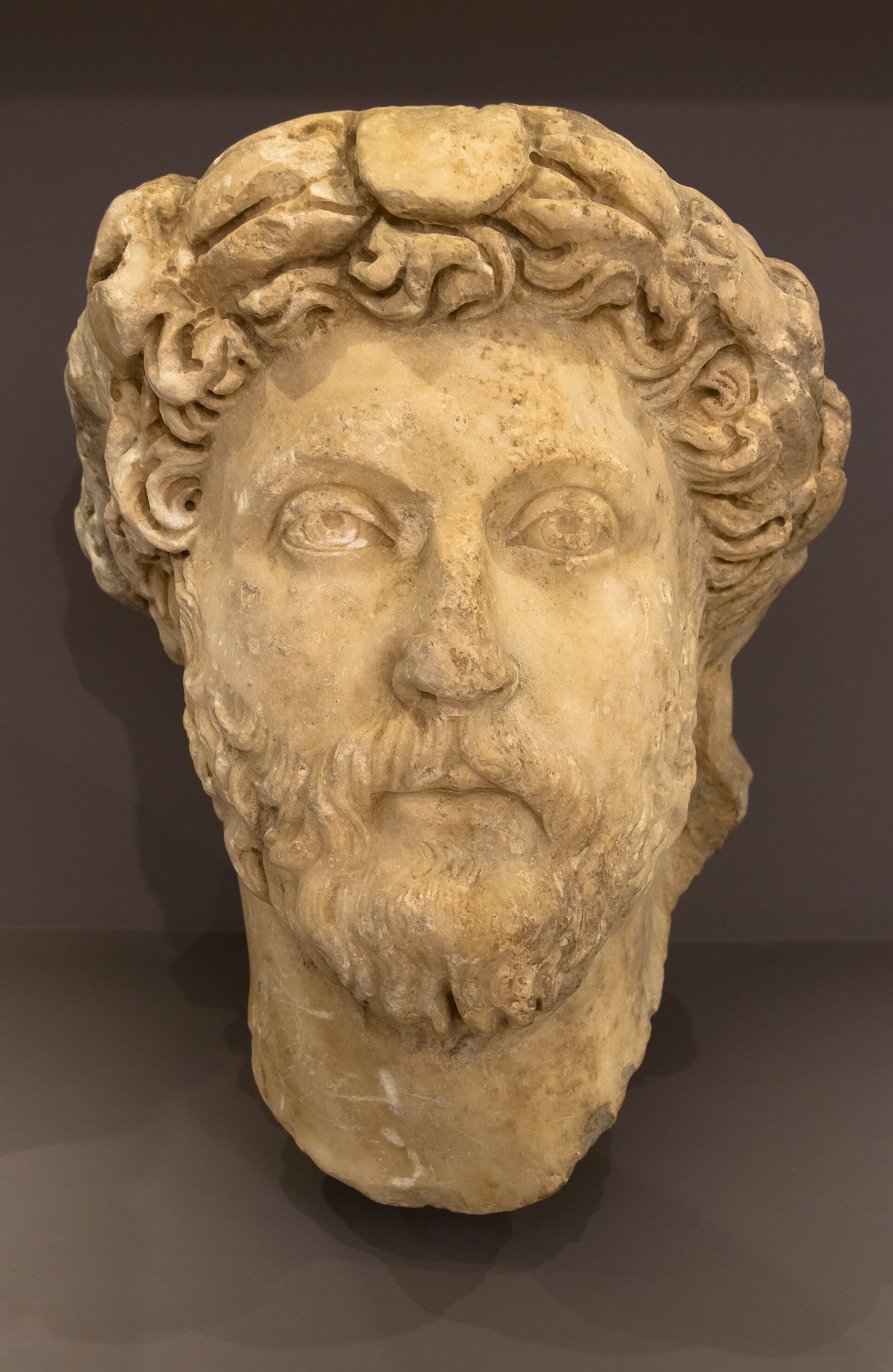 Marcus Aurelius