Who was Faustina the Younger?
Faustina was born into the very center of the Roman succession. Her father was Antoninus Pius, the emperor who adopted Marcus as his heir, and in AD 145 she married Marcus — joining the two branches of the Antonine house in a single marriage. She would remain at his side for roughly thirty years, through the whole of his reign: the childbearing, the plague, the long wars on the Danube, and the loss of child after child. When historians talk about the private life of the philosopher-emperor, they are largely talking about his life with Faustina.
Wife, mother, Mother of the Camp
Theirs was a long and extraordinarily fertile marriage that produced a very large family — though many of their children died young, a grief the couple absorbed again and again. Faustina became Augusta, held the dignity of an empress across decades of dynastic responsibility, and did something unusual for a Roman empress: she went with Marcus on his military travels. For that she received the honorific Mater Castrorum, “Mother of the Camp.” It was not an empty flourish. Her presence with the army on the northern frontier was striking enough that the Roman state chose to mark it with an official title.
Set that record against the frame of the reign — childbirth, bereavement, imperial travel, plague, and war — and Faustina emerges as something more than a name in a genealogy. She held the dynastic household together through the most punishing years of Marcus's life.
What Marcus himself said
The most important witness to this marriage is not a scandal-monger but Marcus. In the opening book of the Meditations, where he lists the people and gifts he is grateful for, he thanks the gods for a wife he remembers as:
“obedient, so affectionate, and so simple.”
Marcus Aurelius, on his wife · Meditations I
Read it in the plain register of Book I — the same register in which he thanks his teachers and his mother — and it is a quiet, unforced tribute. Marcus was a man who scrutinized his own feelings relentlessly and rarely flattered anyone. He gives us no hint anywhere that he regarded his wife with contempt.
The tension, kept honest
Ancient sources also accuse Faustina of adultery, of murder, and of complicity in the revolt of the general Avidius Cassius. Several of those charges descend from hostile or notoriously unreliable traditions. The honest position is the uncomfortable one: we should neither automatically believe them nor pretend they were never made. And weighed against them is a stubborn fact — Marcus kept praising and honoring her, before and after her death. That is the strongest direct evidence we have of what the man who actually knew her thought.
The rumors and the revolt
The most consequential charge is that Faustina was mixed up in Avidius Cassius's rebellion of AD 175, when the trusted eastern general declared himself emperor on a false report that Marcus had died. Some hostile ancient writers suggested she had encouraged Cassius — perhaps fearing for the succession if Marcus really were dead. But the evidence is thin and colored by later invention, and it sits inside a broader pattern of Roman writers attaching scandal to powerful women. On the map of Marcus's circle this is exactly the kind of spoke that crosses another: the same rebellion that tested Marcus's Stoicism also became the peg on which his wife's reputation was hung.
What is not in doubt is how Marcus behaved. He treated the aftermath of the revolt with famous clemency, and he never turned that suspicion against Faustina in anything he left us. When she died, he continued to honor her memory. A husband persuaded of betrayal does not usually do that.
Why she belongs in the circle
Faustina was Marcus's wife for most of his adult life, the mother of his children, his companion during war, and a named subject of his personal gratitude. Among the twenty figures around him, she is the one closest to him in simple daily proximity — and the one whose story most tests how we read hostile ancient sources. Strip away the rumors that cannot be verified and what remains is a thirty-year marriage that Marcus, in the one document where he spoke only to himself, chose to record with thanks.
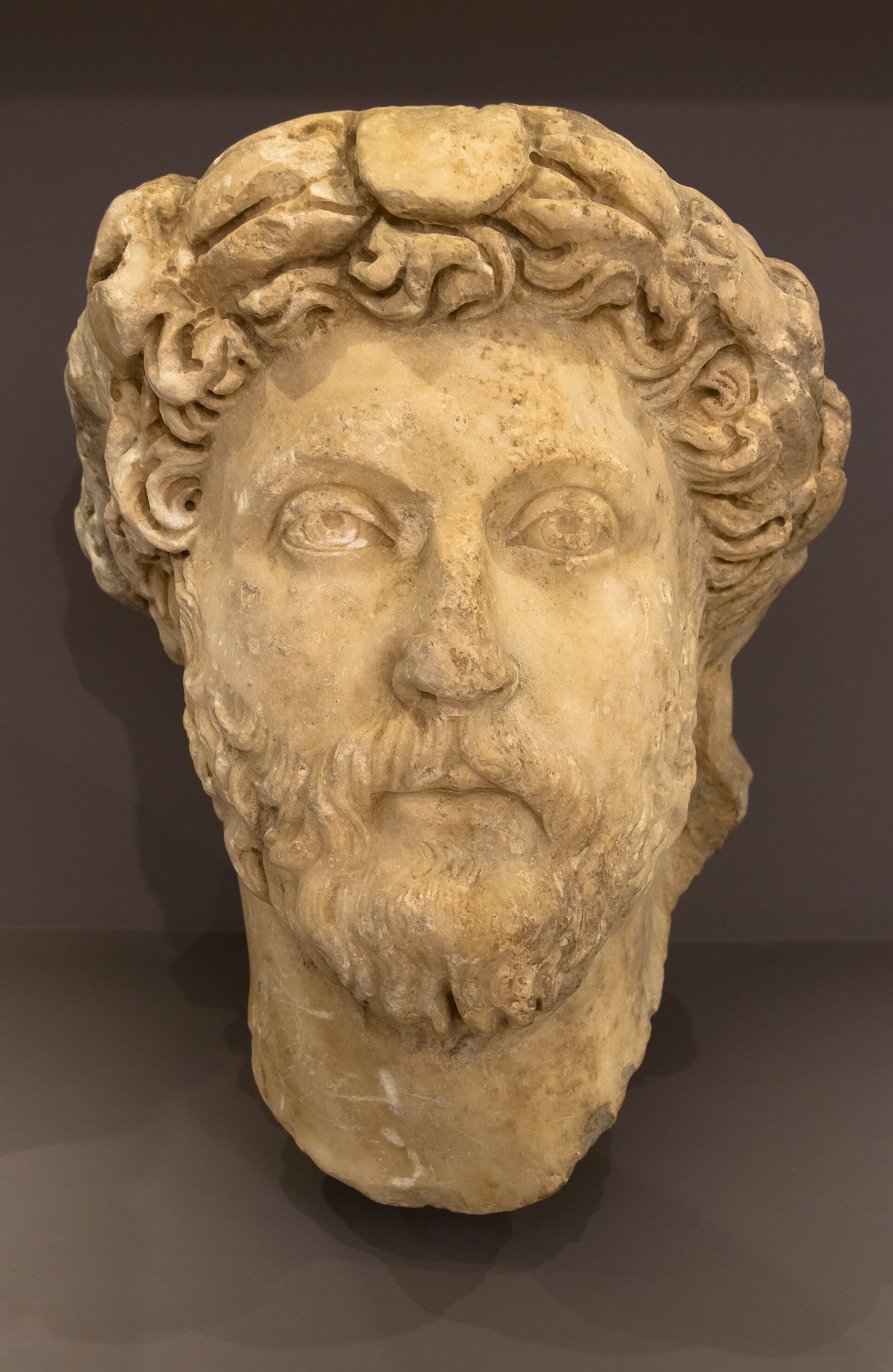 Marcus Aurelius