Antoninus Pius
Adoptive father; taught him to rule
Faustina
Wife of some thirty years
Domitia Lucilla
His mother; his first teacher
Verus & Commodus
Co-emperor brother; troubled son
Why the household matters most
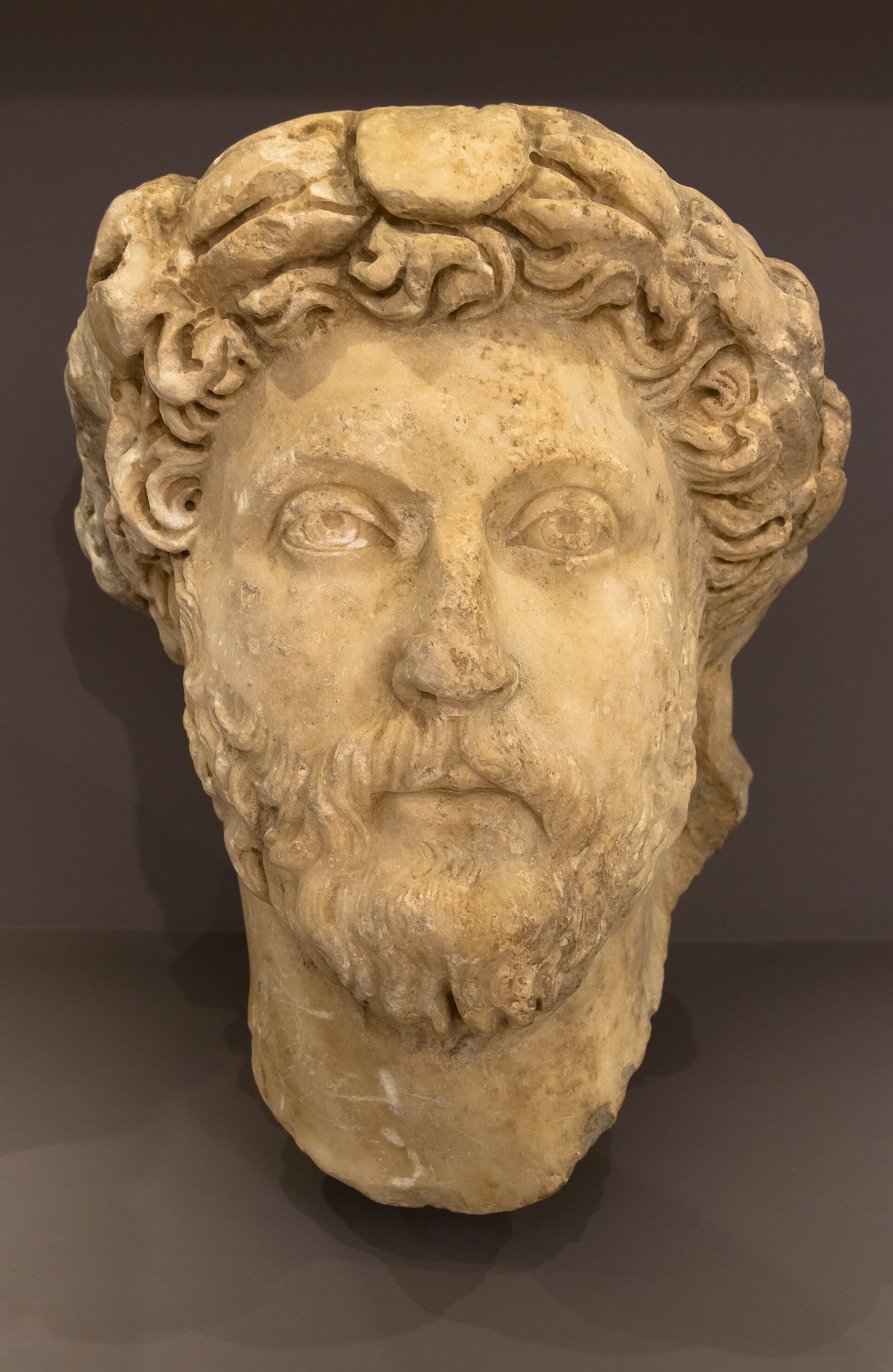
We think of Marcus Aurelius as the product of Stoic teachers, but he tells a subtler story. In Book I of the Meditations he thanks his mother, his adoptive father, his brother, and his wife alongside the philosophers — and the qualities he attributes to them are the ones he is most famous for. The generosity, the simplicity, the restraint amid privilege, the model of imperial conduct: these came from family before they came from books.
This page reads five members of that household through the lens of Marcus: what each gave or meant to him, enough of their own story to stand on its own, and the honest limitations. Three of them — Antoninus Pius, Faustina, and Commodus — have their own full pages and appear here in brief. His mother Domitia Lucilla and his co-emperor brother Lucius Verus get their full treatment below.
A word on the evidence. Marcus's own Meditations is the best witness for his mother, wife, brother, and adoptive father. For the wars and for Lucius Verus's eastern campaign, Cassius Dio is essential, though parts survive only in later epitomes. The Historia Augusta preserves useful material but is unreliable and flagged as such. Where hostile ancient gossip appears — about Faustina, about Commodus — it is labeled as what it is, and no quotation is invented.
The insight
Marcus's household holds both his best inheritance and his worst bequest. From his mother and Antoninus he received the raw material of his character; to his son Commodus he handed an empire that broke with everything he stood for. The same family that made the philosopher produced his gravest failure.
Household I
Antoninus Pius
The adoptive father who taught him not how to think, but how to rule.
Antoninus Pius became emperor in AD 138, adopted by Hadrian on the condition that he in turn adopt Marcus and Lucius Verus. Marcus therefore spent more than two decades as his adoptive son and heir-in-waiting — a long apprenticeship in governing an empire. He was not a philosopher and cannot be securely called a Stoic, yet Marcus treated him as a supreme example of practical virtue and gave him one of the longest tributes in the Meditations, beginning with his:
“mildness of temper.”
Marcus Aurelius, on Antoninus Pius · Meditations I
If Rusticus taught Marcus how to discipline himself, Antoninus taught him how an emperor should behave — how to weigh decisions, handle advisers, manage public money, resist extravagance, and balance firmness with restraint. His full story, and the limits of the peace he left behind, have their own page.
Household II
Faustina the Younger
Wife of some thirty years, mother of his children, companion on campaign.
Faustina was the daughter of Antoninus Pius and married Marcus in AD 145. Their marriage lasted roughly thirty years and produced a very large family, though many of their children died young. She became Augusta, accompanied Marcus on his military travels, and received the title Mater Castrorum — "Mother of the Camp." In the Meditations, Marcus remembers her as:
“obedient, so affectionate, and so simple.”
Marcus Aurelius, on his wife · Meditations I
Hostile ancient sources accuse her of adultery and even complicity in Avidius Cassius's revolt — charges that come from unreliable traditions and should be neither swallowed nor erased. The strongest evidence of Marcus's own view is that he kept praising and honoring her, before and after her death. Her full story, and a fair weighing of the slander, has its own page.
Household III
Domitia Lucilla
His mother — and, by his own account, his first and easily underrated teacher.
Domitia Lucilla was a wealthy Roman aristocrat and heiress whose fortune included major brick-making interests near Rome. Marcus's father died while Marcus was a small child, which left his mother as one of the central formative figures of his early life. When Marcus opens the Meditations by naming his debts, she comes near the very front, credited with:
“piety and beneficence.”
Marcus Aurelius, on his mother · Meditations I
He goes further, thanking her for teaching him religious reverence, generosity, a horror of wrongdoing, and above all simplicity of living. The detail that matters is the wealth behind it. Lucilla was rich, and the lesson she gave was not poverty imposed by circumstance but restraint in the presence of privilege — living plainly when she did not have to. It is hard to overstate how much of the mature Marcus is already visible here: the unease with luxury, the plainness, the moral self-examination all trace back to her.
The honest limitation is that our evidence for her is thin and mostly indirect. She left no philosophical corpus and no political career to compare with the men who taught her son, and much of what we know is inferred rather than documented. But that scarcity should not shrink her importance. Many of the qualities the world admires in Marcus appear, in his own telling, first as lessons from his mother. The philosopher-emperor's moral education did not begin with a Greek sage. It began at home.
Household IV
Lucius Verus
The adoptive brother Marcus raised to co-emperor rather than removed as a rival.
Lucius Verus was adopted by Antoninus Pius alongside Marcus. When Antoninus died in AD 161, Marcus was offered sole power — and instead elevated Lucius to co-emperor, creating the first sustained joint imperial rule of its kind in Roman history. Lucius later married Marcus's daughter Lucilla, binding the two men even more closely. In the Meditations, in a passage usually read as referring to Lucius, Marcus gives thanks that he had:
“such a brother, who was able by his moral character to rouse me to vigilance over myself.”
Marcus Aurelius · Meditations I.17 (trans. George Long)
Lucius's reign was dominated by the victorious war against Parthia. He served as imperial commander in the East while generals such as Avidius Cassius and Statius Priscus did much of the field work; under that command Roman forces recovered Armenia, drove into Mesopotamia, took major Parthian territory, and sacked Ctesiphon. It was a genuine triumph for the regime — and it is worth noticing that the same eastern campaign made the careers of men who would matter enormously later, Cassius among them.
The limitations deserve an honest hearing on both sides. Ancient sources routinely accuse Verus of luxury and indolence, but those accounts are exactly the kind that need caution. What is clearer is that the finest operational achievements of the Parthian war belonged to his generals more than to Verus himself. The deeper point, though, is about Marcus, not Lucius: faced with a potential rival, Marcus chose to share power rather than eliminate it. That decision — cooperation over dynastic paranoia — tells us as much about Marcus's character as any line in the Meditations.
Household V
Commodus
His son and successor — and the greatest contradiction in his legacy.
Commodus was born in AD 161, the year his father became emperor. After the deaths of his brothers he became Marcus's surviving male heir, was named Caesar, and was raised to co-emperor in AD 177. When Marcus died in AD 180, Commodus succeeded him — inheriting experienced advisers, the legitimacy of a biological son, and one of the most powerful states in the ancient world. His reign became a byword for extravagance, court instability, executions, and gladiatorial self-display, and his assassination in AD 192 helped plunge Rome into the Year of the Five Emperors.
No authentic words of Commodus about his father survive to quote. The nearest ancient line is hostile testimony, not self-expression — Cassius Dio, describing the young Commodus during the Avidius Cassius crisis, calls him "too young and also rather simple-minded." That is Dio's judgment, offered against him, and not the young man speaking for himself.
The blunt assessment is that Commodus is the hardest problem in Marcus's legacy. A man celebrated for judgment and self-discipline left the empire to a son who became a symbol of their opposites. There are mitigating pressures — hereditary expectation, no surviving brothers, the real danger of civil war — but the succession remains his gravest political failure. His full story has its own page.
What the household adds up to
Marcus's family is the whole arc of his life in miniature. Antoninus Pius and Domitia Lucilla gave him the character; Faustina and Lucius Verus shared the reign; Commodus inherited the result and broke with it. To read Marcus only as a solitary Stoic in a tent is to miss that his best qualities were gifts from the people closest to him — and that his single largest failure was a member of his own household.
Sources
- Marcus Aurelius, Meditations, Book I (MIT Classics).
- Cassius Dio, Roman History, Book 72 (via LacusCurtius).
- Historia Augusta, Marcus Antoninus and Verus — used with caution.
- Wikipedia and the Cambridge Companion to Marcus Aurelius' Meditations for Antoninus Pius, Faustina the Younger, Domitia Lucilla, Lucius Verus, and Commodus.
 Marcus Aurelius