Two men separated by rank, geography, and roughly a lifetime. One was born a slave; the other was born to rule the known world. They never met. And yet, of everyone who shaped Marcus Aurelius, the former slave may have reached deepest of all.
Who Epictetus was
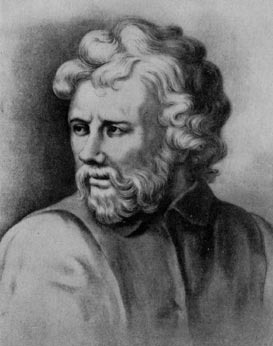
Epictetus was born into slavery at Hierapolis in Phrygia around the middle of the first century AD. After obtaining his freedom he taught philosophy in Rome, and later established a school at Nicopolis in Greece after the emperor Domitian expelled philosophers from the capital. His whole life ran opposite to the one Marcus would inherit: no title, no inheritance, no power over other people — and, in his teaching, no complaint about it.
He wrote nothing himself that we know of. Everything we have comes secondhand: his pupil Arrian took down his teaching and preserved it in the Discourses, then compressed the essentials into a short handbook, the Enchiridion. That secondhand transmission matters for what follows, because it is exactly the form in which the philosophy would one day reach an emperor — as a book, not a voice in the room. Only four of the original eight books of the Discourses survive, and because Arrian holds the pen, we can never be perfectly sure where Epictetus ends and his editor begins.
How his teaching reached Marcus
Here is the fact that surprises people: Marcus Aurelius never studied under Epictetus. By the time Marcus was a young man, Epictetus was gone. There was no lecture room, no personal acquaintance, no correspondence. What Marcus inherited was the text.
The bridge was his teacher Junius Rusticus. In the first book of the Meditations, Marcus explicitly credits Rusticus with giving him access to the teachings of Epictetus. That single act of handing over a book turns out to be one of the most consequential in the history of Stoicism. The chain is worth stating plainly:
The chain of transmission
Epictetus → Arrian → Rusticus → Marcus Aurelius → the Meditations. A slave taught; a pupil wrote it down; a Roman statesman preserved and passed it on; an emperor absorbed it and made it the private discipline of his own mind. Strip out any link — Arrian's notebooks, Rusticus's gift — and the most beloved book of Stoicism reads very differently, or not at all.
So the relationship between these two men is real but strictly one-directional and textual. Marcus met Epictetus the way most of us still do: on the page, alone, at a distance, taking notes.
The dichotomy of control
At the center of what Marcus absorbed is a single, ruthless distinction. Epictetus opens the Enchiridion by dividing the whole of experience into two categories: the things that are up to us, and the things that are not. Our judgments, our desires, our own choices are ours. Our bodies, our reputations, our property, the actions of other people, the course of events — none of that is finally ours to command. He states the principle without softening it:
“The things in our control are by nature free.”
Epictetus · Enchiridion
Everything else in Epictetus grows out of that root. Because our moral choice — what the Greeks called prohairesis — belongs entirely to us, it can never be taken by force. A master can chain the body; he cannot chain the will that decides how to meet the chains. This is why the philosophy came so naturally from a former slave: it locates freedom in the one place slavery could never reach. Illness, loss, humiliation, fear, even death fall outside our control, and so the task is not to escape them but to govern our own response to them without surrendering moral autonomy. Epictetus turned Stoicism from abstract theory into intensely practical training for exactly that.
What Marcus did with it
Marcus took the dichotomy of control and made it a nightly habit. The Meditations are not a treatise; they are a man drilling himself, again and again, on the boundary between what he governs and what he must simply accept. The characteristic move is pure Epictetus, rephrased in Marcus's own voice:
“If thou art pained by any external thing, it is not this thing that disturbs thee, but thy own judgement about it. And it is in thy power to wipe out this judgement now.”
Marcus Aurelius · Meditations 8.47 (trans. George Long)
Across the private notebooks the same discipline surfaces in different forms. Marcus reminds himself that other people's opinions are not his to control, only his own conduct. He tells himself that pain and illness belong to the body and need not disturb the governing mind. He rehearses accepting the assignment nature has given him, and doing the work in front of him without complaint. None of this is invented from nothing: it is a working emperor putting a slave's handbook into daily practice under the pressure of plague, war, and betrayal. Marcus does at times name Epictetus and echo his language directly; rather than reconstruct exact book-and-chapter references from memory, it is enough to say that the fingerprints are everywhere, and that Marcus himself points back to Rusticus and Epictetus as the source.
The former slave taught the emperor to be free
That is the line worth ending on, because it is not merely a neat reversal. It is the whole argument of the philosophy demonstrated by the lives of the two men who carried it. Epictetus, who owned nothing and once belonged to another man, taught that freedom is an interior fact — a matter of judgment and moral choice that no owner can confiscate. Marcus, who owned an empire and commanded legions, was in constant danger of the opposite illusion: that a man with such power over external things must be free. Epictetus corrected him. Real freedom was never in the crown, the armies, or the frontier. It was in the disciplined mind that decides how to meet whatever comes.
Among the twenty figures in Marcus's circle, Epictetus is the deepest indirect influence — the current beneath the surface. Rusticus handed Marcus the book; Epictetus supplied what was written in it. Read the Meditations closely and you are, in a real sense, still listening to a man who was born a slave in Phrygia and never wrote a word down — teaching an emperor, across the years and the pages, how to be free.
 Epictetus