Pompeianus
Son-in-law & closest war commander
Pertinax
Merit over snobbery; later emperor
Maximianus & Paternus
Deep Danube; diplomat and prefect
Fronto
Killed in battle, c. 170 CE
The professionals behind the philosopher
The popular image of Marcus Aurelius is a solitary man in a tent, writing to himself by lamplight. That image is true as far as it goes, but it leaves out everyone in the camp around the tent. The Meditations was written during two decades of near-continuous war, and it was written on frontiers that stayed Roman only because professional soldiers kept them so. Marcus set the strategy and carried the political weight; men like the five below did the fighting, the marching, the supplying, and, in one case, the dying.
Reading Marcus through his generals corrects a distortion. He was not a scholar who happened to wear purple. He was a wartime head of state whose reign was consumed by the Marcomannic and Parthian conflicts, and whose calm on the page was earned against a backdrop of very real emergency. To understand the emperor, meet the officers he trusted to hold the line.
A word on the evidence. Cassius Dio is the essential narrative source for these commanders, though parts survive only through later epitomes. For officers such as Maximianus and Fronto, inscriptions do most of the work — we often know the offices they held and the honors they earned better than their personalities. The Historia Augusta preserves useful material but is unreliable and is treated with caution. Where no secure quotation of a man survives, none is invented here.
One of five
Tiberius Claudius Pompeianus
The strongest candidate for the man personally closest to Marcus in war — general, frontier commander, and son-in-law in one person.
Pompeianus rose from comparatively modest provincial origins in Antioch to become one of the most important military and political figures of the reign. He governed Pannonia Inferior, fought through the northern wars, reached the consulship, and married Marcus's daughter Lucilla — a marriage that made him the emperor's son-in-law. But his weight was never merely dynastic. He was an experienced frontier commander trusted with real armies during a genuine military emergency, when the Marcomannic Wars were at their most dangerous.
What makes him remarkable is that he united three worlds that rarely sat in the same man: the frontier army, the imperial government, and Marcus's own household. When you look for the person who stood closest to Marcus as both a commander and a family member, Pompeianus is the answer. Cassius Dio tells us plainly that Marcus met the German invaders not by taking the field alone but through his officers — and he names them.
“his lieutenants Pompeianus and Pertinax.”
Cassius Dio, Roman History, Book 72
The honest limitation is that the surviving narrative is frustratingly thin on his individual battlefield decisions. We know his standing and his importance better than we know the tactical details of his campaigns. Even so, the shape of his career is clear enough: this was the professional Marcus leaned on hardest, and later kept close as kin.
Two of five
Pertinax
The self-made officer Marcus promoted over aristocratic snobbery — and who, thirteen years after Marcus died, briefly wore the purple himself.
Publius Helvius Pertinax came from genuinely humble origins and built his career the hard way — through teaching, administration, and above all military service. He fought in Marcus's wars and earned high command and the consulship on demonstrated success rather than birth. Cassius Dio notes that some aristocrats resented his advancement precisely because his origins were obscure, which only makes the rise more impressive. Dio's own verdict is refreshingly blunt:
Pertinax “greatly distinguished himself.”
Cassius Dio, Roman History, Book 72
For Marcus, promoting Pertinax was one of his better personnel decisions: a bet on ability against the reflex of a class-bound establishment. It is exactly the sort of judgment the Meditations would lead you to expect from him — valuing the work over the pedigree.
The later chapter is more tragic than triumphant. In 193 CE, long after Marcus's death, Pertinax became emperor. His attempt to restore discipline to the Praetorian Guard provoked the very soldiers he depended on, and they murdered him after only a matter of months. His personal integrity, it seems, outran his power to control a corrupted institution — but that failure belongs to a later Rome, not to the frontier where Marcus knew him.
Three of five
Marcus Valerius Maximianus
A career reconstructed almost entirely from stone — supply, cavalry, and legionary command that carried Roman arms deep beyond the Danube.
Maximianus is fascinating precisely because no surviving ancient historian gives him a conventional biography. His extraordinary career is pieced together mostly from inscriptions, and it ranges across the Parthian War, the Marcomannic Wars, major logistical commands, cavalry commands, legionary command, and eventually the governorship of Numidia. He was decorated for service and rose from moving supplies along the Danube to leading men in battle.
He is associated with the Roman presence at Laugaricio — modern Trencin in Slovakia — where a famous inscription records a dedication:
“To the victory of the emperors.”
The Laugaricio inscription (Trencin, Slovakia)
That single line is evidence of how far north of the river Marcus's forces actually pushed. The discipline the story demands is restraint: with no literary narrative, we must resist filling the gaps with invention. We cannot show how often Maximianus spoke with Marcus in person. What we can say is that he was one of the professional officers whose operational expertise — transport, cavalry, command structure — made the emperor's long campaigns possible at all. Marcus supplied the philosophy of the reign; men like Maximianus supplied its logistics.
Four of five
Tarrutenius Paternus
Diplomat, administrator, and soldier in one trusted official — later Praetorian prefect, later a casualty of the court that followed Marcus.
Paternus first appears as Marcus's senior official for Latin correspondence — a man of the pen before the sword. During the Marcomannic Wars he was sent to negotiate with the Cotini, who promised military help against the Marcomanni and then reneged. Cassius Dio records the humiliation without flinching:
the Cotini “treated Paternus himself shamefully.”
Cassius Dio, Roman History, Book 72
What his career reveals is Marcus's habit of using one trusted man across every register of statecraft. Paternus served as diplomat, as administrator, and as soldier; Dio later records Marcus giving him a substantial force for military operations, and he eventually rose to Praetorian prefect. Compared with Pompeianus or Pertinax, his direct battlefield record under Marcus is less fully documented, but his value was exactly this versatility — the educated senior servant an emperor could send to bargain with tribal leaders one year and entrust with legions the next.
His end came after Marcus. In the dangerous court politics of Commodus's reign, Paternus was executed on accusations of treason, the precise circumstances clouded by hostile and conflicting sources. He is a reminder that the stability Marcus built around himself did not outlive him — the men he trusted were not always safe once he was gone.
Five of five
Marcus Claudius Fronto
The commander who was killed in battle around 170 CE — the human cost of Marcus's frontier wars made literal.
Marcus Claudius Fronto was a senator, consul, legionary commander, and provincial governor, a veteran of both Rome's eastern and Danubian wars. He served in the Parthian conflict before taking on major responsibilities in Dacia and the neighboring frontier regions. Then, around 170 CE, he was killed in battle. The senate honored him with an inscription recording that he fell:
“fighting bravely for the republic to the last.”
Senatorial inscription honoring Marcus Claudius Fronto (CIL VI 41142)
As with so many of these officers, almost everything we know comes from inscriptions rather than a literary biography, so we know his offices and honors better than his temperament. But the one fact that matters most is beyond dispute: he died in combat, in the very wars that dominated Marcus's reign.
That gives Fronto a particular weight in this circle. Marcus writes again and again in the Meditations about death, duty, impermanence, and doing the work nature assigns. It is easy to read those passages as abstract consolation. Fronto is the correction. Around the emperor as he wrote, commanders like this one were actually dying in that work. The philosophy was not composed in a study; it was composed in a war that killed the men who carried it out.
Sources
- Cassius Dio, Roman History, Book 72 (via LacusCurtius).
- "Tiberius Claudius Pompeianus," "Marcus Valerius Maximianus," "Publius Tarrutenius Paternus," and "Marcus Claudius Fronto," Wikipedia (offices and career).
- Livius: Pertinax.
- Historia Augusta, Marcus Antoninus — used with caution.
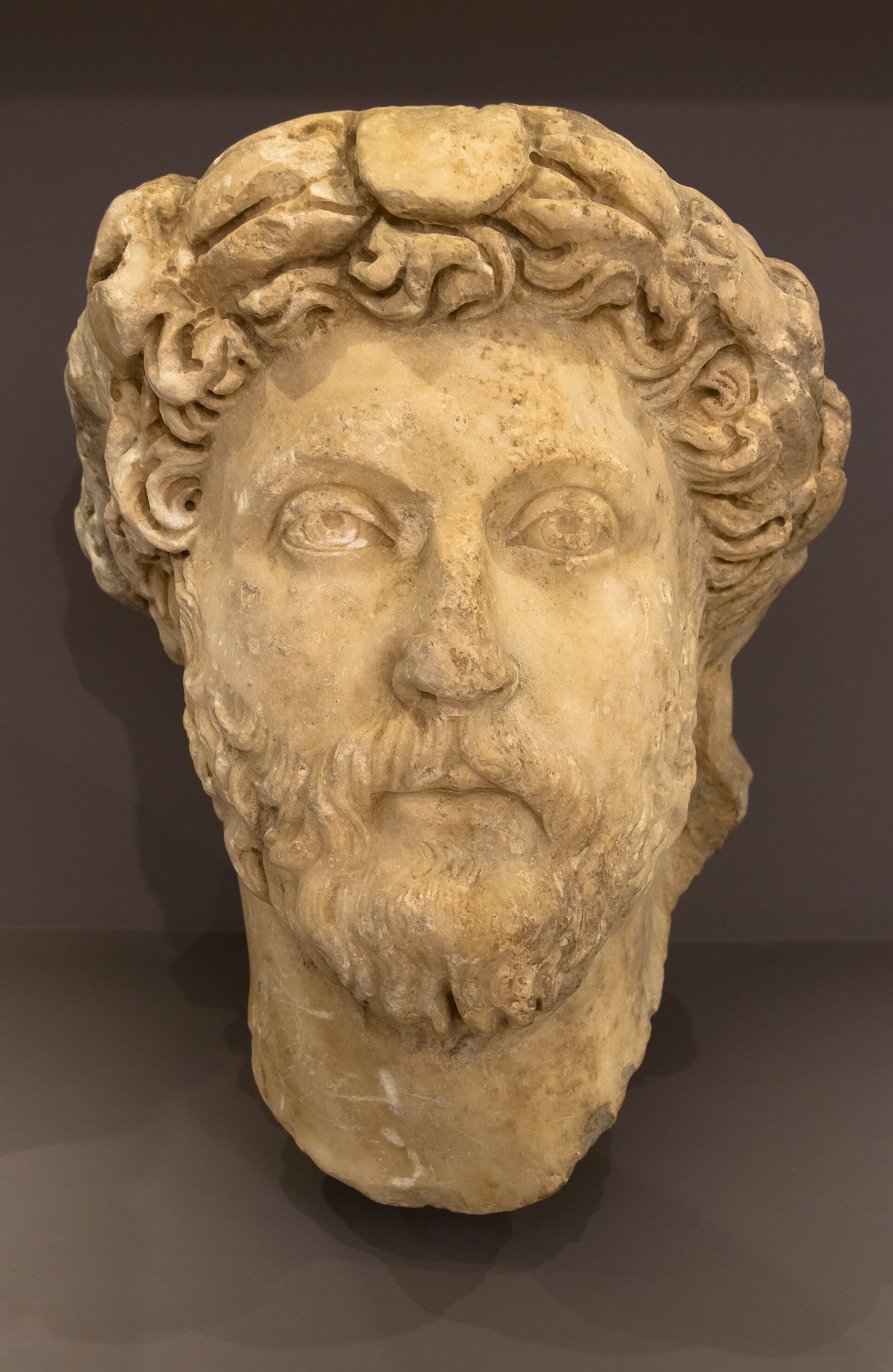 Marcus Aurelius