
Neptune
Neptune is the last of the planets — a deep-blue ice giant on the cold frontier of the Solar System, home to the fastest winds anywhere. Its greatest distinction is how it was found: not by looking, but by mathematics, its position calculated on paper before any telescope was turned its way.
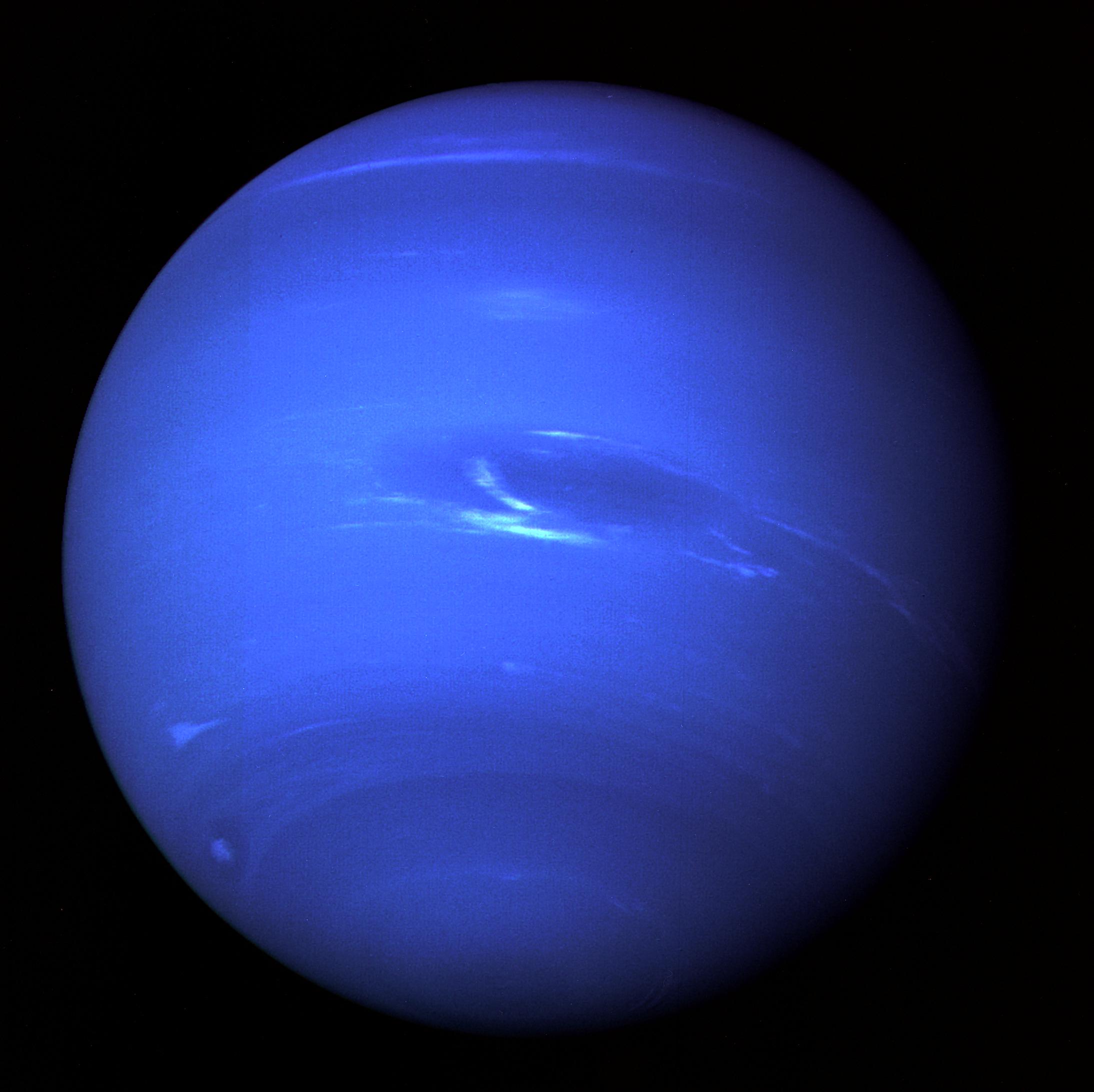
Image credit: NASA/JPL. Neptune from Voyager 2 in 1989 — the only spacecraft ever to visit. The dark oval is the Great Dark Spot, a vast storm; the white streaks are high clouds racing on supersonic winds. (This classic view is contrast-enhanced; the real Neptune is a paler blue.)
Type
Ice giant — the most distant planet
Distance from Sun
~30 AU (~4.5 billion km)
Winds
Up to ~2,100 km/h — the fastest anywhere
Year
165 Earth years
The planet found with a pencil
Neptune is the fourth and outermost giant, a near-twin of Uranus in size and makeup — an ice giant of hydrogen, helium, and heavier ices, its atmosphere colored blue by methane. But it is a far stormier world. Despite lying 30 times farther from the Sun than Earth and receiving barely any sunlight, Neptune has the fastest winds in the Solar System, reaching about 2,100 km/h — supersonic gales that whip huge dark storms, like the Earth-sized Great Dark Spot Voyager 2 saw in 1989, across the disc. Heat welling up from its interior helps drive that ferocious weather.
Its discovery is one of science's great triumphs. In the 1840s astronomers realized Uranus was straying slightly from its predicted path, as if tugged by an unseen world. Urbain Le Verrier and John Couch Adams each calculated where that world must be — and in 1846 Johann Galle found Neptune within a degree of Le Verrier's prediction, almost the moment he looked. A planet had been discovered by mathematics before anyone had knowingly seen it. Neptune's largest moon, Triton, is a captured Kuiper Belt world that orbits backwards.
The one planet you'll never see without help
Neptune is the only planet entirely invisible to the naked eye — at about magnitude 7.8 and 4.5 billion kilometers away, it is simply too faint and too far. Finding it is a deliberate hunt: with binoculars or a small telescope and a good chart or app, you can track it down as an exceedingly faint "star" that, at higher magnification, resolves into a tiny, distinctly blue-grey disc. That subtle disc, non-stellar and coloured, is the confirmation you've bagged the eighth planet.
There is no surface detail to see — the storms and winds are the domain of Voyager and Hubble. The satisfaction is in the achievement and the perspective: the little blue point in the eyepiece is the most distant major world of our Solar System, so far away that its light takes over four hours to reach you, and it has completed just one orbit of the Sun since it was discovered in 1846.
New to stargazing? See how to observe the night sky, and if you're choosing gear, the no-hype telescope buying guide.
Bluer in pictures than in life, and the god of the sea
A widespread misconception is that Neptune is a deep, vivid azure — the color of those iconic Voyager 2 images. In reality that blue was enhanced to bring out faint cloud features; recent reprocessing shows the true Neptune is a much paler, greenish-blue, nearly the same shade as Uranus. A second common slip is calling Neptune "the farthest object in the Solar System" — it is the most distant planet, but the Kuiper Belt, the scattered disk, and the Oort Cloud all lie far beyond it. (And because Pluto's stretched orbit sometimes brings it inside Neptune's, Neptune is occasionally the most distant planet from the Sun for years at a time.)
Neptune is named, aptly for a deep-blue world, after the Roman Neptune, god of the sea. His Greek counterpart is Poseidon, the earth-shaker who ruled the oceans — and Neptune's great moon Triton is named for Poseidon's son, keeping the whole watery family together in one corner of the sky.
Primary sources: NASA — Neptune and NASA/JPL Photojournal PIA01492 (Neptune, Voyager 2). Image credit: NASA/JPL.
The one planet found by arithmetic before it was ever seen — a distant blue giant on the frontier of the Sun's family, whipping the fastest winds in the Solar System across a face barely touched by sunlight.
More astronomy notes
Continue through the astronomy section for beginner-friendly notes, image credits, viewing tips, history, and the stories behind the night sky.
Triton · Kuiper Belt · The Planets · Astronomy · Interests