
Earth
Earth is the third planet, the only world known to hold life, and the one place in the universe every human has ever called home. It is also, uniquely, the planet not named for a god — and the one we learned to see whole only within living memory.
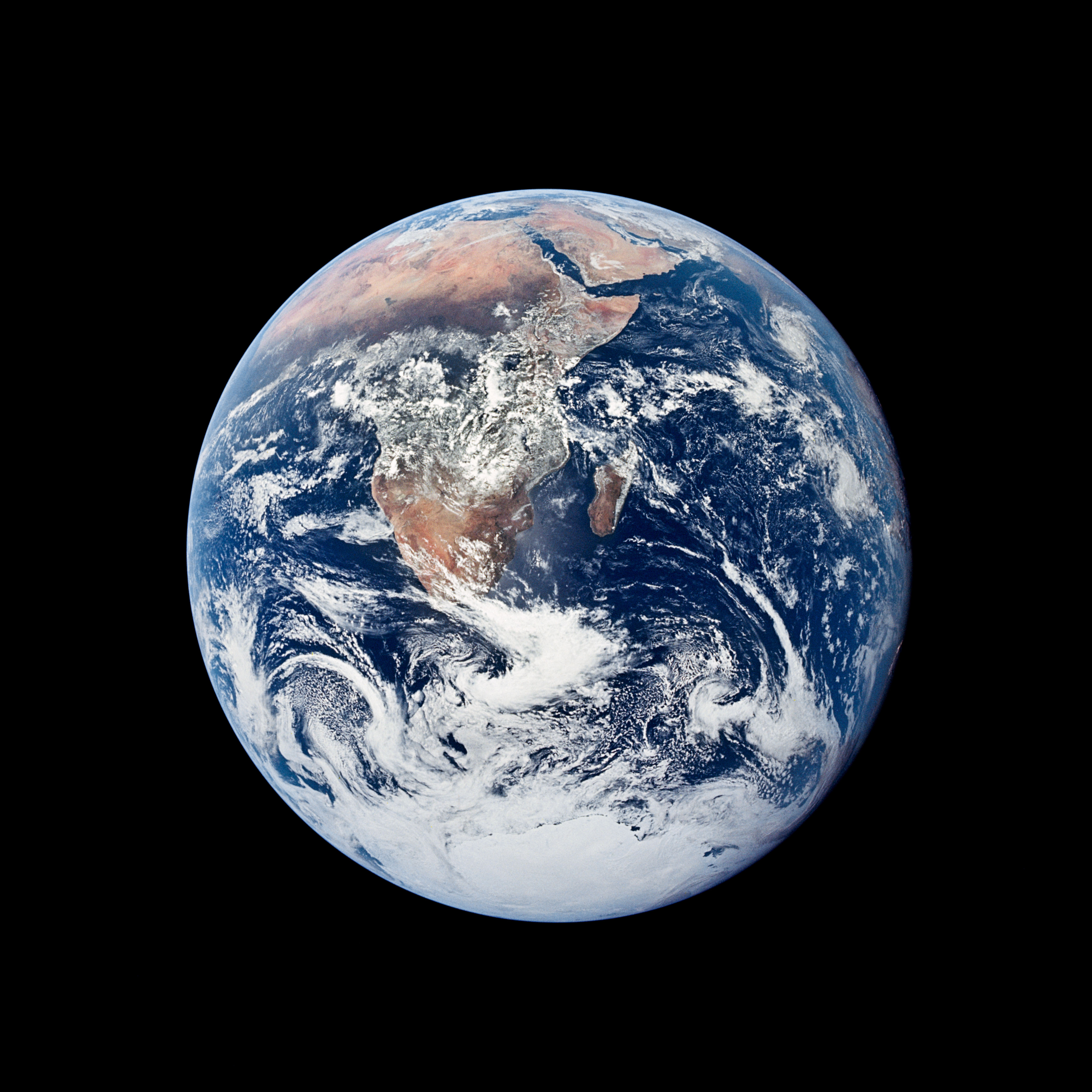
Image credit: NASA / Apollo 17. The "Blue Marble," taken by the Apollo 17 crew in December 1972 — one of the most reproduced photographs in history, and the first time humans had captured the whole, fully lit Earth from space.
Type
Rocky (terrestrial) — largest of the four
Distance from Sun
1 AU (~150 million km) — by definition
Day / Year
24 hours / 365.25 days
Life
The only world known to have it
The rare world where everything came together
Earth is the largest and densest of the rocky planets, and the only one with liquid water oceans, a breathable oxygen atmosphere, and — as far as we know — life. Its habitability is a combination of lucky ingredients working together: it orbits in the Sun's habitable zone, where water can stay liquid; a substantial atmosphere moderates temperatures and shields the surface; a churning iron core generates a magnetic field that deflects harmful solar radiation; and active plate tectonics recycle carbon and renew the surface. Remove any one and the story might read very differently — as it does on Venus and Mars, our scorched and frozen neighbors.
Earth is also the planet we understand from the inside out — and, only recently, from the outside in. The first photographs of the whole Earth from space, Earthrise (1968) and the Blue Marble (1972), reshaped how our species sees itself: a single, finite, borderless world hanging in the dark.
The one planet you can't put in an eyepiece
Earth is the planet you can't observe from a distance — you're standing on it. But that gives it a unique place in this section: it is the reference world against which we measure all the others, and the only one we have ever seen with our own eyes as a landscape, a sky, an ocean, a sunset. Every viewing tip on these pages ultimately compares back to home.
The nearest thing to "observing Earth" is looking at the images sent back by those who left it — the astronauts of Apollo, and the spacecraft that turned their cameras around for a farewell glance. The most humbling is Voyager 1's Pale Blue Dot: Earth reduced to a single point of light, less than a pixel, from six billion kilometers away. It is, in a sense, the ultimate astronomy observation — of ourselves.
New to stargazing? See how to observe the night sky, and if you're choosing gear, the no-hype telescope buying guide.
Not flat, not a perfect ball, and not named for a god
The most infamous modern misconception needs only a sentence: the Earth is not flat — its roundness has been known since the ancient Greeks, who even measured its size, and it is confirmed by every photograph from space, every ship vanishing hull-first over the horizon, and every flight around it. A subtler point is that Earth is not a perfect sphere either: its spin bulges it at the equator into an "oblate spheroid," a little wider around the middle than top to bottom. And the seasons are a common trip-up — they come from Earth's axial tilt, not its distance from the Sun; Earth is actually closest to the Sun in early January.
Earth is the odd one out in the family's names. Every other planet honors a Greek or Roman god, but "Earth" comes from old Germanic and Old English words simply meaning "the ground" — a humble, human name for home. The nearest mythological counterparts are the Greek Gaia and the Roman Terra, the primordial earth-mother, but neither was ever adopted as the planet's name.
Primary sources: NASA — Earth and the Apollo 17 "Blue Marble" (AS17-148-22727). Image credit: NASA / Apollo 17. See also Pale Blue Dot and Earthrise.
One world in all the dark that we know to be alive — round, tilted, water-wrapped, and named not for a god but simply for the ground beneath our feet: the only home our species has ever had.
More astronomy notes
Continue through the astronomy section for beginner-friendly notes, image credits, viewing tips, history, and the stories behind the night sky.
Pale Blue Dot · The Moon · Mars · The Planets · Interests