
The Kuiper Belt
The Kuiper Belt is the vast, icy ring of frozen worlds beyond Neptune — the third zone of the Solar System, home to Pluto, source of the short-period comets, and a deep-freeze archive of the leftovers from which the planets were born.
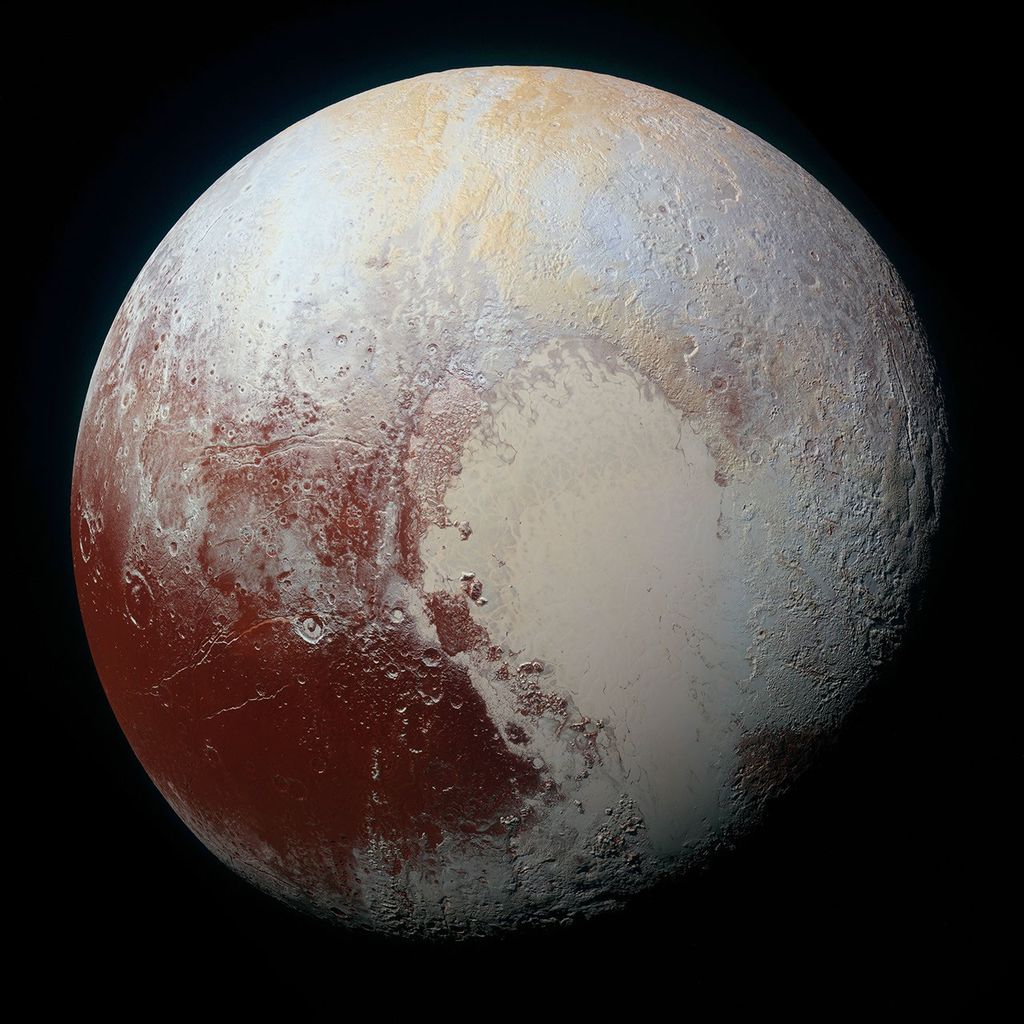
Image credit: NASA/Johns Hopkins APL/Southwest Research Institute. Pluto in enhanced color, from New Horizons in July 2015. The bright, heart-shaped plain is Tombaugh Regio — a vast sheet of nitrogen ice. Pluto is the best-known resident of the Kuiper Belt.
Location
Beyond Neptune
Distance from Sun
30 – 50 AU (about 4.5–7.5 billion km)
Made of
Ices — water, methane, ammonia — and rock
Notable residents
Pluto, Haumea, Makemake, Arrokoth
The belt that starts with K — and it's not after Mars
Here is the mix-up worth clearing up first: the belt just after Mars is the Asteroid Belt. The Kuiper Belt is the icy one, far beyond Neptune — the outermost of the giant planets. If someone asks for "the belt that starts with K," this is it, and it lies at the opposite end of the Solar System from the asteroids.
Schematic by Michael Paycer — not to scale. The Kuiper Belt runs from roughly 30 AU (Neptune's orbit) out to about 50 AU.
An icy archive twenty times wider than the Asteroid Belt
The Kuiper Belt is a doughnut-shaped region of icy bodies stretching from Neptune's orbit out to roughly 50 astronomical units from the Sun. It is the same idea as the Asteroid Belt — leftover building material that never formed a planet — but on a completely different scale and made of completely different stuff. Where the Asteroid Belt is rock and metal baked near the Sun, the Kuiper Belt is ice: frozen water, methane, and ammonia, so cold it behaves like rock. It is roughly twenty times wider and many times more massive than the Asteroid Belt.
Its residents are the trans-Neptunian objects. The largest include the dwarf planets Pluto, Haumea, and Makemake, along with hundreds of thousands of smaller icy bodies. In 2019 NASA's New Horizons spacecraft flew past a small, two-lobed Kuiper Belt object named Arrokoth — a pristine "contact binary" that has drifted, undisturbed, since the Solar System's birth. Objects like Arrokoth are the reason the belt matters so much to science: they are deep-frozen time capsules from 4.6 billion years ago.
The Kuiper Belt is also a comet factory. The short-period comets — the ones that loop back through the inner Solar System every few decades, like Comet Halley's shorter-period cousins — are nudged inward from here and the neighboring scattered disk. The much longer-period comets come from far deeper: the Oort Cloud.
Same concept, opposite ends. The Asteroid Belt is rock, between Mars and Jupiter. The Kuiper Belt is ice, beyond Neptune — bigger, colder, and home to Pluto. If you remember one thing: rock in, ice out.
The one belt you'll need a real telescope for
Be honest with yourself here: the Kuiper Belt is a challenge object. Everything in it is small, dark, and staggeringly far away — billions of kilometers beyond Neptune. Nothing here is a naked-eye or binocular target.
Pluto is the realistic goal, and it is a genuine trophy. At around magnitude 14, it demands a telescope of roughly 8 inches of aperture or more, a good star chart or astronomy app, and dark skies. Even then it is nothing but a faint point of light, indistinguishable from a background star — until you sketch or photograph the field across two or three nights and watch that one "star" creep against the others. That slow drift is you, personally, tracking a world five billion kilometers away. Nobody sees Pluto by accident; you earn it.
Realistic target
Pluto, magnitude ~14. Needs an 8-inch (or larger) telescope, dark skies, and patience.
How you confirm it
Motion. Photograph or sketch the same field over 2–3 nights; the object that moved is Pluto.
Everything else
Other Kuiper Belt objects are fainter still — the realm of large amateur scopes and professional observatories.
New to stargazing? See how to observe the night sky, and if you're choosing gear, the no-hype telescope buying guide.
"Is Pluto a planet?" — the most-argued question in astronomy
No object in the sky has started more arguments than Pluto, and the Kuiper Belt is the reason. When Pluto was discovered in 1930 it was hailed as the ninth planet. But as telescopes improved, astronomers realized Pluto was not alone: it was simply one of the larger members of a whole belt of icy bodies. When an object named Eris turned up in the scattered disk in 2005 — briefly thought to be larger than Pluto — the question became unavoidable. Either the Solar System had a tenth planet (and an eleventh, and a twelfth…), or Pluto was something else.
In 2006 the International Astronomical Union drew the line. A planet, they ruled, must orbit the Sun, be round, and have cleared its orbital neighborhood. Pluto passes the first two tests but fails the third — it shares the crowded Kuiper Belt with countless siblings. So Pluto was reclassified as a dwarf planet. This did not "demote" Pluto so much as promote our understanding: Pluto is not a failed planet but the king of a whole new class of world. The decision remains genuinely contested — some planetary scientists still argue the "cleared its neighborhood" rule is a poor test — which is exactly why the debate never quite dies.
Unlike the Asteroid Belt, the Kuiper Belt is named for a scientist — the Dutch-American astronomer Gerard Kuiper, who theorized about the region in 1951. Its most famous resident, though, carries a god's name: Pluto, the Roman god of the underworld — a fitting title for a cold, dark world at the edge of the Sun's domain. His Greek counterpart is Hades, lord of the dead.
Primary sources: NASA — The Kuiper Belt, NASA — Pluto, and NASA/JPL Photojournal image PIA19952 (Pluto in Enhanced Color). Image credit: NASA/Johns Hopkins University Applied Physics Laboratory/Southwest Research Institute.
Beyond the last of the giant planets lies a frozen frontier — not the edge of nothing, but the beginning of everything left over: a belt of small, patient worlds that remember the Solar System as it was on the morning it was made.
Explore the structure of the Solar System
The Kuiper Belt is one stop in a tour of the Solar System's belts, rings, and clouds — the leftover architecture between and beyond the planets.
The Solar System (hub) · Asteroid Belt · Kuiper Belt · Scattered Disk & Oort Cloud · Planetary Rings · Zodiacal Cloud
More astronomy notes
Continue through the astronomy section for beginner-friendly notes, image credits, viewing tips, history, and the stories behind the night sky.
The Solar System · Asteroid Belt · Scattered Disk & Oort Cloud · Astronomy · Interests