
The Planets
Eight worlds circle the Sun, and no two are alike — from a sun-blasted ball of rock to a storm-wrapped giant that could swallow a thousand Earths. They fall into three families: the small rocky planets, the gas giants, and the ice giants. Here's how they compare, and a page for each.
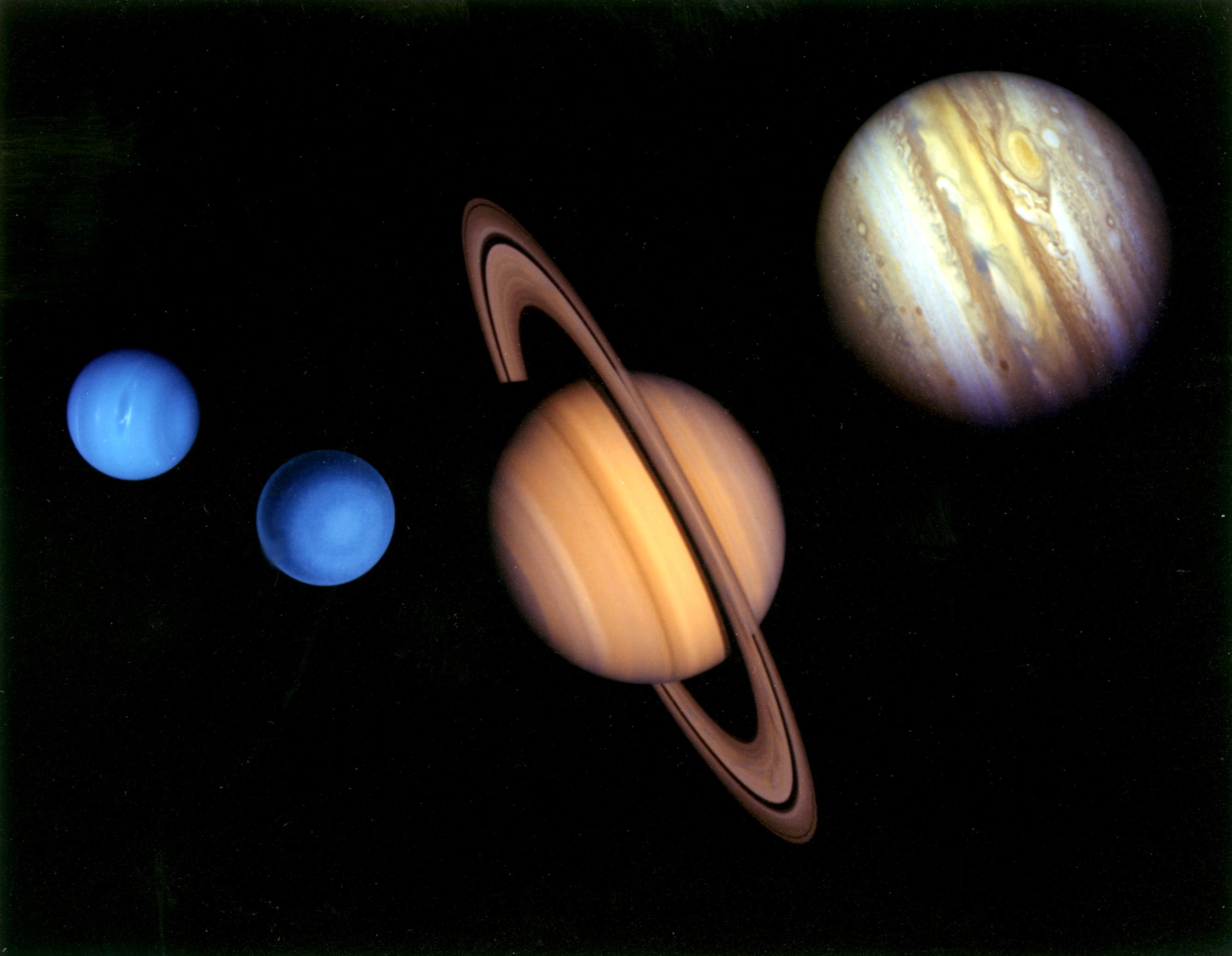
Image credit: NASA/JPL. The outer giants — Jupiter, Saturn, Uranus, and Neptune — as seen by the Voyager missions, whose Grand Tour of the 1980s gave us our first close look at all four.
Rocky worlds, gas giants, ice giants
The terrestrial planets — Mercury, Venus, Earth, and Mars — are small, dense, and rocky, with solid surfaces you could stand on. Beyond the asteroid belt lie the gas giants, Jupiter and Saturn: vast balls of hydrogen and helium with no surface to speak of. Farther still are the ice giants, Uranus and Neptune — smaller, colder, and richer in the heavier "ices" of water, ammonia, and methane that tint them blue.
| Planet | Type | Avg. distance | Day | Year | Moons |
|---|---|---|---|---|---|
| Mercury | Rocky | 0.39 AU | 59 days | 88 days | 0 |
| Venus | Rocky | 0.72 AU | 243 days | 225 days | 0 |
| Earth | Rocky | 1.00 AU | 24 hours | 365 days | 1 |
| Mars | Rocky | 1.52 AU | 24.6 hours | 687 days | 2 |
| Jupiter | Gas giant | 5.2 AU | 9.9 hours | 11.9 years | 90+ |
| Saturn | Gas giant | 9.5 AU | 10.7 hours | 29.5 years | 270+ |
| Uranus | Ice giant | 19.2 AU | 17.2 hours | 84 years | 29 |
| Neptune | Ice giant | 30.1 AU | 16.1 hours | 165 years | 16+ |
A page for each planet
Mercury
The smallest, fastest planet — a cratered ball of rock with wild temperature swings and ice hiding in its polar shadows. Not the hottest, despite being closest to the Sun.
Venus
Earth's scorching twin — the hottest planet of all, wrapped in crushing clouds of acid, spinning slowly and backwards. The brilliant "morning" and "evening star."
Earth
Our home and the only known living world — the "Blue Marble," the one planet not named for a god, seen whole for the first time only in our own lifetimes.
Mars
The rusty Red Planet — home to the tallest volcano and deepest canyon in the Solar System, a watery past, and the "canals" that never were.
Jupiter
The king of planets — a giant of storms and stripes with a centuries-old Great Red Spot, dozens of moons, and the mass of everything else combined.
Saturn
The jewel of the Solar System — its dazzling rings, its low density (it would float), and the strange hexagon at its north pole.
Uranus
The tipped-over ice giant that orbits on its side — the coldest planet, and the only one named for a Greek god rather than a Roman one.
The Solar System (hub) · Moons · Planetary Rings · Dwarf Planets · Astronomy
Return to Michael Paycer
Explore Michael Paycer's professional SQL Server, cloud, ETL, API, automation, and consulting pages, or continue browsing the personal interests section.