
Uranus
Uranus is the Solar System's oddest giant — a pale blue-green ice world tipped completely on its side, so that it rolls around the Sun rather than spinning upright. It is the coldest planet, the first ever found with a telescope, and, alone among the eight, it carries the name of a Greek god rather than a Roman one.
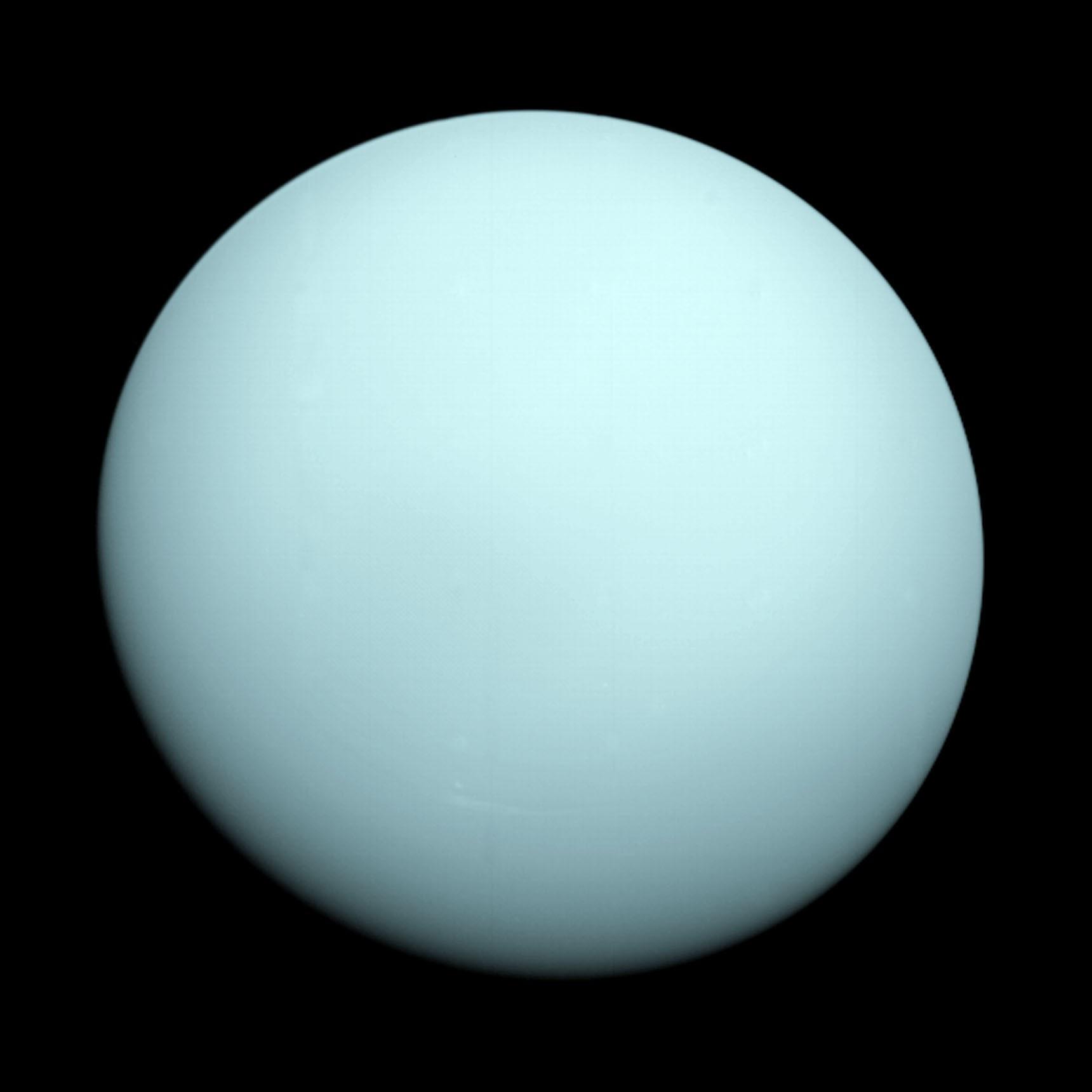
Image credit: NASA/JPL-Caltech. Uranus as Voyager 2 saw it in 1986 — the only spacecraft ever to visit. In visible light it is almost featureless: a smooth, hazy globe tinted blue-green by methane in its atmosphere.
Type
Ice giant — third largest planet
Axial tilt
~98° — it orbits on its side
Temperature
Down to ~ −224 °C — the coldest planet
Discovered
1781, by William Herschel
A world knocked onto its side
Uranus is an ice giant: smaller than Jupiter and Saturn, and made not just of hydrogen and helium but of a large share of heavier "ices" — water, ammonia, and methane. That methane absorbs red light and gives Uranus its distinctive pale blue-green color. It is also the coldest planet, dropping to around −224 °C, colder even than more-distant Neptune, apparently because it radiates almost no leftover heat from its formation.
Its defining strangeness is its tilt. While other planets spin more or less upright, Uranus is tipped about 98° — it essentially lies on its side and rolls along its orbit, most likely after a colossal collision early in its history. The result is the wildest seasons in the Solar System: each pole spends roughly 42 years in continuous sunlight, then 42 years in unbroken darkness, over the planet's 84-year orbit. Uranus keeps a set of thin, dark rings and a family of moons whose names break every convention — more on that below. Only one spacecraft, Voyager 2, has ever visited, in a single 1986 flyby.
The planet at the edge of naked-eye visibility
Uranus holds a special distinction: at about magnitude 5.7 it sits right at the threshold of naked-eye visibility, which is why it went unrecognized as a planet for so long. Under a genuinely dark, moonless sky, sharp-eyed observers who know exactly where to look can just glimpse it as an extremely faint "star." For everyone else, binoculars make it a comfortable target — but only a chart or app will tell it apart from the real stars around it.
A telescope reveals Uranus as a tiny, pale blue-green disc — subtly but distinctly non-stellar, which is the giveaway. Don't expect belts, spots, or detail; even Voyager saw an almost blank ball. The reward here is recognition rather than spectacle: knowing that the little aquamarine dot is a giant world four times Earth's width, tipped on its side, nearly three billion kilometers away.
New to stargazing? See how to observe the night sky, and if you're choosing gear, the no-hype telescope buying guide.
The Greek exception, and moons from Shakespeare
Uranus is the family's naming rebel. Every other planet bears a Roman god's name, but Uranus is named for the Greek sky god Ouranos — father of Cronus (Saturn) and grandfather of Zeus (Jupiter) — making it the only planet whose name is Greek rather than Roman. (Its discoverer, William Herschel, first tried to name it "George's Star" after King George III; happily, that didn't stick.) And its moons break the mold entirely: instead of mythology, they are named for characters from Shakespeare and Alexander Pope — Titania, Oberon, Miranda, Ariel, Umbriel — the only literary moons in the Solar System.
The lasting misconception, fed by Voyager's bland 1986 view, is that Uranus is a featureless, boring planet. It isn't — later observations have caught clouds, storms, and seasonal change; it simply hides its weather behind a hazy veil. The other thing everyone remembers about Uranus is how to say it: astronomers favor "YOOR-uh-nus" precisely to sidestep the schoolyard joke.
Primary sources: NASA — Uranus and NASA/JPL Photojournal PIA18182 (Uranus, Voyager 2). Image credit: NASA/JPL-Caltech.
Knocked onto its side by some ancient blow, the coldest of all the planets rolls around the Sun through 84-year seasons — the family's quiet rebel, Greek where the others are Roman, its moons named not for gods but for Shakespeare's players.
More astronomy notes
Continue through the astronomy section for beginner-friendly notes, image credits, viewing tips, history, and the stories behind the night sky.
Neptune · Saturn · The Planets · Astronomy · Interests