
Pluto
For 76 years Pluto was the ninth planet. Then it became the first dwarf planet — and, thanks to New Horizons, one of the most surprising worlds we have ever seen up close: a heart of frozen nitrogen, mountains of water ice, and a giant moon locked in an eternal face-off.
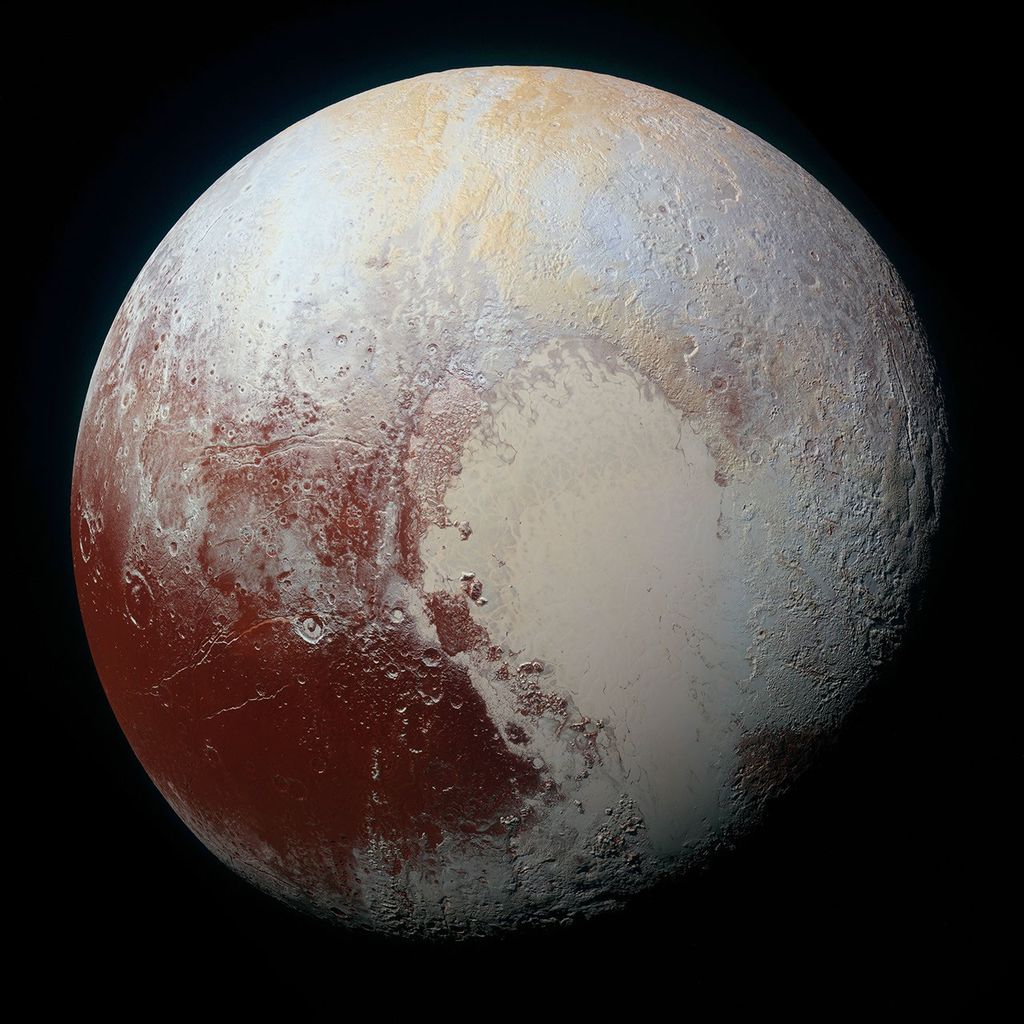
Image credit: NASA/Johns Hopkins APL/Southwest Research Institute. Pluto in enhanced color from the New Horizons flyby, 14 July 2015. The bright "heart" is Tombaugh Regio, a vast plain of nitrogen ice named for Pluto's discoverer.
Type
Dwarf planet (Kuiper Belt)
Diameter
2,377 km (about 2/3 the width of our Moon)
Moons
5 — Charon, Styx, Nix, Kerberos, Hydra
Discovered
1930, by Clyde Tombaugh
A small world that turned out to be anything but simple
Pluto was discovered in 1930 by Clyde Tombaugh, a young observer at Lowell Observatory, who found it by painstakingly comparing photographic plates for a moving dot. For decades it was little more than that — a faint point of light and a set of numbers. The 2015 flyby by NASA's New Horizons changed everything. In place of a dead ball of ice, it revealed an astonishingly active world: a vast, smooth plain of nitrogen ice (Sputnik Planitia, the left lobe of the famous "heart"), mountains of rock-hard water ice thousands of meters tall, possible ice volcanoes, and a thin, hazy atmosphere.
Pluto also travels with a remarkable retinue. Its largest moon, Charon, is fully half Pluto's diameter — so large that the two bodies orbit a shared point in the empty space between them, wobbling like a thrown bolt rather than a planet and a satellite. Four small moons — Styx, Nix, Kerberos, and Hydra — tumble chaotically around the pair. Pluto belongs to the Kuiper Belt, and its 248-year orbit is so elongated that for 20 years of each lap it slips closer to the Sun than Neptune.
A trophy for patient telescope owners
Pluto is a serious challenge, and finding it is a genuine achievement. At around magnitude 14 it is far beyond naked-eye or binocular range; you will want a telescope of roughly 8 inches of aperture or larger, dark skies, and a detailed finder chart or app. Even then, Pluto is nothing but a dim, star-like point — indistinguishable from the background stars around it.
The only way to be sure you have it is to catch it moving. Note the exact star field one night, then return a night or two later: the "star" that shifted position is Pluto. There is no detail to see — but there is the quiet thrill of knowing that faint dot is a whole world five billion kilometers away, the one Clyde Tombaugh found the same way, by watching for the thing that moved.
New to stargazing? See how to observe the night sky, and if you're choosing gear, the no-hype telescope buying guide.
"Demoted," misunderstood, and named by an 11-year-old
The popular story is that Pluto was demoted in 2006 — a downgrade, almost a punishment. That framing misses the point. Pluto did not shrink or change; our understanding grew. Astronomers realized Pluto was not a lonely ninth planet but the brightest member of a whole belt of icy worlds, and they created a category — dwarf planet — to describe it honestly. Pluto is not a failed planet; it is the flagship of a new and fascinating class. The debate is still live: some planetary scientists reject the "cleared its neighborhood" rule entirely, which is why the argument refuses to die.
A lovely piece of true history: the name Pluto was suggested in 1930 by Venetia Burney, an eleven-year-old English schoolgirl, who thought the Roman god of the cold, dark underworld suited the distant new world. (The first two letters also honored astronomer Percival Lowell.) Pluto's Greek counterpart is Hades, lord of the dead — and Charon, Pluto's great moon, is named for the ferryman who carried souls across the river Styx into Hades's realm.
Primary sources: NASA — Pluto and NASA/JPL Photojournal PIA19952 (Pluto in Enhanced Color). Image credit: NASA/Johns Hopkins University Applied Physics Laboratory/Southwest Research Institute.
For most of a century Pluto was a rumor of a world — a moving speck on a photographic plate. Then, in a single July afternoon, it opened into a landscape: a frozen heart, mountains of ice, and a companion moon so large the two forever circle the empty space between them.
More astronomy notes
Continue through the astronomy section for beginner-friendly notes, image credits, viewing tips, history, and the stories behind the night sky.
Kuiper Belt · Eris · Dwarf Planets · Astronomy · Interests