
Venus
Venus is Earth's near-twin in size and its opposite in every other way — the hottest planet in the Solar System, sealed under crushing clouds of sulfuric acid, spinning slowly and backwards. From here it is the most brilliant point in the sky: the dazzling morning and evening star.
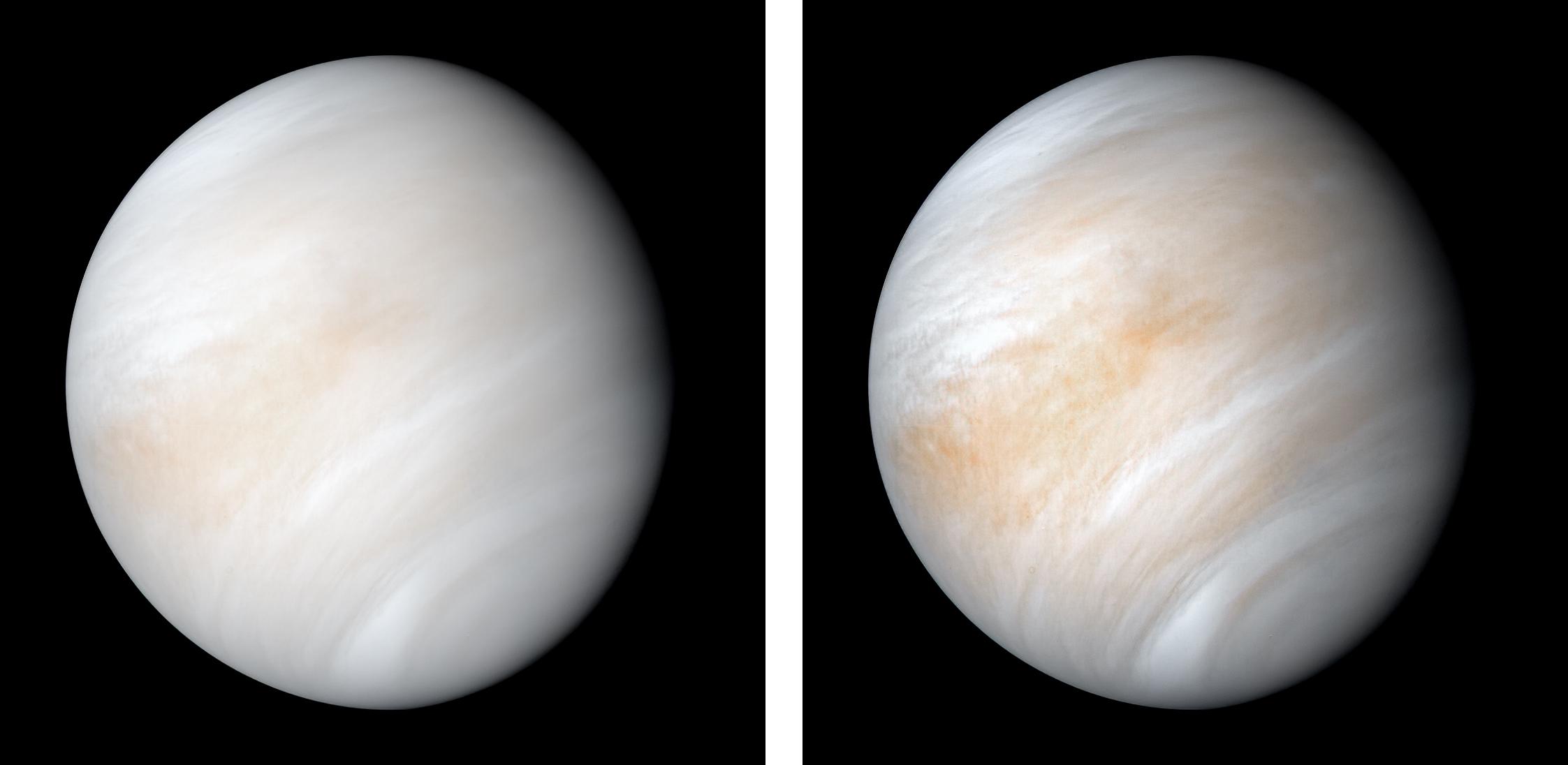
Image credit: NASA/JPL-Caltech. Venus as seen by Mariner 10 — a smooth, pale ball of unbroken cloud. The thick atmosphere hides the surface entirely from ordinary cameras; only radar can map the world beneath.
Type
Rocky (terrestrial) — Earth-sized
Surface temp
~465 °C — the hottest planet
Air pressure
~90× Earth's — like being deep underwater
Spin
Backwards; one day is longer than its year
A greenhouse gone catastrophically wrong
Venus is almost exactly Earth's size, and it may once have been more Earth-like, perhaps even with oceans. But it fell into a runaway greenhouse: its atmosphere, now more than 96% carbon dioxide, traps the Sun's heat so effectively that the surface sits at about 465 °C — hot enough to melt lead, and hotter than Mercury despite being nearly twice as far from the Sun. The air is crushingly dense, about 90 times Earth's pressure (like being 900 meters underwater), and the planet is wrapped in permanent clouds of sulfuric acid. Spacecraft that have landed survived an hour or two at most.
Venus is also a planet of oddities. It spins backwards (retrograde) and so slowly that a single rotation takes 243 Earth days — longer than its 225-day year, meaning a Venusian "day" outlasts its "year." Beneath the clouds, radar reveals a volcanic world of vast plains, highland "continents," and thousands of volcanoes, some of which may still be active today.
The brightest star that isn't a star
Venus is the easiest planet to find and the most dazzling — after the Sun and Moon, it is the brightest object in the sky, bright enough to cast faint shadows and to be seen in broad daylight if you know where to look. It never wanders far from the Sun, so it appears either in the west after sunset (the "evening star") or in the east before dawn (the "morning star"), blazing so brilliantly that it is regularly reported as a UFO.
Point a small telescope at it and you'll see something Galileo found revolutionary: Venus shows phases, from a small "full" disc when it's on the far side of the Sun to a large, thin crescent when it swings near Earth. Those phases were direct evidence that Venus orbits the Sun, not the Earth — a key blow for the Sun-centered model. You won't see surface detail (the clouds hide everything), but the changing crescent over weeks is a genuine pleasure.
New to stargazing? See how to observe the night sky, and if you're choosing gear, the no-hype telescope buying guide.
Two "stars" that are one, and a twin that's a hell
For much of history people believed the brilliant morning star and the brilliant evening star were two different objects — the Greeks even gave them separate names, Phosphorus and Hesperus. They are one and the same: Venus, seen on either side of the Sun. The other lasting misconception is that Venus is Earth's twin. It is a twin only in size; in reality it is the least hospitable major world we know — an acid-clouded oven where nothing we recognize as life could survive. If anything, Venus is a warning of how badly a greenhouse can run away.
Fittingly for the sky's most beautiful object, Venus is named for the Roman Venus, goddess of love and beauty. Her Greek counterpart is Aphrodite, born from the sea foam — and Venus is the only planet named for a female deity, its radiance matched to the goddess it honors.
Primary sources: NASA — Venus and NASA/JPL Photojournal PIA23791 (Venus from Mariner 10). Image credit: NASA/JPL-Caltech.
Named for the goddess of beauty and shining brighter than any star, Venus hides behind that glow the harshest world we know — an acid-veiled furnace where a day lasts longer than a year, and lead would pool on the ground.
More astronomy notes
Continue through the astronomy section for beginner-friendly notes, image credits, viewing tips, history, and the stories behind the night sky.
Earth · Mercury · The Planets · Astronomy · Interests