
Mercury
Mercury is the smallest planet and the Sun's nearest neighbor — a cratered, airless ball of rock that races around the Sun in just 88 days, roasts and freezes by turns, and, against all expectation, hides ice in the eternal shadows of its polar craters.
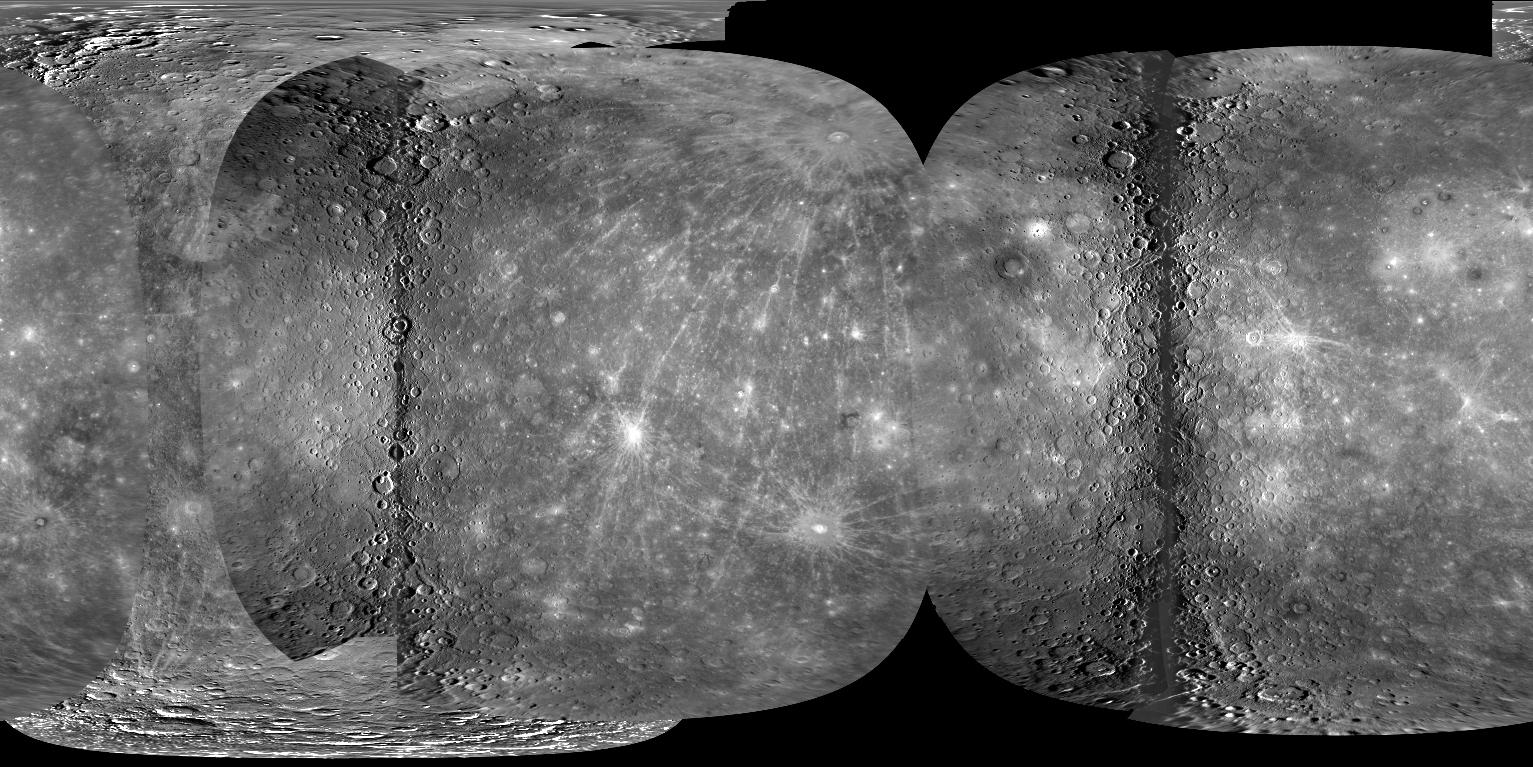
Image credit: NASA/Johns Hopkins APL/Carnegie Institution of Washington. A global view of Mercury assembled from NASA's MESSENGER spacecraft, the first mission to orbit the innermost planet. Its battered, Moon-like surface records billions of years of impacts.
Type
Rocky (terrestrial) — smallest planet
Distance from Sun
0.39 AU (~58 million km)
Year
88 Earth days — the fastest orbit
Temperature
~430 °C by day, −180 °C by night
A world of extremes, wrapped around a huge iron heart
Mercury is barely larger than our Moon and, at a glance, looks much like it — grey, airless, and saturated with craters, including the vast Caloris impact basin. But it hides a surprise inside: an enormous iron core taking up perhaps 60% of the planet's volume, far more than any other planet, which makes Mercury unusually dense and gives it a weak magnetic field. Long wrinkle-ridges scar its crust where the whole planet shrank as that core cooled.
With almost no atmosphere to move heat around or hold it in, Mercury swings between the most brutal extremes in the Solar System: scorching to about 430 °C where the Sun beats down, and plunging to around −180 °C on the night side. Its slow spin (one rotation every 59 days) means a single day-night cycle lasts far longer than its 88-day year. And in the deep craters near its poles, where sunlight never reaches, it is cold enough to preserve water ice — confirmed by NASA's MESSENGER orbiter, an astonishing find on the planet nearest the Sun.
The planet Copernicus supposedly never saw
Mercury is the trickiest of the naked-eye planets, and catching it is a small triumph. Because it hugs the Sun, it never appears in a dark sky — you can only spot it low on the horizon during bright twilight, for a short window just after sunset or before sunrise, and only when its orbit swings it farthest from the Sun (an "elongation"). Legend has it that Copernicus, living in the misty north, never managed to see it at all.
To the naked eye Mercury looks like a modest, slightly pinkish "star" close to the horizon; an astronomy app will tell you when and where to look. A telescope shows a tiny disc that runs through phases like a miniature Moon, though its low altitude blurs any detail. Every so often Mercury crosses directly in front of the Sun — a transit — appearing as a small black dot, visible only with proper solar filters.
New to stargazing? See how to observe the night sky, and if you're choosing gear, the no-hype telescope buying guide.
Not the hottest — and named for the swift messenger
The most common misconception is that Mercury, being closest to the Sun, must be the hottest planet. It isn't. With no atmosphere to trap warmth, its heat escapes to space the moment the Sun goes down, and its nights are frigid. Venus, farther out but smothered in a thick greenhouse atmosphere, is far hotter overall. A second surprise overturns intuition entirely: the planet closest to the Sun holds ice, tucked in craters the sunlight can never reach.
Mercury takes its name from the Roman Mercury, the swift-footed messenger of the gods — a fitting title for the fastest planet, which slips around the Sun quicker than any other. His Greek counterpart is Hermes, the winged herald and trickster who guided souls and carried word between the mortal and divine worlds.
Primary sources: NASA — Mercury and NASA/JPL Photojournal PIA12397 (Mercury global mosaic). Image credit: NASA/Johns Hopkins University Applied Physics Laboratory/Carnegie Institution of Washington.
The smallest world, and the fastest — racing around the Sun in eighty-eight days, roasting on one side and freezing on the other, yet keeping, in the dark of its polar craters, a secret cache of ice.
More astronomy notes
Continue through the astronomy section for beginner-friendly notes, image credits, viewing tips, history, and the stories behind the night sky.
Venus · The Planets · The Solar System · Astronomy · Interests