
Triton
Triton is Neptune's great moon and one of the strangest in the Solar System — it circles its planet backwards, wears a pink-and-cantaloupe crust of frozen nitrogen, erupts geysers into a wisp of atmosphere, and almost certainly began its life not as a moon at all, but as a wanderer captured from the Kuiper Belt.
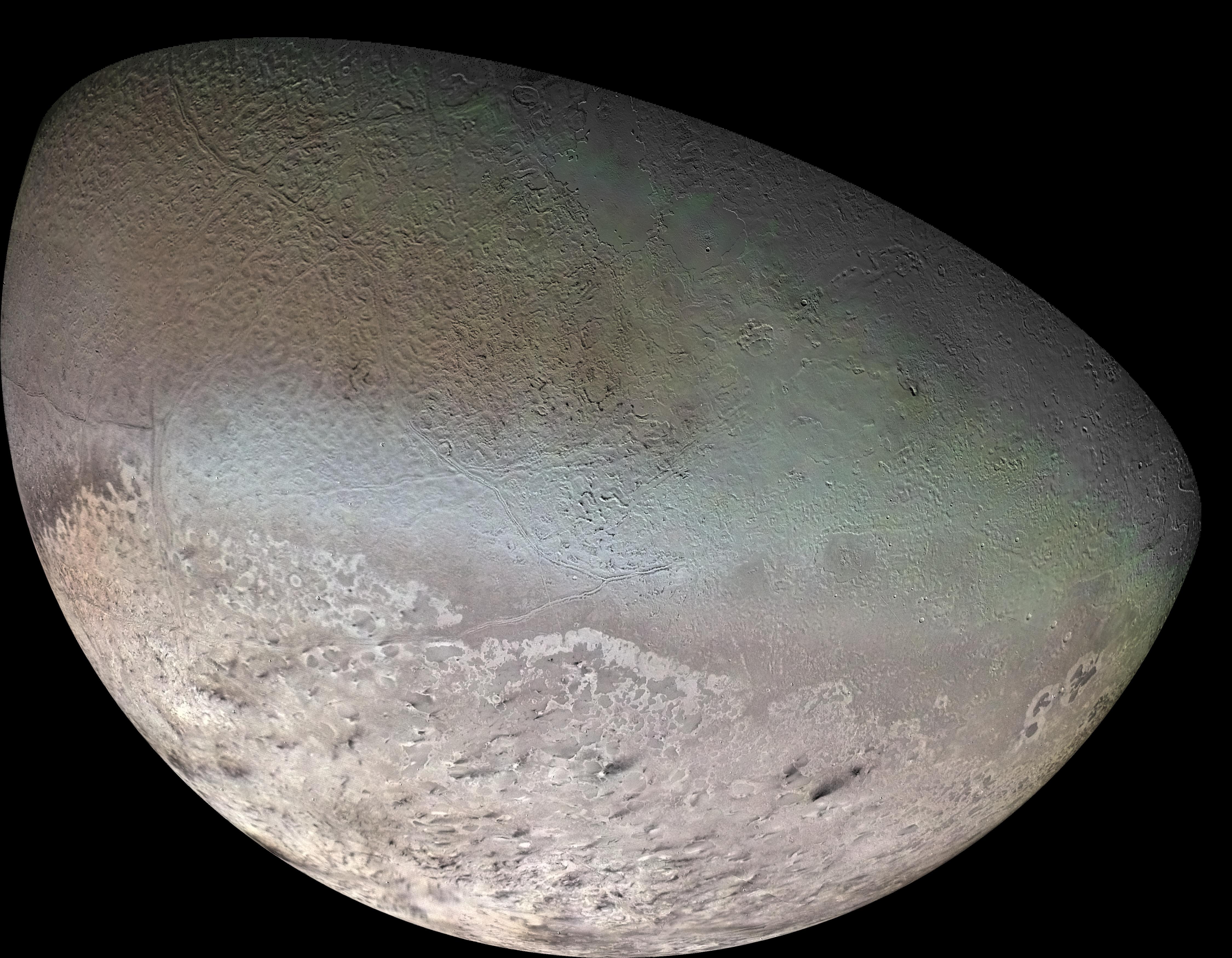
Image credit: NASA/JPL. Triton as seen by Voyager 2 in 1989 — the only close-up we have. The pinkish south polar cap is frozen nitrogen; the wrinkled "cantaloupe terrain" at the top is unlike anything else known.
Orbits
Neptune — backwards (retrograde)
Origin
A captured Kuiper Belt object
Surface
Frozen nitrogen; among the coldest known (~ −235 °C)
Active
Nitrogen geysers seen by Voyager 2
A captured world running in reverse
Triton is by far the largest of Neptune's moons — big enough to be round, and holding more than 99% of the mass orbiting the planet. But it breaks the rules. Nearly every large moon circles its planet in the same direction the planet spins, because they formed together from the same disk of material. Triton goes the opposite way — a retrograde orbit — and that one fact gives away its history: it did not form around Neptune at all. Triton was almost certainly a Kuiper Belt object, a cousin of Pluto, that strayed too close and was captured by Neptune's gravity. It even closely resembles Pluto in size and makeup.
The one spacecraft ever to visit, Voyager 2, found an astonishingly active world in 1989. Triton's surface is a frozen shell of nitrogen and water ice, among the coldest ever measured (around −235 °C), patterned with bizarre wrinkled "cantaloupe terrain" and a pink polar cap. And it is alive: Voyager caught dark geysers venting nitrogen gas kilometers into Triton's thin atmosphere. Its capture would have wreaked havoc on Neptune's original moon system, and its story isn't over — Triton's orbit is slowly decaying, and in the distant future Neptune's gravity may tear it apart into a ring.
One of the harder moons to catch
Triton is a demanding target. At about magnitude 13.5 it sits in the glow of distant Neptune, nearly 4.5 billion kilometers away, and requires a telescope of roughly 8–10 inches or more, a dark sky, and patience even to detect as an exceedingly faint speck near the planet. Confirming it means checking its position against a chart, since it hugs close to Neptune.
There is no detail to be had — Triton is a dim point, and everything we know of its geysers and cantaloupe terrain comes from Voyager 2's single 1989 flyby. But for dedicated observers, bagging Triton beside Neptune is a real trophy: you're glimpsing a captured Kuiper Belt world, running backwards around the most distant planet, from your own backyard.
New to stargazing? See how to observe the night sky, and if you're choosing gear, the no-hype telescope buying guide.
The sea god's son — and a moon that isn't native
Triton is named for the Greek sea god Triton, the son of Poseidon (whom the Romans called Neptune) — a merman-like herald of the deep who calmed or raised the waves by blowing a twisted conch shell. It is a fitting name for the chief moon of the planet named after the god of the sea, and one of the rare cases where a Neptune moon and its planet come from the same watery corner of myth.
The biggest misconception is simply that Triton is an ordinary moon of Neptune. It isn't native at all — its backwards orbit marks it as an immigrant, a Kuiper Belt world snatched by Neptune long ago, which means visiting Triton would in effect be visiting a Pluto-like body without traveling all the way to the Kuiper Belt. Another misunderstanding is that such a cold, remote moon must be geologically dead; instead Voyager found active geysers, making Triton one of the very few worlds where eruptions have been directly observed.
Primary sources: NASA — Triton and NASA/JPL Photojournal PIA00317 (Triton, Voyager 2). Image credit: NASA/JPL.
It circles Neptune the wrong way — the one clue that betrays the truth: Triton was never Neptune's child, but a wanderer from the icy belt beyond, caught in passing and made to dance in reverse.
More worlds around worlds
Moons (hub) · Our Moon · Galilean Moons · Titan · Enceladus · Triton
More astronomy notes
Continue through the astronomy section for beginner-friendly notes, image credits, viewing tips, history, and the stories behind the night sky.
Kuiper Belt · Enceladus · Moons · Astronomy · Interests