
Saturn
Saturn is the jewel of the Solar System — the ringed giant whose glory in a small telescope has hooked more people on astronomy than any other sight. It is a world of contradictions: enormous yet so light it would float on water, wrapped in the most spectacular rings we know, and crowned by a strange six-sided storm.
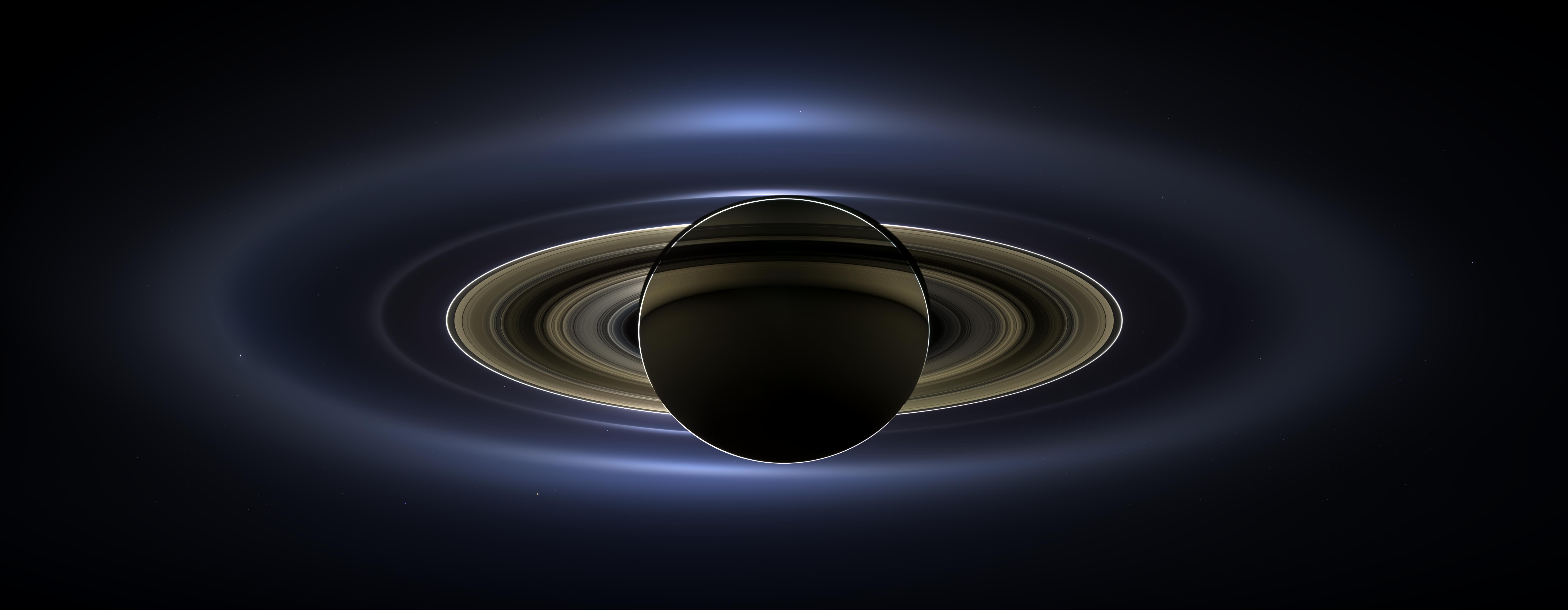
Image credit: NASA/JPL-Caltech/Space Science Institute. Saturn eclipsing the Sun, its rings lit from behind, in Cassini's mosaic "The Day the Earth Smiled" (2013) — a view impossible from Earth, where we only ever see the rings front-lit.
A giant of gas, rings, and moons
Saturn is the second-largest planet and, like Jupiter, a gas giant of hydrogen and helium with no solid surface. What sets it apart is how light it is: Saturn is the only planet less dense than water, so with a big enough ocean it would famously float. Its pale gold bands are subtler than Jupiter's, softened by a high haze, and its fast winds carry a genuine oddity — a stable, six-sided hexagonal jet stream around the north pole, tens of thousands of kilometers wide, seen nowhere else.
And then there are the rings — the finest in the Solar System, a vast, dazzling disc of countless icy particles that spans hundreds of thousands of kilometers yet is only tens of meters thick. Saturn also commands a huge family of moons, more than 270 of them, including two of the most fascinating worlds anywhere: Titan, with its thick atmosphere and methane seas, and Enceladus, which sprays an ocean into space. The Cassini spacecraft studied the whole system in extraordinary detail from 2004 to 2017.
The view that makes people gasp
If there is one thing to point a telescope at, it is Saturn. Almost any small scope at around 30× shows the rings as a separate, three-dimensional structure encircling the globe — a sight so unexpectedly real that first-time viewers routinely gasp and ask if it's a sticker on the eyepiece. It is, for countless astronomers, the moment the hobby became irresistible. To the naked eye Saturn is a steady, pale-yellow "star," not as bright as Jupiter but easy to find once you know where to look.
Push a little further and more appears: the dark Cassini Division splitting the rings (a 4-inch scope on a steady night), the shadow the planet casts on the rings, and Titan as a clear point of light nearby. Watch across a few years and you'll notice the rings' tilt change as Saturn orbits — sometimes wide open, sometimes edge-on and nearly vanishing. Full details are on the planetary rings page.
New to stargazing? See how to observe the night sky, and if you're choosing gear, the no-hype telescope buying guide.
The floating giant, and the god of time
The fun fact that Saturn "would float" is true but often misunderstood — it reflects the planet's low average density, not that it is somehow hollow or insubstantial; there simply is no ocean vast enough to test it. A more consequential misconception is that Saturn is the only ringed planet, or that its rings are solid bands — neither is true, as all four giants have rings and Saturn's are swarms of separate particles. The other common surprise is that Galileo, with his crude telescope in 1610, couldn't make sense of the rings at all, describing Saturn as having "ears."
Saturn takes its name from the Roman Saturn, god of agriculture and time, honored at the midwinter feast of Saturnalia — ancestor of many winter-holiday customs. His Greek counterpart is Cronus (Kronos), the Titan who ruled before Zeus and, in the myth, devoured his own children. It is a weighty name for the Solar System's most beautiful planet.
Primary sources: NASA — Saturn and NASA/JPL Photojournal PIA17172 (The Day the Earth Smiled). Image credit: NASA/JPL-Caltech/Space Science Institute. See also Planetary Rings.
Enormous and yet lighter than water, wrapped in a hundred thousand kilometers of ice and crowned by a six-sided storm — Saturn is the one sight that, glimpsed once through a small telescope, turns a curious glance into a lifelong habit.
More astronomy notes
Continue through the astronomy section for beginner-friendly notes, image credits, viewing tips, history, and the stories behind the night sky.
Planetary Rings · Titan · Uranus · The Planets · Interests